
About this Event
WEEKNIGHTS AT THE WAGNER
“The first reliable account”—The Geology of the Lewis and Clark Expedition
The 1803–06 expedition to explore the Louisiana Territory and the Pacific Northwest by Captains Meriwether Lewis and William Clark produced landmark discoveries in geography, botany, zoology, and ethnology. However, their mineral collecting and geological observations have long been underappreciated and at times unfairly maligned by expedition scholars.
In his new book, Scenes of Visionary Enchantment: The Geology of the Lewis and Clark Expedition, professional geologist John W. Jengo reassesses the pair's role in documenting the geology of the American West and the impact on scientific inquiry. Through in-depth research into the expedition journals and geologial reports, he argues that Lewis and Clark created an accurate account of the geology of the region and admirably fulfilled Thomas Jefferson’s instructions to document the “mineral productions of every kind” of the American West.
Richly illustrated with dozens of photographs of the acclaimed 8,000-mile-long Lewis and Clark Trail, captured over a nearly 30-year period of travel, research, and discovery, Jengo’s talk will trace the fate of the rock, mineral, and fossil specimens that Lewis and Clark collected. The presentation will conclude with a reappraisal of the geoscience content of the rephrased expedition journals published in 1814 and its broad influence on 19th-century scientific inquiry.
An evening lecture series, Weeknights at the Wagner, invites experts into our Victorian lecture hall to speak on a range of science and history of science related subjects. Each talk includes a Q&A with the speaker.
Program Schedule:
Museum open until 5:45 pm.
6 - 7:30 pm: Talk, Q&A, and book signing in the Lecture Hall.
About the Speaker
John W. Jengo, PG, has a B.S. and M.S. in Geology and is a licensed Professional Geologist in several states. He spent most of his 44-year career conducting investigations and clean-ups of large, complex, and severely contaminated industrial sites throughout New Jersey, Pennsylvania, and Delaware, in addition to dozens of petroleum, chemical, manufacturing, and coal ash disposal sites through the Northeast and Southeast. Since 2008, he has planned, managed, and supervised five dam removals in New Jersey to restore ecologically significant migratory fish spawning runs for American shad, river herring, and other species.
A long-standing member of the Lewis and Clark Trail Alliance, Jengo has traveled extensively along the 8,000-mile-long Lewis and Clark Trail over the past three decades and authored more than a dozen articles about the geological observations, mineralogical collection, scientific context and influence of the Lewis and Clark expedition. He is the author of the recently published book Scenes of Visionary Enchantment: The Geology of the Lewis and Clark Expedition (2026).
A dream that keeps growing…
In 1855, William Wagner had a dream of providing free science education to anyone who wanted to learn, regardless of background or ability to pay. Today, the Wagner offers more programs to more people than ever before! Your support helps us provide free education, not only through the museum, but through a wide range of courses, lectures, field trips, and children’s science programs. Donations also assist us in caring for the museum and library collections and in preserving our wonderful building, which was designated a National Historic Landmark in 1990. To learn more about what we do please visit our website.
Registration Information
In keeping with its original charter, admission to the lecture is free—donations are suggested to ensure the future and quality of Wagner's education programs.
Suggested Donations
$15/adult
$8/student
For any questions, please email communications@wagnerfreeinstitute.org or call 215-763-6529 x17.
If you would like to check your membership status or become a member, please email [email protected] or call 215-763-6529 x11.
Images:
Missouri River Breaks at Hagadone Homestead, MT. Taken by John W. Jengo.
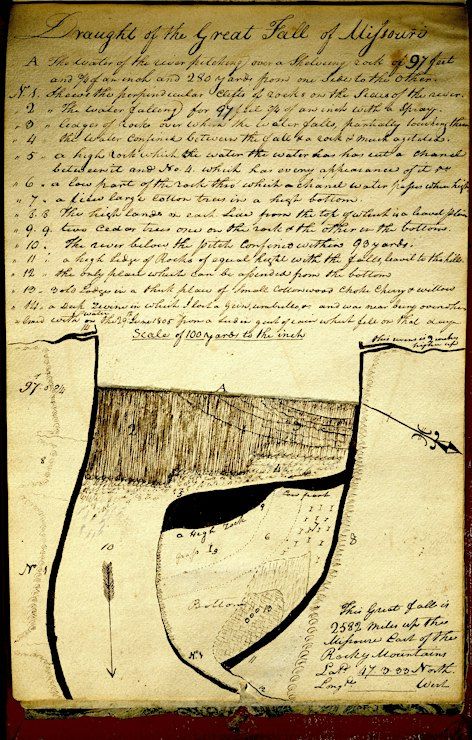
William Clark's Draught of Great Falls from Voorhis Journal (1805) p. 170.
Event venue & nearby stays
Wagner Free Institute of Science, 1700 West Montgomery Avenue, Philadelphia, United States
 Concerts, fests, parties, meetups — all the happenings, one place.