
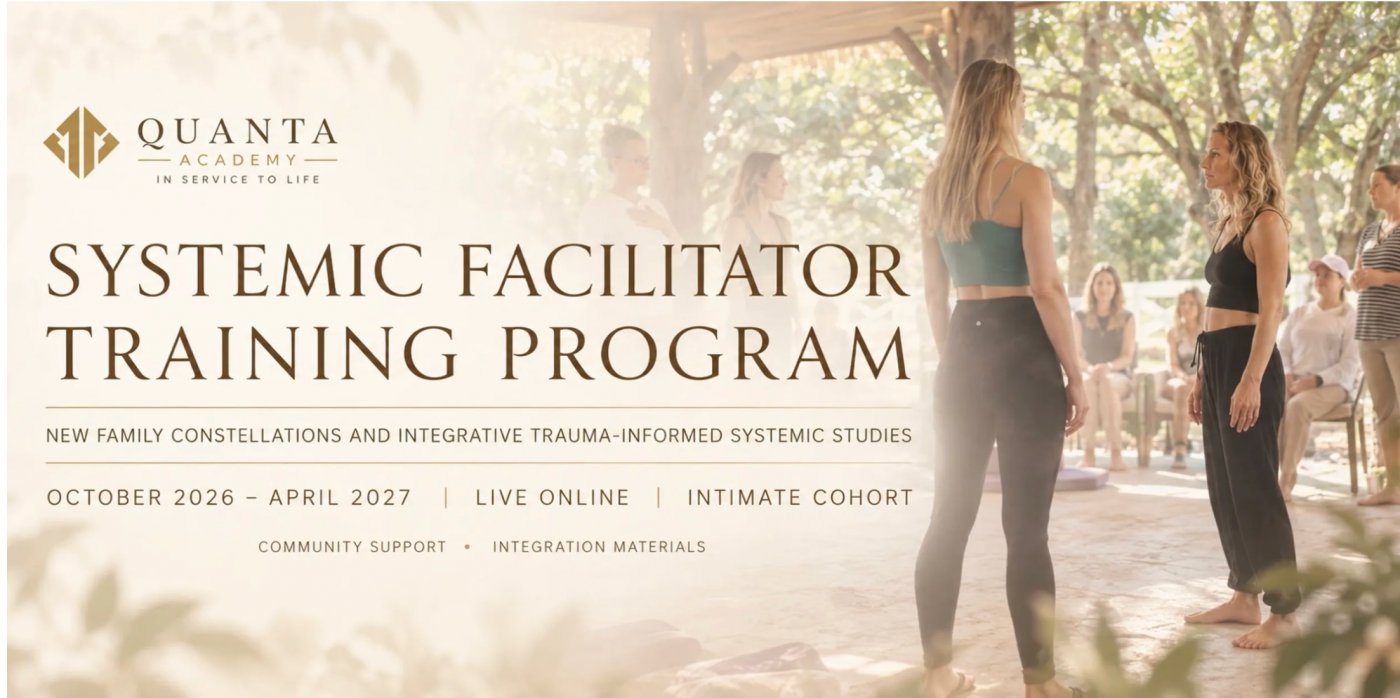
From personal exploration to the capacity to accompany
The role of a facilitator grows through study, practice, observation, feedback, and personal integration. Techniques have a place in this process, and the person who uses them also becomes part of the instrument. The capacity to accompany another human being develops as we recognize our interpretations, emotional reactions, helping impulses, personal history, and relationship with uncertainty.
For this reason, the program moves through two connected dimensions. You study how systemic dynamics operate across different areas of life, and you participate in the same experiential work you will eventually offer to others. Each class becomes an opportunity to observe, feel, question, practice, and integrate.
Some participants enter with the desire to facilitate Family Constellations. Others arrive because they work with people and want a broader understanding of relationships, symptoms, trauma, family history, and human behavior. Some begin through personal curiosity and discover their professional direction during the training. The cohort holds space for these different intentions within one shared commitment to learning.
What becomes visible when we learn to see systemically?
Every human being is composed of many interconnected layers: physical, emotional, mental, energetic, ancestral, collective, and cosmic. Each person is also one link within an immense chain of life, carrying the imprint of ancestral history together with the experiences of their own biography. The systemic perspective explores these layers by seeing the individual as part of a whole and observing how the past has shaped present reality. From this view, we are guided by the morphogenetic fields of the unconscious family system, seeking to revisit everything that remained incomplete.
A systemic perspective expands the frame. A recurring conflict may reveal a family loyalty. An emotion may belong to an earlier experience or connect with someone whose story still has a place in the present. A symptom may carry meaning within a personal or transgenerational history. A difficulty in receiving, relating, helping, or moving forward may become more understandable when the wider system enters the exploration.
Family Constellations offers an experiential language for observing these connections. Through representatives, spatial relationships, body responses, gaze, movement, and the information that emerges in the field, dynamics that once remained outside awareness become available for exploration.
This program may resonate with you if…
· You feel drawn to Family Constellations and want to understand the philosophy, the field, and the practice in depth.
· You accompany people through coaching, therapy, education, health, leadership, bodywork, or another helping profession and want to expand the lens through which you observe human experience.
· You recognize recurring patterns in your own life and want to explore the systems, loyalties, beliefs, emotions, and adaptations participating in them.
· You are considering a future role as a systemic facilitator and want a training that joins personal development with supervised practice.
· You value an approach grounded in respect, phenomenological observation, adult responsibility, inclusion, and life service.
THE PROCESS AND STRUCTURE
A training that is studied, experienced, and practiced
A training that is studied, experienced, and practiced
The program unfolds over six months through weekly live online sessions.
Classes combine conversation, theory, systemic exercises, body-based exploration, constellation demonstrations, real situations brought by participants, supervised practice, and time for questions.
The group itself becomes part of the learning environment, revealing how similar dynamics may appear through different histories and contexts.
Between classes, participants continue through recorded lessons, guides, readings, exercises, and constellation material available on the educational platform.
This rhythm gives the content time to move from intellectual understanding into lived recognition and practical application.
STRUCTURE
Program structure
· Six-month live online training from October 2026 through April 2027.
· 24 weekly live sessions on Wednesdays at 1:00 pm to 3:30 pm. ET (Miami time).
· Approximately 60 hours of live teaching, constellation work, and supervised practice.
· Around 90 recorded lessons and approximately 100 hours of study and integration material.
· Guides, readings, exercises, demonstrations, and recommended resources through the educational platform.
· Five additional summer supervision and practice sessions. (date/time TBA)
· Student consultation chat and access to the wider Quanta learning community.
THE CURRICULUM
What you will experience
The curriculum follows the different layers that condition and organize human experience. Each area is explored through systemic theory, psychological frameworks, experiential practice, and constellation work.
The foundations of systemic perception
· Phenomenology, presence, observation, interpretation, and trust in what emerges.
· Morphic and morphogenetic fields; preparation of the facilitator; dialogue with the inner guide; internal check.
· The language of representatives through position, distance, gaze, sensation, emotion, movement, and relational response.
· The Forces of Love: assent, belonging, exchange and compensation, hierarchy, and life service.
· The three centers and the body as sources of information during systemic work.
Family history, belonging, and repetition
· Family tree exploration and transgenerational dynamics: loyalties, exclusions, blind love, entanglements, compensation, and repetition.
· The systemic energy of the parents, parents as a unity, and taking the life received through them.
· Childhood mandates, life script, beliefs, early decisions, and adaptive resources.
· The relationship between personal experience and the larger family system.
Relationships, emotions, and the adult state
· Emotional life from a systemic perspective, including overwhelming and disproportionate emotions.
· Transactional Analysis, ego states, life script, relational transactions, and the development of the adult state.
· Love and couple relationships, exchange, belonging, previous partners, and the relational histories that enter a bond.
· The role of the seeker’s narrative and the movement from explanation toward direct observation.
Body, symptoms, trauma, and adaptation
· The systemic perspective on health, biological meaning, memorized biological cycles, and the history held within symptoms.
· Trauma through personal, structural, developmental, somatic, ancestral, and meaningful-project dimensions.
· Body awareness, regulation resources, Somatic Experiencing perspectives, HeartMath coherence practices, anchoring, NLP, and hypnotic language.
· Fertility, conception, miscarriage, embryos, IVF, birth, children’s difficulties, food, weight, and other life experiences through systemic and biological lenses.
Complex human experiences
· Victims, perpetrators, guilt, abuse, secrets, exclusions, and movements of reconciliation.
· Depression, suicide, addiction, alcohol, drugs, and mental health themes within a systemic field of observation.
· Money, abundance, work, mission, destiny, essence, and the relationship between individual movement and collective contribution.
The practice of facilitation
· The first conversation with the seeker and the formulation of a workable subject.
· Choosing representatives, opening the field, observing movement, using healing sentences, and recognizing the moment of completion.
· Individual sessions using floor papers and group sessions using representatives.
· Orders of Help, helping impulses, countertransference, boundaries, judgment, responsibility, and ethical integration.
· Practice sessions, case exploration, supervision, written feedback, and continued development after graduation.
What happens inside the live sessions
A live class may begin with a concept and quickly move into experience. A question about emotional reactions can lead to an exercise with the adult, parent, and child ego states. A conversation about belonging can open a constellation where an excluded person becomes visible. A topic related to symptoms may invite attention to biological history, family events, and the body’s response in the present.
You will witness demonstrations, participate as a seeker or representative, practice facilitation with classmates, receive feedback, and observe the same subject from several perspectives. This combination supports the development of perception, language, timing, ethical judgment, and the capacity to remain present while the field unfolds.
INTEGRATION AND COMPLETION
What may grow through this experience
Progress is observed through participation, practical exercises, facilitation practice, a final written integration, and recorded work based on real cases. Each participant submits one individual constellation and one group constellation on a chosen subject and receives written feedback connected to observation, process, ethical judgment, and application of the method.
Following completion of the learning requirements and reviewed practical work, participants receive a certificate from Quanta Systemic Academy describing the scope of the training. The certificate marks the completion of this cycle. Professional maturity continues through practice, supervision, personal work, and continued engagement with the field.
By the completion of the program, you will have developed a systemic framework for observing human behavior, relationships, family history, emotional life, symptoms, trauma, and the dynamics that arise within helping relationships. You will have practiced the structure of both individual and group constellations and received feedback on your work.
You may also recognize changes in the way you listen. The immediate story begins to sit within a wider context. Emotional responses become information. The body participates in the conversation. Family history acquires relevance without becoming a fixed explanation. The role of the facilitator becomes a practice of observation, discernment, responsibility, and respect for the destiny of each person.
Event venue
Online
 Concerts, fests, parties, meetups — all the happenings, one place.