

About this Event
Discover the latest ideas and developments from across astronomy and geophysics. The A&G Highlights Meeting brings together a range of speakers and topics, offering insights for anyone with an interest in either field.
Featured Talks
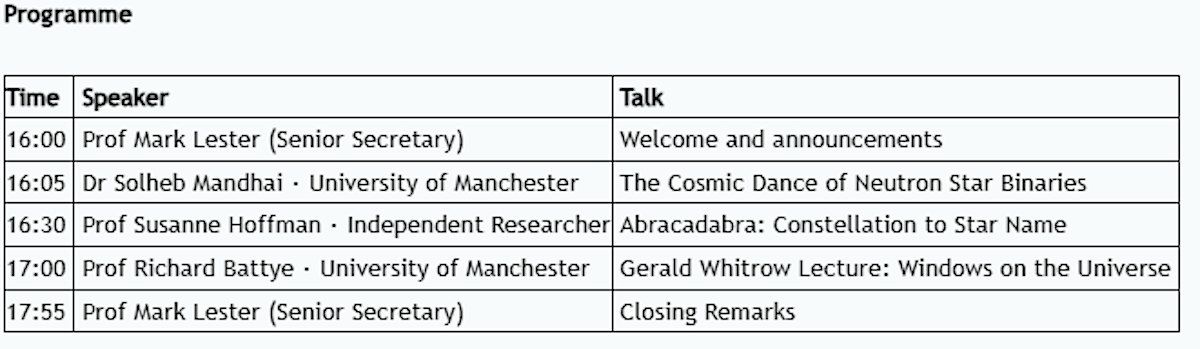
The Cosmic Dance of Neutron Star Binaries · Dr Solheb Mandhai | University of Manchester
When a star much more massive than our Sun reaches the end of its life, it has a chance to form a dense, compact stellar object known as a neutron star. When two of these compact stars exist together in a binary system, they will continuously move to small orbits until they coalesce. These mergers are violent and produce bursts of radiation that can outshine galaxies within mere seconds. Among the chaotic aftermath, these events produce the required energies to form heavy elements such as gold, platinum, and rare Earth metals - elements that are otherwise difficult to form through regular stellar evolution. In this talk, I will overview how our understanding of these neutron star mergers has evolved over the past decade, followed by a glimpse into the future of the field. Tying this research back to Earth, I will explore how these events may have shaped our planet and paved the conditions which ultimately led to the formation of early life.
Speaker Biography
Dr Soheb Mandhai is a researcher in Astrophysics specialising in creating simulations of dense stellar objects orbiting their galaxies. He completed his PhD at the University of Leicester on the "Electromagnetic Counterparts of Gravitational Waves" under the supervision of Professor Nial Tanvir and Dr. Gavin Lamb. He then took on a post-doctoral research position at the University of Manchester where he explored the orbits of binaries ( such as "Spider" pulsars) within Milky Way like galaxies. Alongside research, Soheb is an advocate for science communication through creative mediums. He has organised community sessions and art galleries at the National Astronomy Meetings over the past five years. More recently, alongside the RAS, he organised the science communication meeting, RASreach, which was hosted by the University of Manchester in March.
Abracadabra: Constellation to Star Name · Dr Susanne Hoffman | Independent Researcher
The work of the IAU Working Group on Star Names currently sounds a bit like wizardry: the IAU aims to increase the diversity of languages in standardised astronomical nomenclature. But what can we do when all cultures have names for Vega and Betelgeuse (which are already named) and no culture offers a name for the 3 mag-stars in their neighbourhood? The current strategy is using the names of historical constellations - might them be obsolete early modern inventions or living traditions of Indigenous groups somewhere on our planet. By looking into a specific region of the sky each month and collecting names of traditional constellations in that area, WGSN finds similarities in cultural interpretation and boldly goes where no one has gone before in the comparative history of uranography.
Speaker Biography
Backed by professional training as a planetarium astronomer, Susanne M Hoffmann graduated in physics and history of science, both with a focus on astronomy. Her PhD on Hipparchus's celestial globe also produced a reconstruction of ~70% of his lost star catalogue and led her to study constellation image variants from Greek and Babylonian star data from the 1st millennium BCE. With that preparation, she began developing tools and methods for the IAU WGSN, which she currently chairs.
Gerald Whitrow Lecture: Windows on the Universe · Prof. Richard Battye | University of Manchester
A question often asked of cosmologists is how can we hope to understand the Universe so precisely as they claim, when we can’t predict apparently much more everyday phenomena such as the weather? In this lecture I will outline the key reasons why this might be the case with reference to some very simple physical phenomena which have allowed us to understand certain aspects of the Universe’s evolution so well that we think we can give a very detailed account of how the Universe from the epoch when the light nuclei were first produced to the present day. These “Windows on the Universe” include the Cosmic Microwave Background, Large-Scale Structure and various “Standard” objects whose properties are understood sufficiently well that they can be used to map the evolution of the Universe.
Speaker Biography
Richard received his PhD in 1995 from the University of Cambridge and has been Professor of Cosmology at the University of Manchester since 2012. As a postdoc he was a PPARC (now STFC) PDF at Imperial College and AF in Cambridge, and a research fellow at Trinity College Cambridge. He is an author of more than 250 scientific papers and has been the supervisor of around 40 research students. He was a member of the Planck collaboration that won the RAS group award (2018), the Gruber Prize (2019) and the Giuseppe & Vanna Cocconi Prize (2019). From March 2015 to September 2026, he was the Associate Director (Science) at the JBCA, University of Manchester.
Photo credit: oleviso520 on Unsplash, RAS edit
Event venue & nearby stays
The Royal Astronomical Society, Piccadilly, London, United Kingdom
 Concerts, fests, parties, meetups — all the happenings, one place.