
About this Event
This lecture will compare Indigenous conceptions of history from the eighteenth-century Eastern Woodlands with the European Enlightenment’s “conquest of the historical world” and the rise of historiography. David Hume famously described the period as “the historical age” due to the wide readership for historical writing and corresponding production of books, and this talk will argue that Indigenous peoples resisted their representation in such writings as people without history or disappearing primitive subjects in what Mark Rifkin calls “settler time.” Looking at transatlantic figures such as Mohawk leader Thayendanegea or Joseph Brant and Mohegan preacher and activist Samson Occom, it will show the ways that Indigenous peoples refused narrative or conjectural histories to maintain aesthetic, rhetorical, and temporal sovereignty, particularly through cultural objects. The paper will find kinship between British antiquarian scholarship of the period and Indigenous epistemologies through their shared elevation of objects over written sources and ultimately call for an Indigenous antiquarianism to reclaim historical agency and rhetorical sovereignty through the ancestral belongings still held by museums and universities around the world.
About the Speaker
Robbie Richardson is Mi’gmaw and a citizen of Pabineau First Nation (Oinpegitjoig) in New Brunswick, Canada. He currently teaches Indigenous and eighteenth-century British literature at the University of Glasgow, and previously taught at Princeton University and before that at the University of Kent.
His first book The Savage and Modern Self: North American Indians in Eighteenth-Century British Literature and Culture (University of Toronto Press, 2018) investigates British representations of First Nations people across a wide array of literature, visual art, and material culture from 1660 to 1800, and examines the ways in which the figure of the “Indian” was used to negotiate and shape emerging discourses of modernity throughout the eighteenth century.
His next book project explores the making and history of Indigenous objects, their circulation prior to the nineteenth century and the transmission of meaning between Indigenous and European cultures, and the new forms of transcultural knowledge these objects embodied and produced. This work is positioned between Indigenous studies, eighteenth-century literary studies, and art history.
Robbie has held fellowships at Yale University and Carleton University, and currently holds a Humboldt Fellowship for Experienced Researchers at Freie Universität Berlin. His work has appeared in publications such as PMLA, Eighteenth-Century Fiction, Eighteenth Century: Theory and Interpretation, and ELH.
Event venue & nearby stays
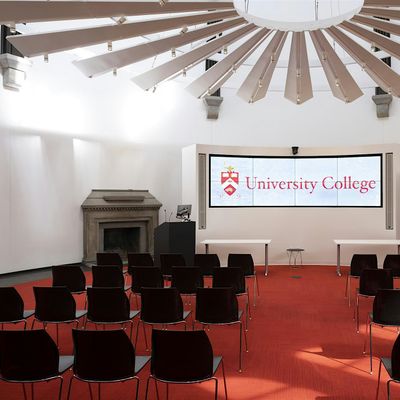
Paul Cadario Conference Centre at Croft Chapter House, University College, Toronto, Canada
 Concerts, fests, parties, meetups — all the happenings, one place.