About this Event
Join us for an evidence-led, practical view of mental health technology.
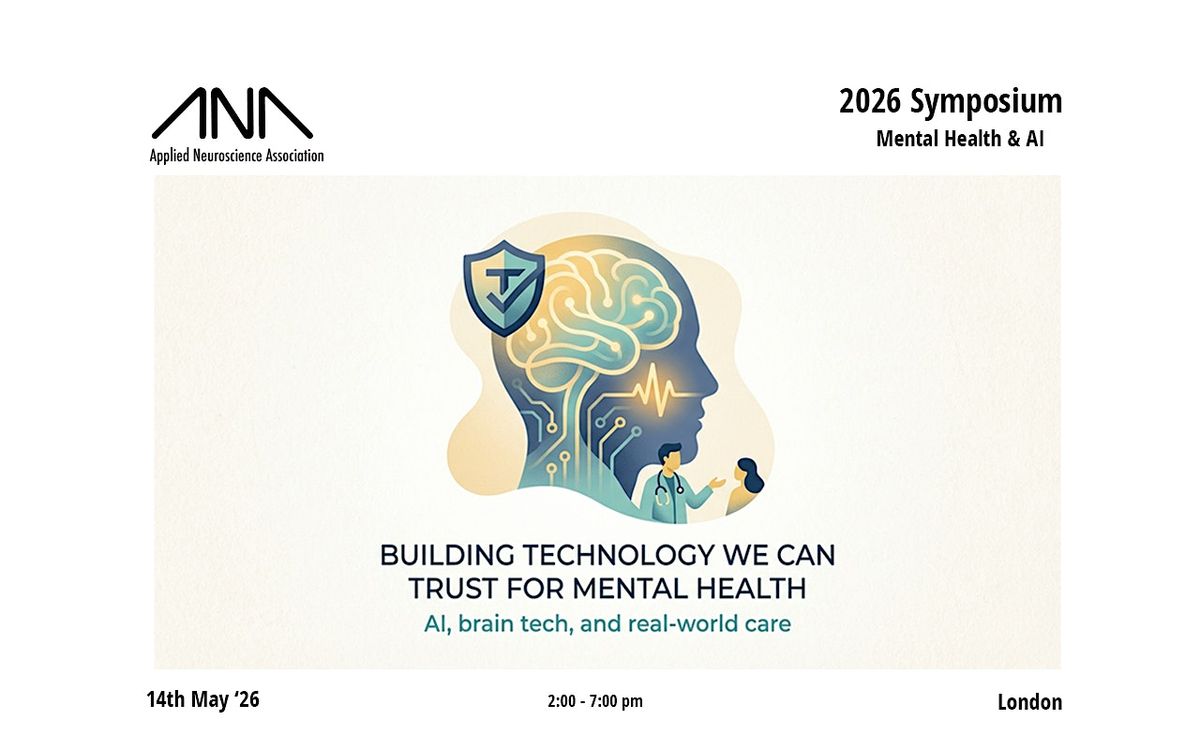
The theme selected for this year’s symposium is “Building Technology We Can Trust for Mental Health. AI, brain tech, and real-world care.”
Nearly 1 in 7 people in the world live with a mental disorder ()
The session aims to bridge the translation gap between remarkable advancements in our understanding of the brain and nervous system and the lived experience of mental health technology. Through a series of fresh-thinking, focused talks and lively conversations in this incredibly important and impactful field. Bringing a fully inclusive immersion into the remarkable advancements in field research, the risks around data, privacy, and exploitation, and what responsible, person-centred design looks like in real-world care.
*********************************************************************************************************
By 2030, the global burden of mental illness is projected to reach $6.7tr (6.7x10^12) (Bloom et al., 2011). Unsurprisingly, this is a strategic area for research and commercialisation, with Neurotechnology patent applications doubling over the past 10 years, particularly those that also relate to computer technologies.
As more mental health professionals incorporate technology into clinical practice, the possibilities for treatment are expanding. (CMI).
The collection of behavioural signals and markers accelerates with our increased curiosity in self-management and improvement applications. Yet evidence swells that over-reliance on incentivised platforms can become exploitative, leading to unintended consequences and potentially distorted care.
How do we design technology that protects and respects the Reason and Conscience of an individual () whilst delivering real improvements?
Invited speakers from: , , , , , , and ANA Members, Aneta Herrenschmidt-Moller and Shalvi Arunprakush working actively “from lab to life” will openly discuss shared mental models, plus concrete examples of what can go wrong, what good looks like, and how to build successful digital frameworks for the people most affected.
Please note - this event will be recorded for distribution across different mediums.
ANA welcomes respectful, open conversation, questions, and feedback from all attendees.
Agenda
🕑: 02:30 PM - 03:00 PM
Opening Keynote: Making Sense of Brain Technology and Mental Health
Host: Charly Massey
Info: This keynote highlights the velocity of neurotechnological research, and where advances in computation, neuroscience, diagnostics, and biomechanics are converging to potentially reshape society.
We will define key terms, map where the field is innovating, identify potential commercial targets and discuss the realistic impacts of lab research on real-life in the next decade.
The talk closes with a practical view of responsible progress. This includes managing bias, safety, and over-claiming across products, services, and policy.
A short glossary will support cross-disciplinary discussion.
🕑: 03:05 PM - 03:10 PM
A user's perspective: Mental Health AI - What the Evidence Really Tells Us
Host: Aneta Herrenschmidt-Moller
🕑: 03:10 PM - 04:00 PM
The Statistical Ghost: AI in Mental Health
Host: Kevin Flanagan
Info: Tech giants are currently investing hundreds of billions of dollars into generative AI infrastructure, desperately seeking massive scale and new network effects to justify unprecedented capital expenditure. As these companies look to disrupt new markets and automate services, mental healthcare has emerged as a prime target for technological intervention and "datafication".
However, the fundamental economics of Large Language Models (LLMs) are dangerously misaligned with the realities of psychiatric and psychological care. Because foundation models currently function as undifferentiated commodities relying on "thin wrappers" for consumer interaction, they depend on population-level statistical averages and massive data extraction to remain commercially viable. This talk explores how this economic imperative treats complex human distress as a quantifiable "information signal problem" rather than a relational human experience.
Throughout the presentation, Kevin will unpack the "atypical
🕑: 04:00 PM - 04:05 PM
A user's perspective: Applying Mental Health AI in Crohn's Disease
Host: Shalvi Arunprakash
🕑: 04:10 PM - 04:55 PM
Building AI Tools We Can Trust: Making Brain Technology Safe and Supportive
Host: Lewis Hotchkiss
Info: A conversation about creating responsible artificial intelligence for mental health and brain research — focusing on how we protect privacy, ensure fairness, and translate lab discoveries into real-world care.
The Dementias Platform UK Data Portal is a Trusted Research Environment which provides secure data access to over 3.5 million participants worth of multi-modal data for health data research. Over the past few years, DPUK along with many other TREs have seen a significant increase in project applications for AI model development which has meant we have had to develop new governance and infrastructure to be able to enable this type of research in a safe and secure way. Funded by DARE UK to establish community groups on AI Risk and Synthetic Data to develop governance frameworks that enable the safe and responsible development of AI models that can be translated from research into real-world clinical practice.
🕑: 05:15 PM - 06:15 PM
Applying Multi-Modal AI to Advance Precision Psychiatry
Host: Dr Paris Alexandros Lalousis
Info: Lecturer (Assistant Professor) and Researcher in Artificial Intelligence in Mental Health at King’s College London’s Institute of Psychiatry, Psychology & Neuroscience, where he leads the Artificial Intelligence in Mental Health (AIM) Lab.
Dr Lalousis research focuses on applying multimodal AI to advance precision psychiatry, with a particular emphasis on psychosis, depression, dementia, and transdiagnostic dimensions such as anhedonia. Beyond academia, he co-founded Bloomwise Ltd, a workplace mental health company. Most recently, he has collaborated with This Can Happen to explore how AI can be harnessed to support employee mental wellbeing at scale.
🕑: 06:15 PM - 07:15 PM
One HealthTech (OHT) Lived Experience in a Digital World
Host: Klaudia Budniak
Info: One HealthTech is a global volunteer-led community on a mission to make health, care, and life sciences more equitable, inclusive, and accessible for all. Breda Spillane, Saira Arif, and Klaudia Budniak are OHT Fellows, representing the OHT Mental Health Network.
This session will open with a presentation on the Digital Inclusion Framework by Maja Golf-Papez, followed by a panel discussion on person-centred design moderated by Klaudia Budniak, with speakers exploring how to leverage user experience and practical, real-world expertise to effectively integrate digital solutions within mental health pathways, ensuring a systemic approach to successful health tech innovation across the entire mental health system.
🕑: 07:15 PM - 07:30 PM
Closing Note
Host: Charly Massey
🕑: 07:30 PM - 08:30 PM
Networking and Lite Refreshments
Event Venue & Nearby Stays
Cannon Street, Cannon Street, London, United Kingdom
GBP 0.00 to GBP 19.99