
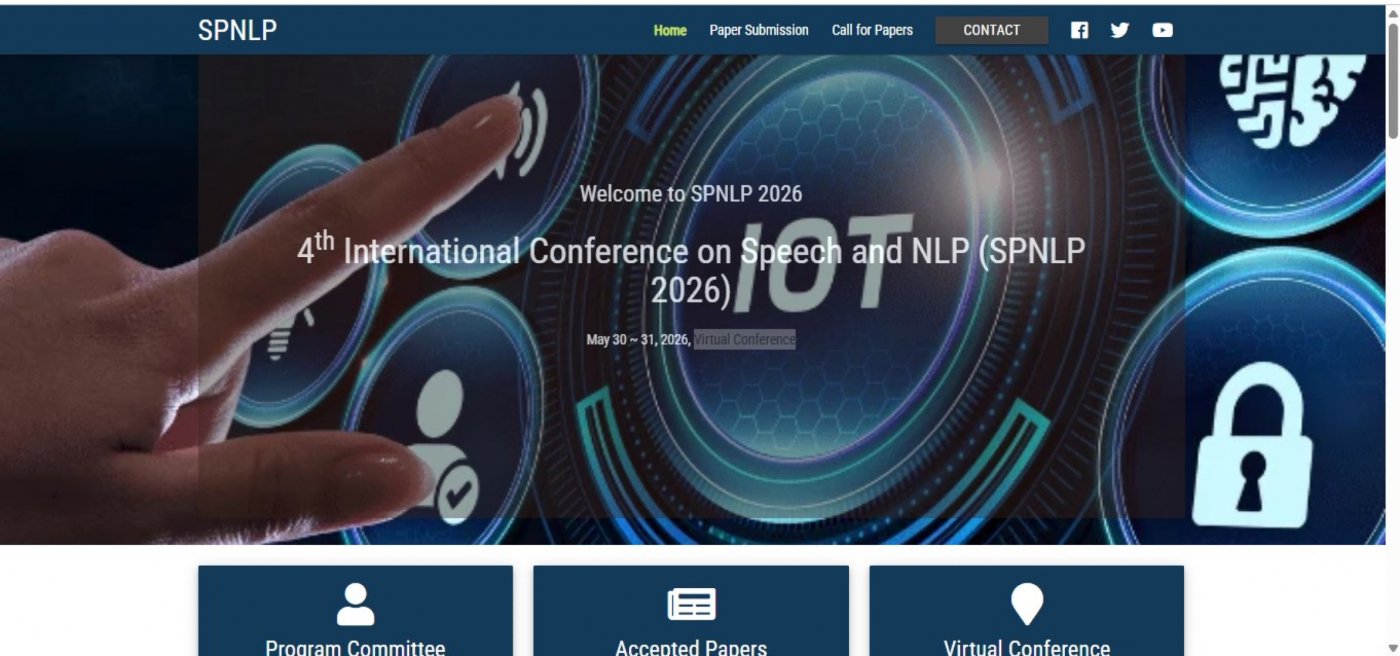
4th International Conference on Speech and NLP (SPNLP 2026)
May 30 ~ 31, 2026, Virtual Conference
https://spnlp2026.org/index
Scope
4th International Conference on Speech and NLP (SPNLP 2026) will provide an excellent international forum for sharing knowledge and results in the theory, methodology, and applications of Speech Processing and Natural Language Processing (NLP). As speech, language, and multimodal intelligence continue to advance at an unprecedented pace, the conference aims to bring together researchers, practitioners, and industry experts to exchange innovative ideas, discuss emerging challenges, and explore cutting edge developments shaping the future of human–machine communication.
SPNLP 2026 welcomes significant contributions that address both foundational research and practical implementations across all major areas of speech and NLP. The conference encourages submissions that present novel research results, experimental studies, system prototypes, survey articles, and industrial experiences that demonstrate meaningful progress in the field.
Authors are invited to contribute by submitting articles that illustrate research results, projects, surveying works, and industrial experiences describing significant advances in the following areas, but not limited to:
Topics of interest include, but are not limited to, the following
NLP, Linguistics and Language
Foundational NLP and Linguistics
Morphology, Phonology, Syntax and Semantics
Parsing, Structured Prediction and Grammatical Formalisms
Lexical Semantics and Word Sense Disambiguation
Discourse, Pragmatics and Dialogue Structure
Linguistic Resources, Corpora, Annotation and Benchmarking
Computational Linguistics and Formal Models of Language
Multilingual NLP, Cross Lingual Transfer and Low Resource NLP
Sociolinguistic NLP: Dialects, Code Switching and Language Variation
Modern NLP Paradigms
Large Language Models (LLMs) and Foundation Models
Instruction Tuning, Preference Optimization (DPO, PPO, ORPO)
Retrieval Augmented Generation (RAG) and Knowledge Augmented NLP
Long Context Models and Memory Augmented LLMs
Reasoning Models: Chain of Thought, Tool Use and Planning
Neuro Symbolic NLP and Hybrid Reasoning
Continual, Lifelong and Incremental NLP
Personalized NLP and User Modeling
Efficient NLP: Distillation, Quantization, Pruning, TinyNLP and TinyLLMs
Speech, Audio and Multimodal Intelligence
Speech and Spoken Language Processing
Automatic Speech Recognition (ASR)
Text to Speech (TTS) and Speech Synthesis
Spoken Dialogue Systems and Conversational AI
Speech Understanding, Emotion Recognition and Prosody
Speech Translation and Cross Modal Speech Text Models
Robust Speech Processing and Noise Resilient Models
Speech Foundation Models and Speech Language Joint Models
Voice Cloning, Voice Conversion and Speech Editing
Speaker Diarization, Attribution and Multi Speaker Modeling
On Device and Real Time Speech Models (TinySpeech)
Audio Intelligence and Generative Audio
Audio Diffusion Models and Generative Audio
Sound Event Detection, Classification and Generation
Audio Language Models (ALMs)
Audio Forensics and Deepfake Speech Detection
Multimodal and Embodied AI
Vision Language Models (VLMs)
Audio Language Vision Models
Vision Language Action (VLA) Models
Video Language Models and Video Reasoning
3D Multimodal Models and Embodied 3D Reasoning
Language Grounding in Vision, Robotics and Embodied Agents
sign Language Processing and Gesture Language Integration
NLP Applications, Generation and Knowledge Technologies
NLP Applications
Information Extraction, Text Mining and Knowledge Extraction
Information Retrieval, Neural IR and Search Systems
Question Answering, Reading Comprehension and Open Domain QA
Summarization (Extractive, Abstractive, Multimodal)
Machine Translation and Cross Lingual Generation
Sentiment Analysis, Opinion Mining and Argument Mining
NLP for Healthcare, Finance, Education and Social Media
NLP for Accessibility and Assistive Technologies
NLP for Misinformation, Disinformation and Digital Trust
NLP for Policy, Governance and Societal Impact
Text Generation and Language Modeling
Paraphrasing, Entailment and Natural Language Generation (NLG)
Controlled Generation, Style Transfer and Content Manipulation
Narrative Generation, Storytelling and Creative NLP
Safety Aware Generation and Toxicity Mitigation
Knowledge Enhanced NLP
Knowledge Graphs, Ontologies and Semantic Web
Knowledge Grounded Dialogue and QA
Commonsense Reasoning and World Knowledge Integration
Symbolic Neural Hybrid Models
Machine Learning for NLP and Model Analysis
ML Techniques for NLP
Deep Learning Architectures for NLP
Transformers, Attention Mechanisms and Sequence Modeling
Reinforcement Learning for Language Tasks
Continual Learning, Meta Learning and Transfer Learning
Statistical NLP (modernized) and Hybrid ML Approaches
Model Evaluation, Interpretability and Safety
Interpretability, Explainability and Model Transparency
Evaluation Metrics, Benchmarks and Human Evaluation
Bias, Fairness, Ethics and Responsible NLP
Robustness, Adversarial Attacks and Defenses
Hallucination Detection and Mitigation in LLMs
Safety, Alignment and Red Teaming for NLP Models
Holistic Evaluation of LLMs and Multimodal Models
Agent Based Evaluation and Real World Task Evaluation
Emerging Topics in Speech and NLP
Agentic NLP Systems and Autonomous Language Agents
Multi Agent Communication, Coordination and Social Simulation
Multilingual LLMs and Universal Speech Language Models
Low Resource and Zero Shot Speech/NLP
Synthetic Data for Speech and NLP
Human AI Collaboration and Co Creation
Cognitive NLP and Psycholinguistic Modeling
Theory of Mind (ToM) in NLP and Language Reasoning
Real World Deployment, Efficiency and Scalability of NLP Systems
NLP for Safety, Security and Digital Trust
Paper Submission
Authors are invited to submit papers through the conference Submission System by May 23, 2026 (Final Call). Submissions must be original and should not have been published previously or be under consideration for publication while being evaluated for this conference. The proceedings of the conference will be published by International Journal on Cybernetics & Informatics (IJCI) (Confirmed).
Selected papers from SPNLP 2026, after further revisions, will be published in the special issue of the following journal.
- International Journal on Natural Language Computing (IJNLC)
- International Journal of UbiComp (IJU)
- International Journal of Data Mining & Knowledge Management Process (IJDKP)
- International Journal of Grid Computing & Applications (IJGCA)
- Signal & Image Processing : An International Journal (SIPIJ)
Important Dates
Second Batch : Submissions after April 21, 2026
Submission Deadline; May 23, 2026 (Final Call)
Authors Notification; May 28, 2026
Registration & camera – Ready Paper Due; May 29, 2026
Contact Us
Here’s where you can reach us : [email protected] (or) [email protected]
Event venue
VIRTUAL CONFERENCES, Wollankstraße 11/1. OG, 13187 Berlin, Germany, Berlin
 Concerts, fests, parties, meetups — all the happenings, one place.