

About this Event
Join us for an enlightening event where clinicians, health systems, researchers, builders, investors, policymakers, and industry leaders determine what earns trust, adoption, and scale.
This year, we're partnering with Coalition for Health AI (CHAI) to open the week with a dedicated pre-conference on October 6th, setting the stage for two full days of in-depth discussions on October 7th and 8th. Tickets for their event are available here.
Earn up to 13 hours of CE credit across eligible sessions during the two-day Symposium.
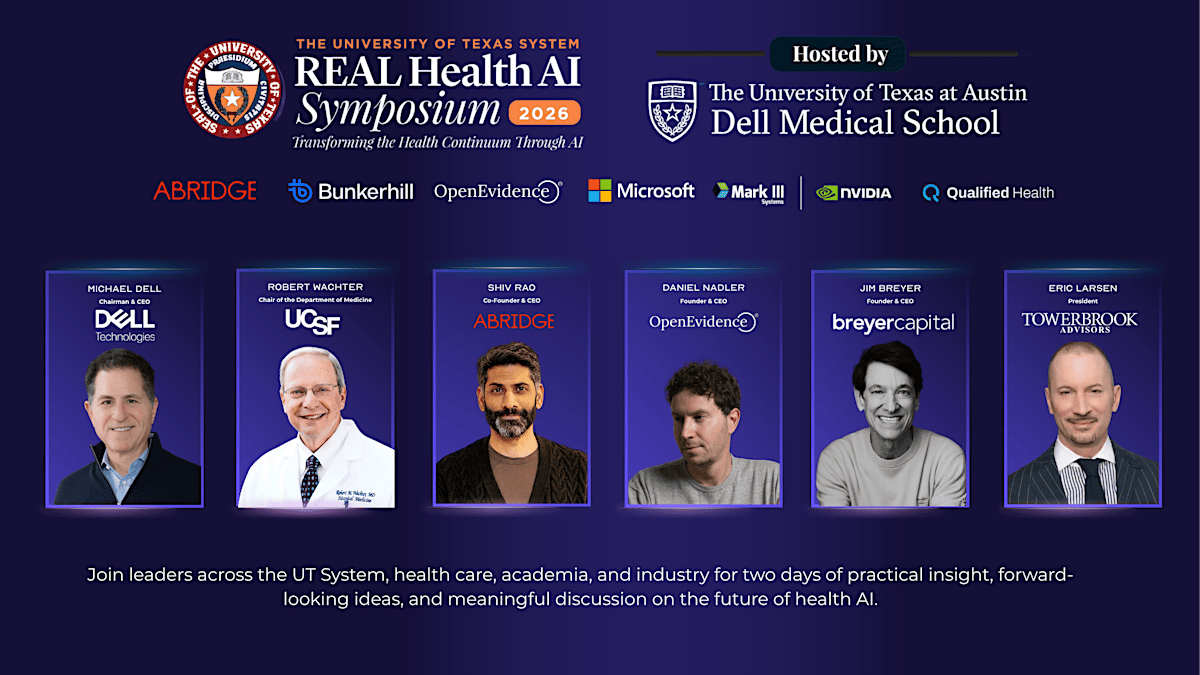
About the Symposium
AI is already changing the health landscape. The primary question that emerges from this unprecedented evolution is: how do you earn trust, adoption, and scale?
The UT REAL Health AI Symposium brings the people answering that question into one room:
- The clinicians deciding what they will use,
- The health systems addressing what they will fund and govern,
- The researchers producing the evidence,
- The builders creating the tools,
- The investors placing the capital, and
- The policymakers writing the guardrails.
A Rare Environment of Possibilities
The University of Texas System is the largest university system in Texas and one of the nation’s largest health systems. Across 13 institutions, UT-owned and affiliated hospitals and clinics recorded nearly 11.7 million outpatient visits in the latest reported year. The UT REAL Health AI Symposium convenes the people who decide the future of health AI in Texas.
This is your opportunity to join this critical moment.

Continuing Education Credit
Target AudienceSpecialties - ALLProfessions - Allied Dental Staff, Counselor, Dentist, Genetic Counselor, Geneticist, Nurse - APRN, Nurse - LVN, Nurse - RN, Occupational Therapist, Other, Pharmacist, Ph*rm*cy Technician, Physical Therapist, Physician (MD or DO), Physician Associate, Psychologist, Radiation Technician, Radiation Therapist, Respiratory Therapist, Social Worker, Speech-Language Pathologist, Student or Trainee, Veterinarian
Credits
AMA PRA Category 1 Credits™ (13 hours), AAPA Category 1 CME (13 hours), ACPE Contact Hour(s) (13 hours), ANCC - Nursing Contact Hour(s) (13 hours), Non-Physician Attendance (13 hours)
Overview
The UT REAL Health AI Course is a two-day educational program designed to prepare healthcare professionals to effectively evaluate, implement, and responsibly apply artificial intelligence (AI) within healthcare settings. Developed as part of the University of Texas System's UT REAL Health AI initiative, the course features expert-led presentations addressing current and emerging applications of AI in clinical care, research, operations, governance, ethics, and implementation. The activity is open to participants from both the UT System and external organizations. Continuing education credit will be offered for physicians, nurses, APRNs, physician assistants, pharmacists, and dentists, with certificates of attendance available for all other professions.
ObjectivesAt the conclusion of this activity, learners will be able to:
- Evaluate current and emerging AI applications across healthcare.
- Differentiate governance, regulatory, ethical, and implementation considerations.
- Assess the benefits, limitations, and risks of AI-enabled solutions.
- Identify organizational strategies supporting responsible AI implementation.
- Recognize opportunities to apply AI concepts within professional practice.
- Discuss future trends influencing AI-enabled healthcare delivery.
Accreditation
ACCME Statement
In support of improving patient care, The University of Texas MD Anderson Cancer Center is jointly accredited by the Accreditation Council for Continuing Medical Education (ACCME), the Accreditation Council for Ph*rm*cy Education (ACPE), and the American Nurses Credentialing Center (ANCC) to provide continuing education for the healthcare team.
Credit Designation
The University of Texas MD Anderson Cancer Center designates this live activity for a maximum of 13 AMA PRA Category 1 Credits™. Physicians should claim only the credit commensurate with the extent of their participation in the activity.
The University of Texas MD Anderson Cancer Center designates this live activity will award 13 Nursing Contact Hour(s) Credit Designation.
The University of Texas MD Anderson Cancer Center has been authorized by the American Academy of PAs (AAPA) to award AAPA Category 1 CME credit for activities planned in accordance with AAPA CME Criteria. This activity is designated for 13 AAPA Category 1 CME credits. PAs should only claim credit commensurate with the extent of their participation.
The University of Texas MD Anderson Cancer Center designates this application-based activity for 13 hours under UAN JA0004118-0000-26-025-L99-P. Credits will be provided to NABP CPE Monitor within 60 days after the activity completion. Learners must provide their NABP e-profile ID and Date of Birth in their MyCE Profile for credits to be reported to CPE Monitor.
The Program at a Glance
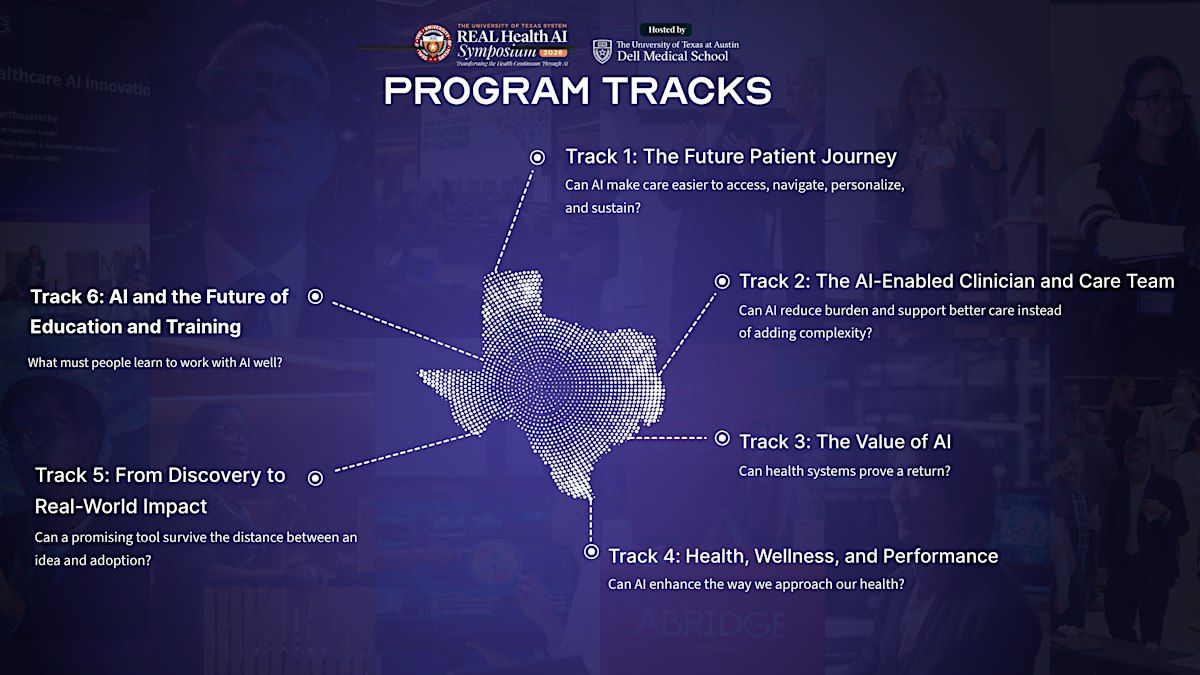
The symposium is organized around six program tracks, supported by keynotes, main-stage conversations, panels, workgroups, and concurrent sessions.
Track 1: The Future Patient Journey
The Future Patient Journey
Special Session: Rural Health
Muthu Alagappan, MD, Counsel Health
Tom Lee, MD, Galileo
Jim Weinstein, DO, MS, Senior VP of Microsoft
David Rhew, Global Chief Medical Officer & VP of Healthcare for Microsoft
Track 2: The AI-Enabled Clinician and Care Team
The AI-Enabled Clinician and Care Team, and Next-Generation Care Delivery: Robotics and Sensors
Special Session: AI in Nursing Practice and Patient Care
Main-Stage Keynote
Robert Wachter, MD, University of California, San Francisco
Main-Stage Keynote
Shiv Rao, MD, Abridge
Claudia Lucchinetti, MD, Dean, Dell Medical School, UT Austin
Jose del R. Millan, Ph.D., Texas Robotics, UT Austin
Track 3: The Value of AI
The Value of AI: revenue cycle, prior authorization, staffing, scheduling, throughput, supply chain, CMS, regulatory, payment models, ROI
Nick Chedid, MD, Associate Chief Medical Officer, Qualified Health
Corey Shank, Senior Managing Director, Texas Tech University Health Sciences Center
Salim Saiyed, Chief Medical Informatics Officer, Dell Medical School
Special Session: AI Value Panel
Jack O'Hara, MBA, CEO, Translucent
Jamie Bailey, MBA, Chief Financial Officer, UT Medical Branch
Stephanie Swanson, Chief Financial Officer, UT Southwestern
Omer Sultan, MBA, MD Anderson Cancer Center
Special Session: Fireside Chat on AI Value and Impact
Kevin Schulman, MD, MBA, Stanford
Stephanie Carlton, MBA, Centers for Medicare & Medicaid Services (CMS)
Eric Peterson, MD, UT Southwestern
Special Session: Afternoon Keynote Fireside
Michael Dell, Dell Technologies
Jim Davis, President, UT Austin
Claudia Lucchinetti, MD, Dean, Dell Medical School, UT Austin
Introduction by Peter McCaffrey, MD, UT Medical Branch
Special Session: Investor Panel and Fireside
Jim Breyer, MBA, Breyer Capital
Daniel Nadler, Ph.D., OpenEvidence
Morgan Cheatham, MD, Breyer Capital
Special Session: VC Panel
John Schilling, MD, TPG
Vijay Pande, Ph.D., VZVC Venture Fund
Margaret Malone, Flare Capital
Pat Pace, MD, UTIMCO
Special Session: AI Disruption
Vijay Pande, Ph.D., VZVC Venture Fund
Dan Shoenthal, MD Anderson Cancer Center
Special Session: Future of Robotics (value focus)
Peter Stone, Ph.D., Texas Robotics, UT Austin
Steph Tryphonos, Co.bot, Collaborative Robotics
Hugh Rashid, MD, Navigait
Jeff Cardenas, Apptronik
Dean Zhang, Ph.D., UTHealth Houston
Track 4: Health, Wellness, and Performance
Leveraging AI to Improve Health, Wellness and Performance: "Soft Electronics for Human Sensing and Robotic Care in the AI Age"
Special Session: Digital Twin Panel
Nanshu Lu, Ph.D., UT Austin
Caroline Chung, MD, MD Anderson Cancer Center
Tom Yankeelov, Ph.D., Oden Institute, UT Austin
David Jaffray, Ph.D., MD Anderson Cancer Center
Track 5: From Discovery to Real-World Impact
Special Session: A National Path Forward for Trustworthy Health AI
Jason Funderburk, MD, Office of the National Coordinator for Health IT (ONC)
Brian Anderson, MD, Coalition for Health AI (CHAI)
James Buntrock, Dell Medical School, UT Austin
Special Session: AI Ethics and Social Implications
Craig Watkins, Ph.D., UT Austin
Joel Granoff, Patient Advocate
Special Session: Legal and Compliance
Dennis Char, MD
Monika Bickert, JD
Natalie Ramello, JD, UT Southwestern
Jennifer Kennedy, JD, UT System
Special Session: Government Relations - Shaping AI Policy in Healthcare
Sean Griffin, UT System
Special Session: Workgroup Presentations - Maturity Framework, AIMS, UT-HIP
David Jaffray, Ph.D., Senior VP and Chief Technology and Digital Officer, MD Anderson
Shawn Stapleton, Ph.D., Director of Data Impact & Governance
Claus Jensen, Ph.D., Chief Information Officer, Dell Medical School
ShuRon Green, MBA, Executive Director of UT HIP
Special Session: Workgroup Presentations - UT REAL Health AI Moonshot Awards
Hongfang Liu, Ph.D., Chair, Department of Quantitative and Systems Health Sciences, Dell Medical School
Special Session: Compute, Chips and AI Factories - Building the Infrastructure for the AI-Native Health System
Kelly Gaither, Ph.D., Texas Advanced Computing Center (TACC)
Paul Rad, Ph.D., Dean, UT San Antonio
Peter McCaffrey, MD, UT Medical Branch
Track 6: AI and the Future of Education and Training
Education Track Keynote
Eric Larsen, President, TowerBrook Advisors
Moderator: Nilay Shah, Ph.D., Dell Medical School, UT Austin
AI-Ready Healthcare Education: Building Trust, Skills, and Responsible Practice
Susan Fenton, Ph.D., UTHealth Houston
Susan McBride, Ph.D., UT Tyler
Edward Sankary, MD, UT San Antonio
Business Education and the AI-Ready Workforce
Dean Staats, McCombs School of Business, UT Austin
Special Session: AI Brain Health
Jennifer Bickel, MD, Vice President and Chief Wellness Officer
Jochen Reiser, MD, Ph.D., President, The University of Texas Medical Branch
Event venue & nearby stays
AT&T Hotel and Conference Center, 1900 University Avenue, Austin, United States
 Concerts, fests, parties, meetups — all the happenings, one place.