

About this Event
How can everyday practices make laboratories and R&D environments more accessible to disabled scientists?* How can work be better organized, skills shared, and support provided?
Through a fishbowl conversation — an open, rotating discussion format — this experimental panel brings together disabled and not disabled people to develop milestones towards more inclusive laboratory and R&D environments that are both physically and psychologically safe. We will explore:
1- Non-visible disabilities and (non-) disclosed adjustments: Why can disclosure sometimes be difficult? What forms of support already enable people with less visible disabilities and long-term conditions to work better? What issues remain unseen and need to be addressed in laboratory and workshop practice? And how can we build the trust that makes disclosure easier?
2- Accessibility in practice: How can laboratories and workshops become more accessible, from everyday practices to wider systemic and infrastructural change? Which measures are easiest to implement, which are harder, and what currently prevents them? How might we recognise meaningful progress towards more inclusive practice?
Laboratories and workshops are distinctive research environments: they are equipment-intensive, safety-critical and often shaped by fixed procedures, specialist skills and operational pressures. Although accessibility standards and guidance exist, translating them into everyday practice remains difficult. Our aim is not to produce another checklist. We want to identify practical changes that work, understand where barriers persist, and explore how laboratories and workshops might move progressively towards more inclusive practice.
The learning from this event will inform the development and implementation of adapted guidance for the University of Cambridge, research partners and industry partners.
This event is organised by the Institute for Manufacturing (IfM), Department of Engineering, University of Cambridge, with support from the University Diversity Fund, and delivered in collaboration with the West Hub and the Science and Technology Studies Cambridge Network (SCaN).
*The term disability is used broadly, including visible and non-visible disabilities, neurodivergence, chronic illness, long term conditions, mental health conditions, D/deafness, visual impairment, mobility impairment and other accessibility needs. We also use the terms laboratory and R&D broadly. This includes wet and dry laboratories, workshops, technical facilities, media and computing labs, pilot lines, field sites and other research or technical settings. We also recognise that experiences of disability and accessibility intersect with factors such as career stage, gender, race, class and migration status, and may therefore differ considerably between people working in apparently similar environments.
Time
Session
12:00–12:30 : Welcome lunch and arrival
12:30–12:50: Welcome, project framing, participation and accessibility briefing
12:50–13:50: Fishbowl 1: invisible disabilities and (non-) disclosed adjustments
13:50–14:00: Break
14:00–15:20: Fishbowl 2: accessible labs in practice
15:20–15:30: Live reflection, next steps and close
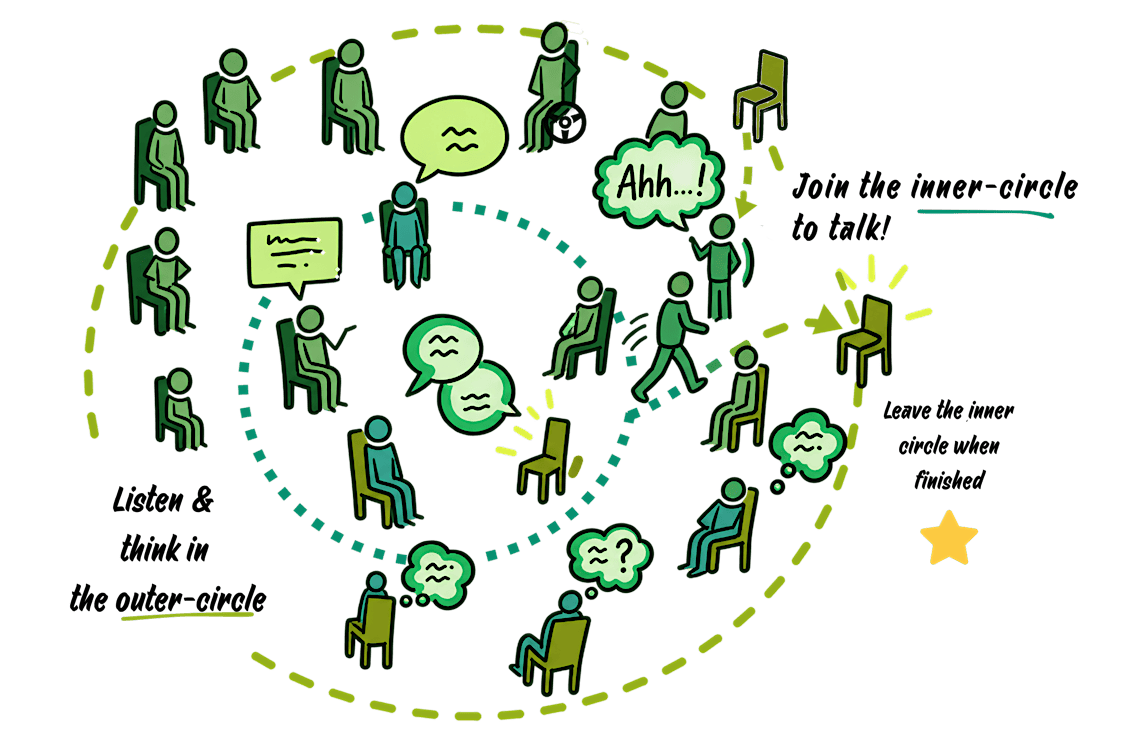
What's a fishbowl? A fishbowl is a discussion format where a small group of participants sits in the inner circle to actively speak, while everyone else observes and listens from the outer circle. An empty chair in the inner circle allows anyone to join and ask questions or make comments. After speaking, participants make space for others. This creates a space to share perspectives, ask questions and explore ideas together. The format is designed to reduce the hierarchy of a conventional panel, allow expertise and lived experience to meet on more equal terms, and create room for unexpected connections.
Speaking out loud or joining the inner circle is entirely voluntary. You are equally welcome to participate by listening, observing or contributing in writing through our pre-event survey https://cambridge.eu.qualtrics.com/jfe/form/SV_1TtRt8uO7TzqB3o
Event venue & nearby stays
West Hub, JJ Thomson Avenue, Cambridge, United Kingdom
 Concerts, fests, parties, meetups — all the happenings, one place.