
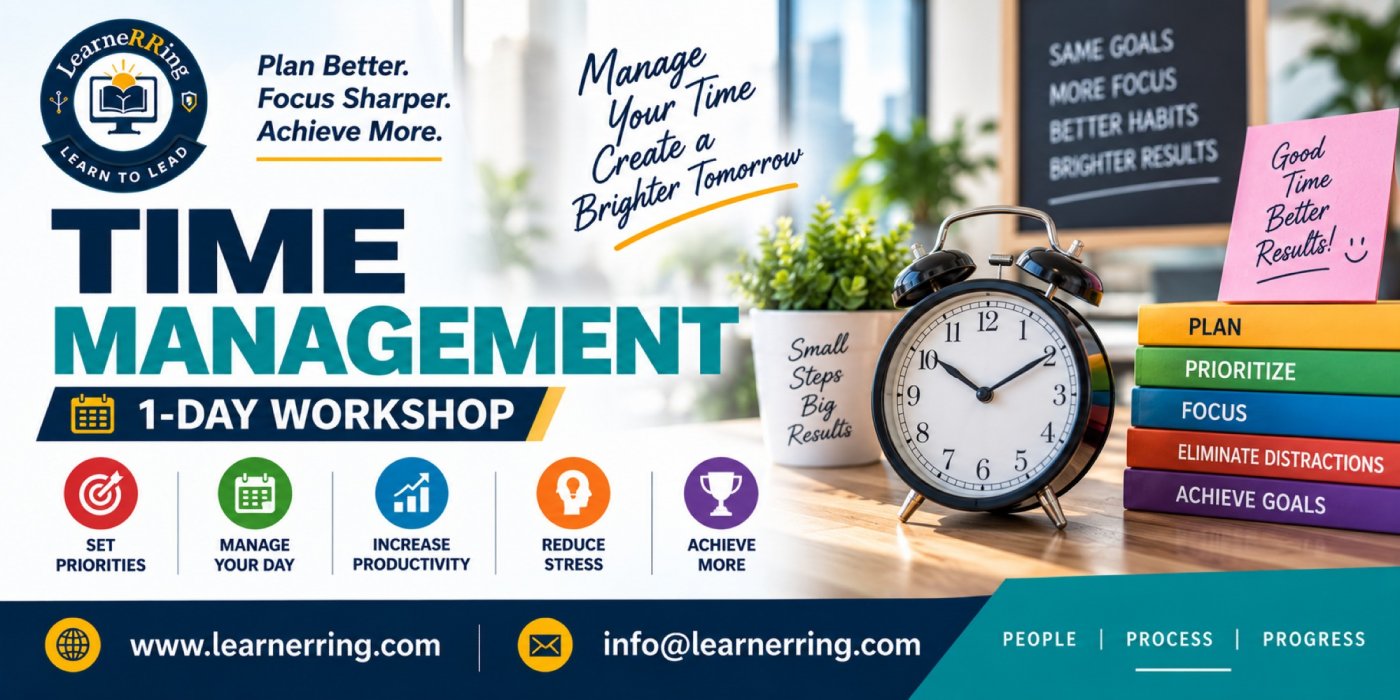
Event Details
- Duration: 1-Day Practical Training (8 Hours)
- Timing: 9:00 AM – 5:00 PM (including breaks)
- Location: Location shared via email ( Complete Address )
- City Selection: Select your preferred city. We’ll confirm the nearest available training location after registration. Onsite training is also available on request.
- Format: Classroom Training (Virtual option available on request)
- Language: English
- Certificate: Course Completion Certificate
- PDUs Awarded: 8 Professional Development Units
- Contact: [email protected]
Event Description
Time is one of our most limited professional resources. While everyone has the same number of hours available, the way we plan, prioritize, focus, and respond to competing demands can make a significant difference to productivity and performance.
This practical Time Management 1-Day Workshop is designed to help participants take greater control of their workload, focus on high-value activities, reduce unnecessary distractions, and develop more effective working habits.
Participants will explore practical techniques for setting goals, prioritizing tasks, planning their day, managing competing deadlines, overcoming procrastination, improving concentration, controlling interruptions, managing email and meetings, delegating appropriately, and responding to unexpected demands.
The workshop also examines personal productivity patterns and helps participants identify when they work most effectively. Rather than trying to complete everything at once, participants will learn how to make better decisions about what requires attention, what can wait, what can be delegated, and what may not need to be done at all.
Through practical exercises, workload scenarios, prioritization activities, self-assessment, and action planning, participants will develop a personalized approach to managing their time more effectively.
The goal is to help participants work with greater clarity and control while improving productivity, reducing avoidable pressure, and creating more sustainable working habits.
What You Will Learn
· Understand the principles of effective time management.
· Identify where your working time is currently being spent.
· Recognize personal productivity patterns.
· Set clear and achievable goals.
· Connect daily activities with important objectives.
· Distinguish between urgent and important work.
· Prioritize competing tasks more effectively.
· Apply the 80/20 principle to workload decisions.
· Plan your day and week more strategically.
· Use time blocking and task batching.
· Reduce ineffective multitasking.
· Improve focus and concentration.
· Understand why procrastination happens.
· Apply practical techniques for overcoming procrastination.
· Manage workplace interruptions and distractions.
· Improve email and calendar management.
· Organize tasks and information more effectively.
· Delegate appropriate work.
· Make meetings more productive.
· Respond effectively to unexpected priorities.
· Set appropriate boundaries and communicate priorities.
· Create a personal time-management improvement plan.
Workshop Modules
Module 1: Understanding Time and Personal Productivity
· What effective time management really means.
· Moving from being busy to being productive.
· Understanding activity versus results.
· Identifying common time-management challenges.
· Recognizing personal time-wasting habits.
· Understanding controllable and uncontrollable demands.
· Assessing your current approach to workload management.
· Identifying opportunities to work more effectively.
· Establishing personal productivity objectives.
Module 2: Discovering Your Productivity Rhythm
· Understanding personal energy and concentration patterns.
· Identifying high-focus and low-focus periods.
· Matching demanding tasks with productive periods.
· Understanding the limitations of multitasking.
· Using focused work periods.
· Applying task batching.
· Understanding the importance of appropriate breaks.
· Managing energy as well as time.
· Creating a more sustainable working rhythm.
Module 3: Goal Setting and Purposeful Planning
· Understanding the relationship between goals and time.
· Setting clear professional objectives.
· Using SMART goals effectively.
· Breaking larger goals into manageable actions.
· Connecting daily work with longer-term priorities.
· Creating milestones.
· Tracking progress.
· Reviewing and adjusting goals.
· Avoiding activity that does not contribute meaningful value.
· Creating a practical goal-to-action plan.
Module 4: Prioritizing Your Work
· Understanding why prioritization matters.
· Distinguishing urgent work from important work.
· Applying an Urgent/Important Matrix.
· Understanding the 80/20 principle.
· Identifying high-impact activities.
· Evaluating competing requests.
· Ranking tasks by importance and consequence.
· Breaking large tasks into manageable pieces.
· Making conscious decisions about lower-value work.
· Reprioritizing when circumstances change.
Module 5: Planning and Scheduling Your Workday
· Creating realistic daily plans.
· Planning the week before it becomes reactive.
· Using calendars effectively.
· Scheduling priority work.
· Using time blocking.
· Creating protected focus periods.
· Building flexibility into schedules.
· Estimating task duration more realistically.
· Managing multiple deadlines.
· Avoiding over-scheduling.
· Conducting an effective end-of-day review.
Module 6: Overcoming Procrastination and Improving Focus
· Understanding why people procrastinate.
· Recognizing personal procrastination triggers.
· Breaking difficult work into smaller actions.
· Starting when motivation is low.
· Managing perfectionism.
· Dealing with fear of failure.
· Creating realistic deadlines.
· Reducing digital distractions.
· Improving concentration.
· Building momentum through small wins.
· Developing stronger completion habits.
Module 7: Managing Interruptions, Distractions and Boundaries
· Identifying common workplace interruptions.
· Understanding the cost of repeated task switching.
· Managing colleague interruptions professionally.
· Handling instant messages and notifications.
· Protecting focused working time.
· Setting communication expectations.
· Using assertiveness appropriately.
· Saying no or renegotiating deadlines professionally.
· Managing competing requests from different stakeholders.
· Creating practical boundaries without damaging relationships.
Module 8: Managing Email, Tasks and Your Workspace
· Reducing unnecessary inbox checking.
· Prioritizing incoming messages.
· Separating actionable messages from information.
· Creating an effective email-processing routine.
· Using calendars and task-management tools.
· Capturing commitments in one reliable system.
· Organizing digital information.
· Reducing unnecessary physical and digital clutter.
· Creating a workspace that supports concentration.
· Developing a simple personal workflow.
Module 9: Delegating for Better Time Management
· Understanding why effective delegation matters.
· Identifying tasks suitable for delegation.
· Choosing the appropriate person.
· Defining the required outcome.
· Communicating expectations clearly.
· Agreeing deadlines and checkpoints.
· Providing appropriate authority and resources.
· Avoiding micromanagement.
· Monitoring progress appropriately.
· Giving feedback after completion.
· Using delegation to develop others as well as manage workload.
Module 10: Managing Meetings More Effectively
· Determining whether a meeting is necessary.
· Defining the purpose and expected outcome.
· Inviting the right participants.
· Creating focused agendas.
· Preparing before meetings.
· Starting and finishing effectively.
· Keeping discussions on track.
· Managing off-topic conversations.
· Recording decisions and actions.
· Assigning responsibilities and deadlines.
· Reducing unnecessary meeting time.
Module 11: Managing Unexpected Demands and Workload Pressure
· Understanding why plans sometimes change.
· Responding to genuine urgent situations.
· Evaluating unexpected requests.
· Reprioritizing without losing control.
· Communicating changes to stakeholders.
· Managing unexpectedly complex tasks.
· Handling conflicting deadlines.
· Knowing when to escalate workload concerns.
· Maintaining focus during busy periods.
· Learning from recurring workload problems.
· Building flexibility without becoming permanently reactive.
Module 12: Building Your Personal Time Management System
· Reviewing current time-management habits.
· Identifying personal productivity strengths.
· Identifying priority improvement areas.
· Selecting techniques that fit your role.
· Establishing daily planning habits.
· Creating weekly review routines.
· Defining focus and interruption-management strategies.
· Improving delegation and meeting practices.
· Identifying habits to stop, start, and continue.
· Setting measurable productivity goals.
· Creating a 30-day time-management action plan.
· Building sustainable productivity habits.
Who Should Attend?
This workshop is suitable for:
· Managers and supervisors.
· Team leaders.
· Project managers.
· Business professionals.
· Administrative professionals.
· Office and operations professionals.
· Sales and customer-service professionals.
· HR professionals.
· Entrepreneurs and business owners.
· New and emerging managers.
· Professionals managing multiple projects or deadlines.
· Remote and hybrid workers.
· Professionals experiencing competing workplace priorities.
· Employees looking to improve productivity.
· Anyone who wants greater control over their workload and working day.
🎓 Certification
All participants will receive a Certificate of Completion from LearneRRing, recognizing their achievement.
Exclusive OffersGroup Discounts:10% off for groups of 5-10 participants15% off for groups of 11-20 participants
Corporate & Team Training Available
Want this course delivered at your workplace or for your team? We offer customized onsite and virtual sessions for companies.📩 Email us at [email protected] for details.
Event venue
Utah, For venue details reach us at [email protected] PH: +1505 369 2908 Utah, United States, Salt Lake City
 Concerts, fests, parties, meetups — all the happenings, one place.