

About this Event
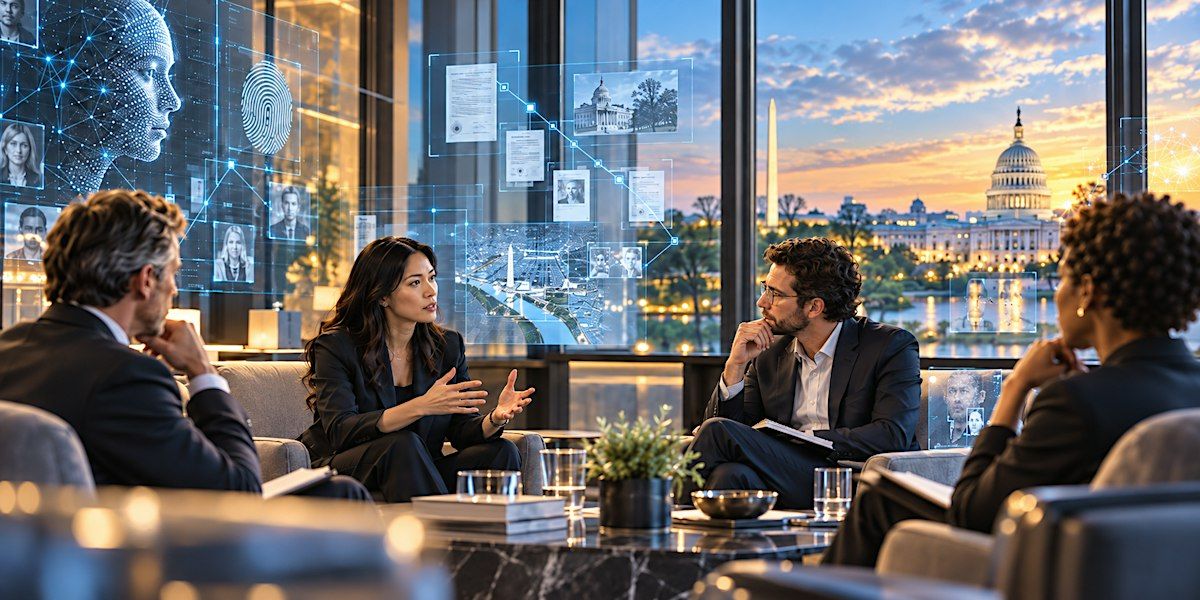
The Verification Room: AI, Security & the Future of Truth
Welcome to The Verification Room, an intimate 16-person forum examining one increasingly difficult question:
How do we establish trust when text, images, voices, identities, and digital evidence can be generated or manipulated at scale?
This is not a traditional conference, lecture, or panel discussion.
Participants will work through three structured scenarios designed to challenge assumptions about AI, cybersecurity, identity, evidence, and institutional trust.
A moderator will guide the room through short case briefings, small-group discussion, competing interpretations, and full-room synthesis.
The Three Questions
Scenario One — Can We Still Trust What We See?
Participants examine a hypothetical case involving convincing digital evidence with uncertain origins.
The discussion explores:
- Authenticity and provenance
- Verification before amplification
- Human judgment versus automated detection
- How uncertainty should be communicated
Scenario Two — Who Is Really on the Other Side?
A second case explores digital identity, impersonation, automated agents, and security decisions.
Discussion focuses on:
- Identity verification
- AI-enabled impersonation
- Human approval checkpoints
- Authentication and organizational safeguards
- What happens when legitimate-looking communication can no longer be trusted by default
Scenario Three - What Does Trust Look Like After Verification Fails?
The final case considers what organizations should do when information is incomplete, disputed, or later shown to be wrong.
Participants explore:
- Correction mechanisms
- Evidence standards
- Transparency
- Accountability
- Communicating uncertainty without creating unnecessary confusion
What Participants Receive
- Three structured AI and trust case exercises
- A moderated small-group discussion experience
- Axiom Trust & Verification Framework
- Personal decision-mapping worksheet
- Curated post-event reading list
- Digital post-event synthesis brief
- Coffee, tea, water, and light refreshments
The purpose of the session is not to persuade the room toward one predetermined position.
Participants are encouraged to challenge assumptions, distinguish evidence from interpretation, and examine where reasonable people may reach different conclusions.
Discussion Integrity
The main discussion will not be recorded.
Participants may take personal notes, but identifiable comments from other attendees should not be publicly attributed without permission.
Guests should not disclose confidential security incidents, protected personal information, proprietary datasets, passwords, credentials, or sensitive organizational information. Hypothetical, redacted, or publicly documented examples should be used instead.
The event provides educational discussion and structured analysis. It does not provide legal, cybersecurity, or professional risk guarantees.
TIMELINE
1:40 PM – Doors Open
Check-in, refreshments, seating, and individual opening question.
2:00 PM – Axiom Opening: What Counts as Evidence?
Moderator introduction, discussion principles, and baseline assumptions.
2:20 PM – Scenario One: Can We Still Trust What We See?
Case briefing, four-person table discussions, and room synthesis.
2:55 PM – Scenario Two: Who Is Really on the Other Side?
Identity, impersonation, security, and human-verification discussion.
3:30 PM – Short Break
3:40 PM – Scenario Three: What Happens When Verification Fails?
Trust recovery, corrections, transparency, and institutional response.
4:15 PM – The Verification Framework
Participants map practical principles across evidence, identity, uncertainty, and human judgment.
4:40 PM – Final Question Round
Each participant identifies one assumption they changed, strengthened, or still question.
4:55 PM – Closing Resources
5:00 PM – Event Ends
Event venue & nearby stays
1250 Connecticut Ave NW suite 700, 1250 Connecticut Avenue Northwest, Washington, United States
 Concerts, fests, parties, meetups — all the happenings, one place.