About this Event
PLEASE NOTE: VENUE MAY CHANGE
If you are a Columbia/Barnard affiliate with campus access, please use your Columbia/Barnard email when registering.
Each attendee must have their OWN registration and email address.
Registration for external guests closes at 4PM on April 2. Registration will automatically close at that time. Columbia/Barnard affiliates may register at the door.
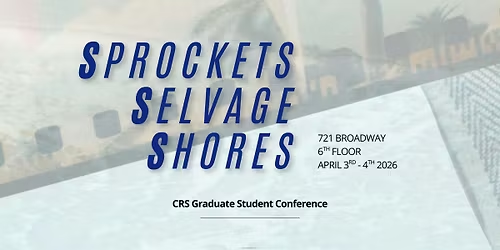
Techno-Fascism: Past and Present explores the convergence of far-right ideologies, authoritarian politics, and digital technologies. As algorithmic governance, social media influencers, and AI-driven propaganda reshape political power, this conference examines how digital tools are used to reinforce exclusionary nationalisms, gender and racial hierarchies, and anti-democratic regimes. Bringing together scholars and media practitioners, it offers a critical space to reflect on historical precedents, contemporary resistance, and the future of media, technology, and political struggle.
Schedule:
10:00 am - 10:30 am Introductory Remarks
10:30 am - 12:00 pm Roundtable 1: Platform Politics
This roundtable seeks to discuss how digital platforms, and the tech-corporations that run them, mediate politics; specifically, we will consider how these platforms enable and disable certain kinds of political action and subjectivity together with their role in perpetuating societal inequalities. In what ways do digital platforms reinforce authoritarianism—not because they are inherently authoritarian, but because they are designed, deployed, and governed in certain ways that centralize power, diminish accountability, and intensify control? Together, we will consider emerging trends such as techno-nationalism, the weaponization of digital platforms for radicalization and disinformation, disillusionment with democratic institutions, and a possible global reconfiguration of neoliberalism towards neoilliberalism.
12:00 pm - 1:00 pm Lunch
1:00 pm - 2:30 pm Domestic Dystopias: Tradwives, the Manosphere, and the Digital Aesthetics of Fascism
This panel examines how far-right gender politics are repackaged and circulated through digital culture. From tradwife influencers who aestheticize submission and domesticity to manosphere networks that weaponize grievance, these formations mobilize nostalgia, irony, and algorithmic amplification to normalize authoritarian ideals. The panel explores how platform economies reward hyper-visible performances of gender hierarchy and racialized nationalism, transforming intimate life into political spectacle. Situating these trends within longer histories of fascist aesthetics and propaganda, participants analyze how digital media reconfigure domesticity, masculinity, and belonging—and how these narratives might be contested.
2:30 pm- 3:00 pm Coffee Break
3:00 pm - 4:30 pm Roundtable 2: Media, Power, and Global Politics
This roundtable brings together perspectives on Latin America, India, and Russia to examine how media and digital technologies intersect with authoritarianism and far-right politics across past and present contexts. Speakers will offer historically grounded overviews of Hindu nationalism; Colombian and Venezuelan political dynamics within a broader regional framework; and Russian governance today, highlighting how media infrastructures have shaped ideological mobilization and/ or state power. The discussion will explore how digital platforms mediate relations between states and popular sectors, enable new forms of political organization, and challenge independent journalism under conditions of censorship and democratic erosion.
4:30 pm - 5:00 pm Coffee Break
5:00 pm - 6:30 pm Keynote: Fred Turner, Harry and Norman Chandler Professor of Communication, Stanford University
Event Venue & Nearby Stays
Brown Institute for Media Innovation, 2950 Broadway, New York, United States
USD 0.00