

About this Event
ICB 2027 Public Lecture Series | 24 April 2027
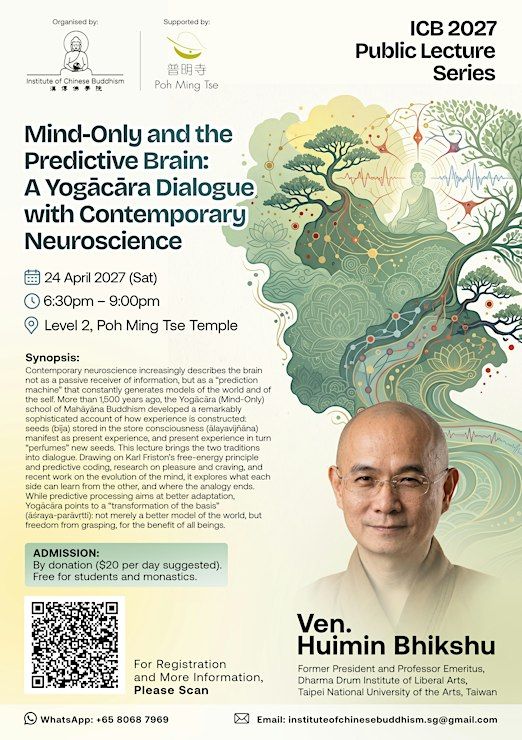
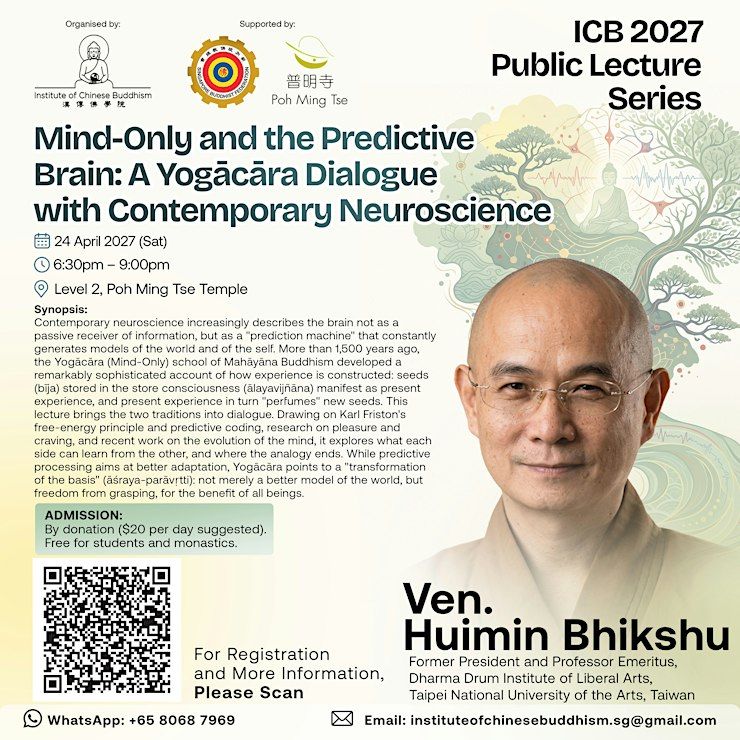
The Institute of Chinese Buddhism (ICB) warmly invites you to join our April 2027 Public Lecture, featuring Ven. Huimin Bhikshu, Former President and Professor Emeritus of Dharma Drum Institute of Liberal Arts, and Taipei National University of the Arts, Taiwan.
How does our mind construct reality? Can ancient Buddhist wisdom offer new perspectives on how the brain works?
For centuries, Buddhist philosophy has explored the nature of consciousness, perception, and the human experience. Today, modern neuroscience is investigating similar questions, revealing fascinating connections between how the brain processes information and how Buddhist teachings explain the workings of the mind.
Titled "Mind-Only and the Predictive Brain: A Yogācāra Dialogue with Contemporary Neuroscience," this lecture brings together two perspectives separated by more than 1,500 years: the Yogācāra (Mind-Only) school of Mahāyāna Buddhism and contemporary neuroscience.
Modern neuroscience increasingly describes the brain not simply as a passive receiver of information, but as a prediction machine that continuously generates models of the world and the self.
Similarly, Yogācāra Buddhist philosophy offers a sophisticated understanding of how our experiences are constructed through consciousness, including the concept of seeds (bīja) stored in the store consciousness (ālayavijñāna), which influence present experiences and future mental patterns.
Drawing on Karl Friston's free-energy principle, predictive coding, and research on pleasure, craving, and the evolution of the mind, Ven. Huimin will explore what these two traditions can learn from one another, where their similarities lie, and where their perspectives differ.
While neuroscience focuses on understanding and improving the brain's ability to predict and adapt, Yogācāra Buddhism offers a deeper spiritual objective: the transformation of consciousness and freedom from grasping for the benefit of all beings.
This lecture offers a unique opportunity to explore the intersection of Buddhist philosophy, consciousness, and modern neuroscience, encouraging participants to reflect on how we perceive ourselves and the world around us.
Whether you are interested in Buddhism, psychology, neuroscience, or the mysteries of human consciousness, this lecture welcomes everyone curious about the nature of the mind.
Lecture Details
Speaker: Ven. Huimin Bhikshu
Date: 24 April 2027 (Saturday)
Time: 6:30 PM – 9:00 PM
Venue: Level 2, Poh Ming Tse Temple
Format: In-Person Lecture
Admission: By donation (S$20 suggested)
Free admission for students and monastics.
Lecture Topic
Mind-Only and the Predictive Brain: A Yogācāra Dialogue with Contemporary Neuroscience
Explore the fascinating relationship between ancient Buddhist philosophy and modern scientific understandings of the brain.
This lecture examines how the Yogācāra school of Mahāyāna Buddhism explains consciousness and the construction of experience, and how these teachings compare with contemporary neuroscience's understanding of predictive processing.
Through this dialogue, participants will discover how both traditions approach questions about the mind, perception, and reality, while recognising their different aims and perspectives.
What to Expect
- Understanding the Predictive Brain: Discover how modern neuroscience describes the brain as a prediction machine that continuously constructs models of the world and the self.
- Exploring Yogācāra (Mind-Only) Philosophy: Learn how Buddhist teachings explain the construction of experience through consciousness, mental seeds, and store consciousness.
- Buddhism Meets Neuroscience: Explore the similarities and differences between Buddhist understandings of the mind and contemporary scientific theories.
- Understanding Craving and Mental Patterns: Examine research on pleasure, craving, and the evolution of the mind alongside Buddhist perspectives on consciousness.
- Beyond Understanding the Mind: Discover how Yogācāra's concept of transforming consciousness offers a spiritual perspective that extends beyond adaptation towards freedom from grasping.
Who Should Attend?
- Individuals interested in Buddhist philosophy, consciousness, and the nature of reality
- Buddhist practitioners seeking a deeper understanding of Yogācāra teachings
- Students, academics, and researchers interested in neuroscience, psychology, and philosophy
- Anyone curious about how the human mind works and how ancient wisdom relates to modern science
All are welcome. No prior knowledge of Buddhism or neuroscience is required.
About the Speaker
Ven. Huimin Bhikshu is the Former President and Professor Emeritus of Dharma Drum Institute of Liberal Arts and Taipei National University of the Arts, Taiwan.
In this lecture, Ven. Huimin brings Buddhist philosophical perspectives into dialogue with contemporary neuroscience, exploring how ancient teachings and modern scientific research can contribute to our understanding of consciousness and the human mind.
Registration
https://forms.cloud.microsoft/r/U1GD6t6e8Z
For enquiries, please contact:
WhatsApp: +65 8068 7969
Email: [email protected]
Organised by: Institute of Chinese Buddhism (ICB)
Supported by: Singapore Buddhist Federation and Poh Ming Tse Temple
Event venue & nearby stays
Poh Ming Tse Temple, 438 Dunearn Road, Queenstown, Singapore
 Concerts, fests, parties, meetups — all the happenings, one place.