About this Event
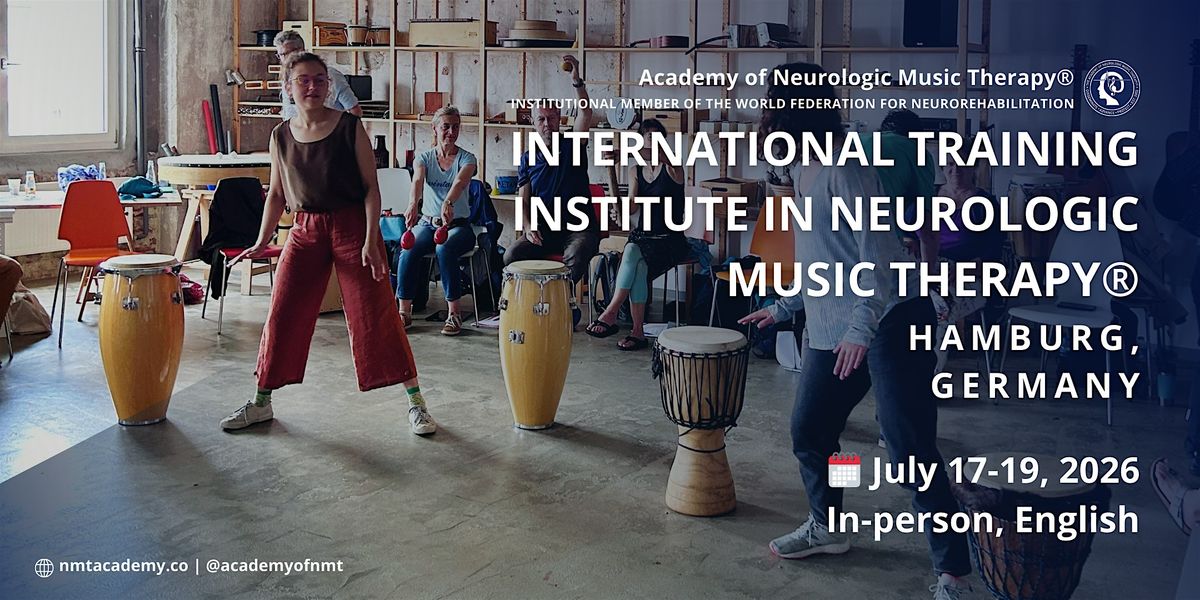
This hybrid training will provide participants with clinical training and scientific knowledge to practice within the NMT™ system within their professional scope of practice.
Part 1: June 17- July 16th - online asynchronous modules (20 hours)
Part 2: July 17-19th - in-person practice sessions (15 hours)
Participants will have access to the training modules from June 17-July 16th. Materials and presentations will be in English. In addition to asynchronous training modules to be completed on your own, in-person clinical practice sessions will be required to attend in Hamburg July 17-19th.
In-person participation in all synchronous portions of the training is required for successful completion of this training. All modules for each domain must be completed prior to the start of the practice sessions.
If you are interested in joining from a low-income, lower-middle income, or upper-middle income country (based on World Bank classifications), please reach out to the Academy at [email protected] for adjusted registration fees.
https://datatopics.worldbank.org/world-development-indicators/the-world-by-income-and-region.html
This International Training Institutes in Neurologic Music Therapy® is open to music therapists and music therapy students and who are interested in gaining a deeper understanding of Neurologic Music Therapy® (NMT™) and utilizing NMT™ methodology and techniques within their scope of practice.
Students who complete the training during their undergraduate or graduate music therapy program, prior to board certification or completion of their training as a music therapist, will need to complete an NMT™ Clinical Practice Workshop to receive their NMT™ designation. Once the NMT™ Student completes their training as a music therapist, they can register for a Clinical Practice Workshop at a discounted rate. Students must be in their third or fourth year of their bachelor's program or a master's level student to complete the training.
To uphold and maintain best practices of the Neurologic Music Therapy® (NMT™) system of standardized techniques, safeguard both the consumers of NMT™ and the public at large, and to preserve and protect the integrity of NMT™ for future generations, participants will sign a license agreement with the Academy of Neurologic Music Therapy® allowing one to practice the NMT™ System of Techniques and use the professional designation assigned for five years.
The Neurologic Music Therapy® (NMT™) System of Techniques is a standardized evidence-based clinical treatment system of 20 techniques that is driven by advances in applied auditory music neuroscience and the clinical understanding of music perception, production, and cognition. The NMT™ System targets specific functional behaviours in the areas of cognition, sensorimotor, and speech and language based on a client’s diagnostics and treatment goals. The NMT™ system provides structured music-based exercises that are not only relevant to NMT™ music therapists but exemplify how music can be integrated into intervention practices for all allied healthcare professionals, in the disciplines such as physical therapy, occupational therapy, neuropsychology, and speech-language pathology.
Communities served by NMT™ include, but are not limited to: acquired brain injuries, movement disorders, developmental disorders and ASD, AD, and other related dementia, and mental health. The NMT™ Techniques are implemented by therapists who have received advanced professional training through the Academy of Neurologic Music Therapy®.
Upon completion of this course, participants will:
1) Be able to demonstrate a basic definition and introductory knowledge about Neurologic Music Therapy® (NMT™), including the taxonomy of techniques used in NMT™;
2) Demonstrate an increased knowledge of current research supporting NMT™ techniques;
3) Demonstrate a working knowledge of the Transformational Design Model (TDM)™; a model to assist in treatment selection based on functional goals;
4) Identify current clinical assessments that can be used by NMT™ professionals for treatment evaluation;
5) Be able to answer basic neuroanatomy and pathology questions related to a variety of neurologic disorders.
Upon successful completion of this course and a written test, a certificate of completion in advanced Neurologic Music Therapy® (NMT™) training will be issued by the Academy for Neurologic Music Therapy®. Completion of the NMT™ training allows the music therapist to practice and use the credential of NMT™ for five years. There are no required prerequisites to take this training.
IMPORTANT INFORMATION AND FREQUENTLY ASKED QUESTIONS:
On June 17th you will receive the link to the training modules and practice materials. These modules must be completed prior to the in-person practice sessions. Two weeks prior to the in-person practice sessions, you will receive an email containing additional information for the location and schedule. A final schedule can be found in the link with the training materials 2 weeks prior to the practice sessions. General start and stop times will not change.
An electronic copy of the required training manual is covered under your registration fee. It will be essential to have this with you during the training.
A certificate of completion will be provided by e-mail at the end of the training. Please note that you must attend the training in its entirety to receive your certificate. Completion of the training in its entirety is expected to gain the NMT™ designation and certificate.
COURSE CURRICULUM:
Scientific Foundations of Neurologic Music Therapy® (NMT™)
Neuropathology/ Disease Review
Sensorimotor Techniques:
- Rhythmic Auditory Stimulation (RAS)®
- Pattern Sensory Enhancement (PSE)®
- Therapeutic Instrumental Music Performance (TIMP)®
Speech Techniques:
- Melodic Intonation Therapy (MIT)™
- Musical Speech Stimulation (MUSTIM)™
- Rhythmic Speech Cueing (RSC)®
- Vocal Intonation Therapy (VIT)®
- Therapeutic Singing (TS)™
- Oral Motor and Respiratory Exercises (OMREX)™
- Developmental Speech and Language Training Through Music (DSLM)®
- Symbolic Communication Training through Music (SYCOM)™
Cognitive Techniques:
- Musical Neglect Training® (MNT™)
- Auditory Perception Training (APT)™
- Musical Attention Control Training (MACT)™
- Musical Mnemonics Training (MMT)™
- Musical Echoic Memory (MEM)™
- Associative Mood and Memory Training (AMMT)™
- Musical Executive Function Training (MEFT)®
- Music Psychosocial Training and Counseling (MPC)™
APPROXIMATE TRAINING SCHEDULE-
Asynchronous component to be completed over a 30 day period:
(21.25 hours of video + assignments)
Introductory Modules: (4 hours)
- Intro to Principles of Neurologic Music Therapy (NMT)® (1.25)
- Neuropathology and Disease Review (.75)
- Transformational Design Model® (1.25)
- Rethinking the Role of Music in Neurodevelopmental Disorders (.75)
Speech/Language Modules: (5 hours)
- Melodic Intonation Therapy (MIT)
- Musical Speech Stimulation (MUSTIM)
- Rhythmic Speech Cueing (RSC)®
- Basic Principles of Singing
- Vocal Intonation Therapy (VIT)®
- Oral Motor and Respiratory Exercises (OMREX)™
- Therapeutic Singing (TS)™
- Developmental Speech and Language Training Through Music (DSLM)®
- Symbolic Communication Training through Music (SYCOM)®
Cognition Modules: (6.5 hours)
- Musical Sensory Orientation Training (MSOT)®
- Musical Attention Control Training (MACT)™
- Music Neglect Training (MNT)™
- Auditory perception Training (APT)™
- Musical Mnemonics Training (MMT)™ and Music Echoic Memory (MEM)™
- Associative Mood and Memory Training (AMMT)™
- Musical Executive Function Training (MEFT)®
- Music Psychosocial Training (MPC)™
- NMT Techniques with Developmental Disabilities (1.25)
Sensorimotor Modules: (4.5 hours)
- Patterned Sensory Enhancement (PSE)® (1.25)
- Therapeutic Instrumental Music Performance (TIMP)® (.75)
- Gait Assessment (1.25)
- Rhythmic Auditory Stimulation (RAS)® (2.5)
In Person Practice Sessions: (16.75)
Friday, July 17th, 2026 (6.5 hours)
9:00-9:30 Registration
9:30-10:30 Introduction
10:30-11:30 Speech/Language Technique Review/Q&A
11:30-11:45 Break
11:45-1:00 Speech/Language Practice Session
13:00-14:00 Lunch
14:00-14:30 Wrap up Scenario Presentations
14:30-16:00 Speech/Language Scenario Group Presentations
16:00-16:15 Break
16:15-17:00 Wrap up Speech/Language
Saturday, July 18th, 2026 (6.5 hours)
9:00-9:30 Registration
9:30-10:30 Cognitive Technique Review/Q&A
10:30-11:45 Cognitive Technique Practice Session
11:45-12:00 Break
12:00-13:00 Cognitive Scenario Group Presentations (Part 1)
13:00-14:00 Lunch
14:00-14:30 Cognitive Scenario Group Presentations (Part 2)
14:30-15:00 Wrap up Cognition
15:00-15:45 Sensorimotor Technique Review/Q&A
15:45-16:00 Break
16:00-17:00 Sensorimotor Practice Session #1- PSE/TIMP
Sunday, July 19th, 2026 (3.75 hours)
9:00-10:00 Sensorimotor Practice Session #2- PSE/TIMP
10:00-11:00 RAS Review/Q&A
11:00-11:15 Break
11:15-12:15 RAS Practice Session
12:15-1:00 Q&A/Wrap-up
This International Training Program of the Academy is endorsed by the World Federation of Neurologic Rehabilitation (WFNR), by the European Federation of Neurorehabilitation Societies (EFNS), and the International Society for Clinical Neuromusicology (CNM). Training is also approved by the U.S.Certification Board for Music Therapists (CBMT) as advanced provider for Continuing Music Therapy Education (CMTE) credits [The Academy for Neurologic Music Therapy, #P-105, maintains responsibility for program quality and adherence to CBMT policies and criteria].
The 32-hour Institute will provide the board-certified music therapist with 38 CMTE credits that can be applied towards recertification. Your certificate of completion can be submitted as proof of your attendance and participation. Completion of this course does not ensure that the participant is currently a Board Certified Music Therapist (MT-BC). Verify music therapy board certification status at www.cbmt.org
*******ACADEMY Teaching Faculty*******
Dr. Michael H. Thaut
Michael H. Thaut received his Masters in Music in 1980 and his PhD in music with a cognate minor in movement science in 1983, both from Michigan State University. He is also a graduate of the Mozarteum Music Conservatory in Salzburg/Austria. At Colorado State University he was a Professor of Music and a Professor of Neuroscience and served as CoDirector of the School of the Arts and Chairman of the Department of Music, Theater, and Dance from 2001-2010. He was also the director of the Center for Biomedical Research in Music for 11 years. He has been a Visiting Professor in medical and music schools around the world (Germany, Italy, USA, Japan), and 2010-2012 was chancellor of the University System of the SRH-Foundation Heidelberg. He currently is Professor of Music with cross appointments in Neuroscience and Rehabilitation Science at the University of Toronto where he directs the Music and Health Research Collaboratory (MaHRC) and the Masters/PhD programs in Music and Health Sciences. He has been a Visiting Professor in medical and music schools around the world (Germany, Italy, USA, Japan), and 2010-2012 was chancellor of the University System of the SRH-Foundation Heidelberg.
Dr. Thaut’s internationally recognized research focuses on brain function in music, especially time information processing in the brain related to rhythmicity and biomedical applications of music to neurologic rehabilitation of cognitive and motor function. He received the National Research Award in 1993 and the National Service Award in 2001from the American Music Therapy Association. He has over 120 scientific publications and has authored and coauthored 3 books. His works have appeared in German, Japanese, Korean, Italian, and Spanish language. Popular TV media and numerous print media have featured his research nationally and internationally.
As a former professional violinist in the classic and folk genre he has recorded several recordings of chamber and folk music in the US and Germany and has toured in Europe extensively with folk bands and chamber groups. He is also the author of a landmark anthology of Northern European and American fiddle music. In 1995 his group ‘Folk Chamber Ensemble ‘ played 3 invited concerts at the Northwest German Summer Music Festival entitled ‘Folk Meets Classic’. He continues to perform in small chamber and folk ensembles as time permits.
Dr. Corene P. Hurt-Thaut, Executive Director
Corene P. Hurt-Thaut received her master’s in music therapy, and her PhD. with an interdisciplinary focus of music, neuroscience and statistical design, from Colorado State University. She has been the Program Director for The Academy of Neurologic Music Therapy since 1997 and is currently an assistant professor, research associate, and coordinator of the MMus in Applied Music and Health at the University of Toronto, as well as an associate professor at the ArtEZ Conservatory in the Netherlands. Previously she served as a special assistant professor of music therapy at Colorado State University from 1997-2014, where she was also a research associate at The Center for Biomedical Research in Music from 1997-2015, and the co-founder and program director of The Unkefer Academy for Neurologic Music Therapy International Training Institutes and Fellowship Training for Neurologic Music Therapy since 1999.
Dr. Hurt-Thaut is nationally and internationally recognized for her clinical expertise in the evidence-based practice of Neurologic Music Therapy, with clinical experience including 3 ½ years as a music therapist at Wesley Woods Geriatric Hospital and the Center for Rehabilitation Medicine at Emory University Medical School in Atlanta, and 4 years as a Neurologic Music Therapist at Poudre Valley Hospital and The Center for Neurologic Rehabilitation in Fort Collins, Colorado. Her work has included a diverse range of clinical populations including stroke, Parkinson’s disease, traumatic brain injury, cerebral palsy, multiple sclerosis, Alzheimer’s disease, autism, and psychiatric disorders. She served on the exam committee for the National Certification Board for Music Therapy (CBMT) as both a member and Committee Chair from 2001-2006, and as an elected member of the CBMT National Board of Directors from 2009-2013. She has also served as President and Vice President of the Midwestern Region of American Music Therapy Association. Dr. Hurt-Thaut has numerous research publications in the area of music and motor control as well as ten book chapters highlighting specific applications of neurologic music therapy to her credit.
Suzanne Oliver, MT-BC, NMT Fellow
Suzanne Oliver is the Founder and Executive Director of Neurologic Music Therapy Services of Arizona/NMTSA, a nonprofit organization that has provided clinical music therapy services to the Phoenix community for over 32 years. She also founded a school for students with autism, approved through the Arizona Department of Education, in 2007. Suzanne is a Board Certified Music Therapist who received her NMT training in 1999, and additionally has completed three fellowships through the Center for Biomedical Research in Music since that time. Suzanne assisted in developing the Unkefer Academy for Neurologic Music Therapists at CSU and co-authored the Medical Coding and Records Manual: Neurologic Music Therapy. Her passion is to educate the community on current research regarding the impact of rhythm on the brain and how this knowledge can positively impact the treatment of individuals with neurologic differences and improve their everyday life.
Ruth Rice, DPT
Ruth Rice, Physical Therapist, has been involved with research on the effects of rhythm and music for neurological rehabilitation techniques for the last 20 years, and has also been a clinician treating orthopedic and neurological diagnoses for the last 22 years. Ruth received her Masters degree in Physical Therapy in 1988 and a Doctorate in Physical Therapy in 2008. She has been a clinician at Poudre Valley Hospital in Fort Collins for the last 20 years and also is an instructor/facilitator for 3 Neurologic Music Therapy community exercise groups per week, she also continues with research projects with the Center for Biomedical Research in Music at Colorado States University.
For more information about the curriculum, course objectives, and training schedule, visit http://nmtacademy.co, or contact Kimberly Albanowski at [email protected]
Event Venue & Nearby Stays
MSH Medical School Hamburg Campus Harburger Binnenhafen, Schellerdamm 22, Hamburg, Germany
EUR 374.09 to EUR 746.99