
About this Event
This two-day event brings together academic, policy, and industry perspectives to examine the reconfiguration of global energy security in the context of geopolitical tensions. Led by Dr Maísa Edwards (King’s College London) and Dr Rodrigo Pedrosa Lyra (Federal University of Pernambuco, Brazil), the event focuses on the Global South and the South Atlantic as emerging and underexplored arenas in global energy governance.
The programme combines expert-led lectures with applied, interactive workshops designed to translate academic research into policy-relevant insights. A core objective is to develop practical recommendations for UK and European energy diversification strategies, with particular emphasis on the strategic role of the South Atlantic.
Participants will engage with real-world case studies, scenario-based exercises, and collaborative policy design, culminating in a structured simulation exercise that tests policy pathways in a South Atlantic energy context.
This event is generously supported by the King's School of Security Studies (SoSS) Impact Fund.
Key Themes
Global energy security and geopolitical fragmentation.
- Energy transition and shifting global power structures.
- The South Atlantic as an emerging energy space.
- Critical minerals and global value chains.
- Energy cooperation across the Global North and Global South
- Policy pathways for UK and European energy diversification.
Format
The event combines:
- Morning lectures and Q&A sessions.
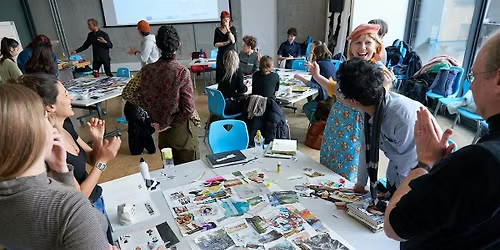
- Interactive workshops focused on mapping, scenario-building, and policy design.
- Applied group exercises translating research into policy tools.
- Collaborative drafting of a UK/EU policy brief.
- A final structured simulation exercise testing policy pathways.
Day 1 – Wednesday 8 July 2026
09:30 – 09:45 | Welcome and Introduction
Dr Maísa Edwards and Dr Rodrigo Lyra
09:45 – 10:45 | Lecture 1: Energy, Power, and the Reconfiguration of Global Order: An IPE Perspective
Dr Rodrigo Lyra
- Energy transition reshaping global power.
- Energy security driving geopolitical fragmentation.
10:45 – 11:30 | Guest Presentation and Q&A: Cristina Cortes
- Career reflections in oil and gas.
- Energy sector experience in Venezuela.
- Industry perspectives on geopolitical risk and cooperation.
11:30 – 11:45 | Break
11:45 – 12:30 | Guest Presentation and Q&A: Dr Clement Sefa-Nyarko
- Energy beyond geopolitics.
- Social licence and supply chain risks of critical minerals.
12:30 – 13:30 | Lunch Break
13:30 – 15:30 | Workshop 1
Dr Maísa Edwards
- Mapping global energy cooperation networks.
- Identifying risks and opportunities across regions.
- Translating cooperation models into policy tools.
- Applied group exercises.
- Strategic relevance of the South Atlantic for UK/EU energy diversification.
15:30 – 16:00 | Day 1 Wrap-Up Discussion
- Key insights.
- Framing questions for Day 2.
Day 2 – Thursday 9 July 2026
09:30 – 09:45 | Key Questions to Consider
- UK and EU energy diversification strategies.
- Strategic role of the South Atlantic.
- Policy relevance of cooperation frameworks.
09:45 – 10:45 | Lecture 2: The South Atlantic as an Energy Space
Dr Maísa Edwards and Dr Rodrigo Lyra.
- Strategic importance and underexplored potential.
- Supply chains, production, and cooperation.
10:45 – 11:00 | Break
11:00 – 12:00 | Lecture 3: Critical Minerals, Global Value Chains, and the South: Who Wins the Energy Transition
Dr Rodrigo Lyra
- Critical mineral geography in Brazil and South America’s strategic role.
- Global South opportunities and risks in mineral value chains.
12:00 – 13:00 | Lunch Break
13:00 – 15:00 | Workshop 2
Dr Maísa Edwards and Dr Rodrigo Lyra
- Scenario simulation: cross-regional energy futures.
- Negotiating partnerships across the Global South.
- Lessons for the UK and Europe.
- Group recommendations.
15:00 – 16:00 | Final Synthesis & Closing Session
- Policy implications and research insights.
- Consolidation of workshop outputs.
- Final structured simulation exercise testing UK/EU energy diversification pathways in a South Atlantic context.
- Closing remarks.
About the speakers
- Dr Maísa Edwards is a Lecturer in Foreign Policy and Grand Strategy Education in the Department of War Studies at King’s College London (King's). She holds a Joint PhD in International Relations from King's and the University of São Paulo, where her doctoral research focused on Brazil, the Zone of Peace and Cooperation of the South Atlantic (ZOPACAS), and the wider South Atlantic region. In addition to her lectureship at King's, she is a Research Fellow at the Department of Military History at Stellenbosch University and serves as Co-Convenor of the British International Studies Association (BISA) Foreign Policy Working Group (Nov 2025 – Present).
- Dr Rodrigo Pedrosa Lyra is an Assistant Professor of International Relations in the Department of Political Science at the Federal University of Pernambuco, Brazil. He holds a PhD in International Relations from the University of São Paulo and King’s College London, through a dual degree programme funded by the São Paulo Research Foundation. Rodrigo is also a Researcher at the Center for the Study of International Negotiations at the University of São Paulo.
- Dr Clement Sefa‑Nyarko is a UKRI Future Leaders Fellow and Lecturer in Security, Development and Leadership in Africa at King’s College London. He has extensive experience as an international development practitioner, having worked across Africa and the Asia-Pacific on issues of governance, natural resources, and social policy. His research focuses on critical minerals governance, theories of the state, environmental and social justice, leadership, and security. Dr Sefa‑Nyarko has designed and led multi‑country research and evaluation programmes in Ghana, Kenya, South Sudan and Nigeria, combining methodological innovation with participatory and community‑centred approaches. His UKRI Future Leaders Fellowship, ‘Justice in Critical Minerals Governance and Energy Transitions’, pioneers Hermeneutical Ethnography to examine how communities experience justice in mineral‑rich regions and to support more equitable governance of energy transitions. He has produced a wide range of publications, policy briefs and public analyses, contributing to debates on extractive politics, natural resource governance, and state–society relations in Africa. His work continues to shape thinking on bottom‑up approaches to justice, leadership, and sustainable development.
- Cristina Cortes is an experienced CEO with international experience in government, finance, energy and the NGO sector, and 30 years’ expertise in strategy, business development, government relations, commercial negotiations, financial management and thought-leadership. Her career as Commercial Director with BP included international business development, acquisitions and divestments, joint venture management, government relations, and commercial negotiations with a wide range of businesses and governments across Europe and Latin America. As Strategy Director for BP’s ethics and compliance function, she was responsible for the development and implementation of the company’s first Code of Conduct for 100,000 employees. Cristina joined Canning House – the UK’s leading forum for contacts, thought-leadership and pragmatic debate on Latin American political, economic, social and environmental trends and issues, and business risks and opportunities – in 2015 and was Chief Executive Officer from 2018 until 2022. Of Anglo-Brazilian descent, Cristina speaks English, Spanish and Portuguese and has lived and worked in Europe, the USA and Latin America. She divides her time between London, Granada, and extensive travels in Latin America, is involved in several Brazilian non-profit activities, and is the current Chair of the Anglo-Brazilian Society.
Event Venue & Nearby Stays
Franklin-Wilkins Building, FWB 1.19, London, United Kingdom
USD 0.00