

About this Event
Organised by University of Edinburgh International Law Reading Group Convenor's Alexandrine Lamarre, Kağan Sürücü, Lucy Tomkins, Rota Shima and the Edinburgh Centre for International and Global Law.
Global Law Conference
University of Edinburgh Centre for International and Global Law (CIGL), and the International Law Reading Group (ILRG) is jointly organising the University of Edinburgh Global Law Conference, a two day conference on 30 April and 1 May 2026 aiming to gather research that can demonstrate the multifaceted nature of global law, its explanatory power of the contemporary legal order, and deepen the understanding of legal scholarship on the role global law plays to respond to current and future challenges. The conference is held in person only at the University of Edinburgh Old College.
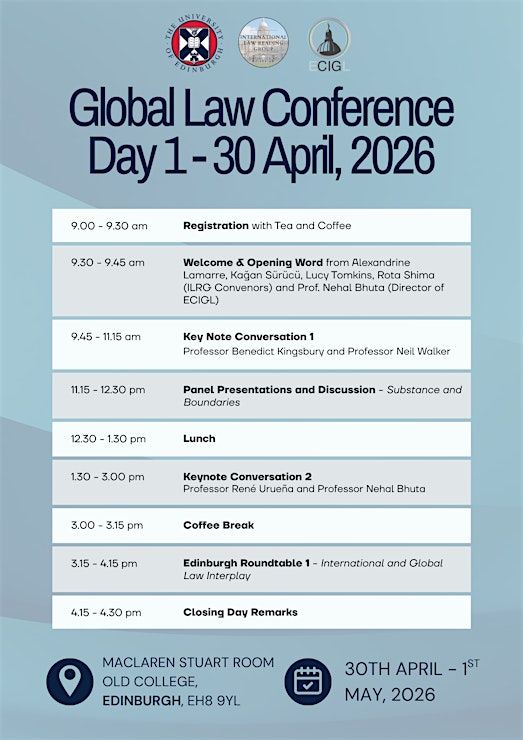
Day 1: What is Global Law?
Day 1 will focus on the overarching question ‘What is Global Law?’. Global law is an intentionally broad, and inherently flexible concept. As a result, it can be used by various legal disciplines in different ways. Global law could refer to the nature of lawmaking under globalised world, and could be conceptualised to have a stronger focus on the legal order created and sustained through non-state entities, such as international organisations, NGOs, or other transnational networks and communities. It can also be conceptualised as the form of legal order that tackles with issues that are beyond the boundaries of states. It can refer to the plurality of legal systems, demonstrating the variety and significance of local and regional legal systems across the “globe” beyond prevailing systems. Focusing on this inherently multifaceted nature of this concept, Day 1 will explore various ways of understanding global law, and what it means for different fields of law.
The day will start with an opening speech by Prof. Nehal Bhuta, Director of the CIGL, and the Convenors of the ILRG. Subsequently, there will be a keynote conversation between Prof. Benedict Kingsbury and Prof. Neil Walker on the theme of the day,followed by a panel session and a second keynote conversation between Prof. René Urueña and Prof. Nehal Bhuta. The day will conclude with a roundtable with University of Edinburgh researchers.
The themes of the panel and roundtable for that day could be found below:
Panel 1: Substance and Boundaries
This panel will aim to delineate “global law” as a field through its substance as well as the boundary-work expressed by the actors of the field. The panel will ask how global law can be conceptualised with its own unique characteristics. It aims to understand the field’s traditions, constitutive epistemologies, normative affinities, political economy, sources of authority and argumentative techniques.
Edinburgh Roundtable 1: International and Global Law Interplay
The Roundtable will explore what a growing field of global law means for the discipline of international law. On the one hand, the discussion will evolve around fundamental issues on the raisons d’être as well as the parameters that define and differentiate the two fields. On the other hand, weaknesses, overlaps and potential challenges between those fields will also be explored, whereas it may be of interest to inquire whether and why global law and international law (c/should) interact in the first place, and whether and how the two fields can supplement each other.
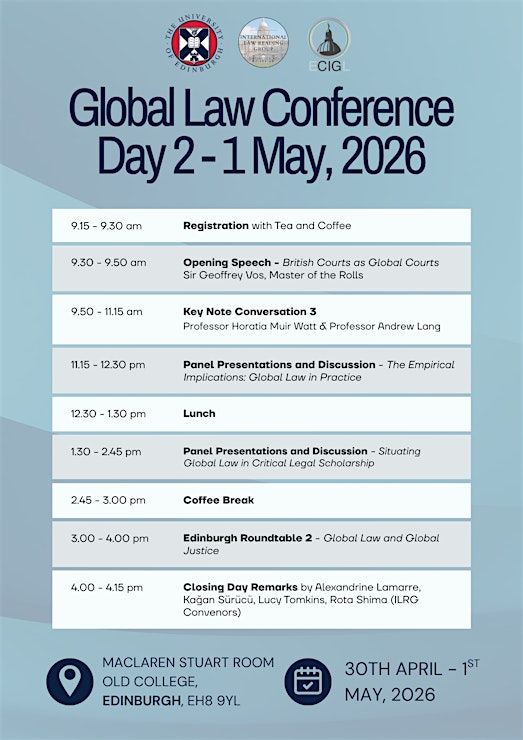
Day 2: Challenges to Global Law
Day 2 of the conference will focus on ‘Challenges to Global Law’. Under this theme, we will focus on the contribution of the concept of global law to the contemporary legal order. Connecting to our discussion on different ways of defining global law, the panels will explore the utility of adopting the language of global law in different fields, potential challenges and issues that global law could respond to and also, existing shortcomings and challenges of using the concept of global law itself.
Day 2 will start with the opening speech of Sir Geoffrey Vos, Master of the Rolls, followed by a keynote conversation between Prof. Horatia Muir Watt and Prof. Andrew Lang. Following this, there will be two panel sessions and a second roundtable with University of Edinburgh researchers. The themes for the panels and the roundtable are the following:
Panel 2: The Empirical Implications: Global Law in Practice
This panel will inquire into the empirical implications of global law, with a view of global law in the context of legal practice. The overarching theme will be what the theory of global law means in the professional field. This includes the questions of what “practice” of global law means and where it can be identified. This panel also welcomes contributions to address issues broadly related to the assessment of the merits and challenges of global law in practice, as well as what problems it can practically solve (or not solve).
Panel 3: Situating Global Law in Critical Legal Scholarship
This panel will delve into the relationship between ‘global law’ and critical scholarship. The panel interrogates the aspirational components of global law and whether this field has a place in critical scholarship. As discourses of global law can be accompanied by claims of universalism, this asks the extent to which global law scholars have affinities with critical sensibilities. Further, the panel will ask how critical legal scholars can engage in meaningful criticism of a field that is characterised by diffused boundaries.
Edinburgh Roundtable 2: Global Law and Global Justice
This Roundtable will address the relationship and tension between global law and the project of global justice. The Roundtable will focus on whether global law discourse could assist in articulating a novel framework of global justice and if so, how it suggests providing or shaping institutional and social solutions to answer a need for justice. The Roundtable will be invited to examine any existing or potential contributions to global justice from the emerging global law projects and focus on how global law can facilitate addressing global justice, demonstrating any potential normative affinities and opportunities for cross-fertilisation between these two concepts.
Logistics
The conference will be held in person at the University of Edinburgh Old College, MacLaren Stuart Room and Quad Teaching Room on 30 April and 1 May 2026.
All substantive conversations and panels will be held at the MacLaren Stuart Room.
Throughout the conference, refreshments and lunch will be provided at the Quad Teaching Room.
Convenors and Organisers:
Alexandrine Lamarre - [email protected]
Kagan Surucu - [email protected]
Lucy Tomkins - [email protected]
Rota Shima - [email protected]
Please feel free to send your questions to our email - [email protected], and follor our for further updates about the conference and other events organised by the ILRG.
Conference Schedule
Event Venue & Nearby Stays
Old College, The University of Edinburgh, South Bridge, Edinburgh, United Kingdom
GBP 0.00