About this Event
Join us for a special International Book Club featuring with author and professor Kate Brown. This event is also part of Earth Fest at UW-Madison.
Register for a chance to receive one of 20 free copies of the book!
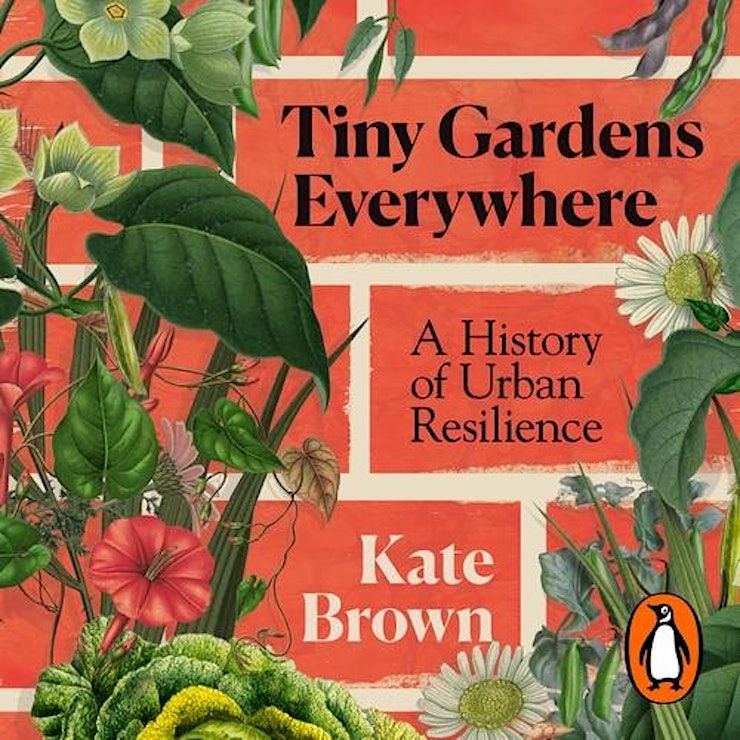
Tiny Gardens Everywhere: The Past, Present and Future of the Self-Provisioning City
From the eighteenth century to the twenty–first, the surprising history and inspiring contemporary panorama of urban gardening: nurturing health, hope, and community.
This manifesto for the next food revolution by acclaimed environmental historian Kate Brown speaks to nature lovers, food activists, social–justice warriors, urban planners, WOOFers, and the climate–concerned.
Ever since wage labor in cities replaced self–provisioning in the countryside, gardeners have reclaimed lost commons on urban lots. They composted garbage into topsoil, creating the most productive agriculture in recorded human history, without use of fossil fuels. The ecological diversity they fostered made room for human difference and built prosperity, too: in Nazi Berlin, working–class gardeners harbored dissidents and Jews; in Washington, DC, Black southern migrants built communities around gardens and orchards, the produce funding homeownership.
Grafting contemporary experience and concerns onto every historical chapter, Kate Brown creates a mesmerizing hybrid past and present, archive and experience, showing how down–to–earth gardeners can reap abundant harvests while fostering mutual aid and political engagement.
About Kate Brown
Kate Brown grew up in Elgin, Illinois, a rustbelt community near Chicago. She attributes her attraction to modernist wastlands to a childhood in Elgin ghosting through empty buildings wondering who was the last to turn out the lights. Read more here.
Brown has an undergraduate degree from UW/Madison and a PhD from the University of Washington/Seattle. She started her career at UMBC in Baltimore. She is currently the Thomas M. Siebel Distinguished Professor in the History of Science at the Massachusetts Institute of Technology. Brown's work is distinguished by its combination of archival research, oral history, sensory observation, reflective autobiography, and innovative literary form in the writing of history.
Brown is the founding editor of History Unclassified, a section of the American Historical Review. History Unclassified enourages authors to cross boundaries, undermine binaries, and encourage experimentation in the AHR, the flagship journal of the historical profession. The idea of History Unclassified is to create a space for thinking differently about what forms history can take.
Kate Brown has written five books. Manual for Survival (2019), a ground-level study of the medical and environmental impacts of the Chernobyl nuclear disaster, was described by The Economist as “a magisterial blend of historical research, investigative journalism, and poetic reportage. In 2015, Brown published Dispatches from Dystopia, a collection of essays about the making and unmaking of historicaly narratives. She is the only historian ever to receive the United States’ highest scholarly prizes in Russian studies, U.S. history, Western history, environmental history, and the history of the Americas—all for the same work, Plutopia, a comparative study of nuclear production and social transformation in the Cold War United States and the Soviet Union. Brown recently completed a global history and future of urban farming called Tiny Gardens Everywhere (Norton and Bodley Head (UK) 2026). Brown’s first book, A Biography of No Place, is about the creation of ethnic identity and the cleansing of ethnic minorities in Ukraine during the Stalinist period.
Brown has been the recipient of many of the signature honors in the arts and humanities. These include fellowships from Guggenheim Foundation, the Carnegie Foundation, the National Endowment for the Humanities, the American Council of Learned Societies, the Netherlands Institute for Advanced Study, and the Berlin Prize Fellowship.
This event is co-sponsored by the Center for Culture, History, and Environment, Center for Integrated Agricultural Systems, Center for the Humanities, Community and Environmental Sociology, Department of Geography, Department of History Food Studies Network, IRIS NRC, and the Kemper K. Knapp Bequest Fund.
Event Venue & Nearby Stays
Conrad A. Elvehjem Building *Room L140*, 800 University Avenue, Madison, United States
USD 0.00