About this Event
A fantastic author talk that you don't want to miss!
We all feel it, the teetering toward a place in America from which there is no return. The battle to remain hopeful in spite of injustice after injustice. In this powerful story of one lawyer’s fight for his community, both justice and hope are redeemed.
The Greenwood neighborhood of North Tulsa was once a promised land for African Americans, deemed “Black Wall Street.” But on May 31, 1921, the deadliest race massacre in U.S. history sent Greenwood up in flames. At the time, Lessie Randle was just a child running to safety as bullets ricocheted around her. Almost a century later, lawyer Damario Solomon-Simmons knocks on her door asking if she’d be willing to run toward justice this time.
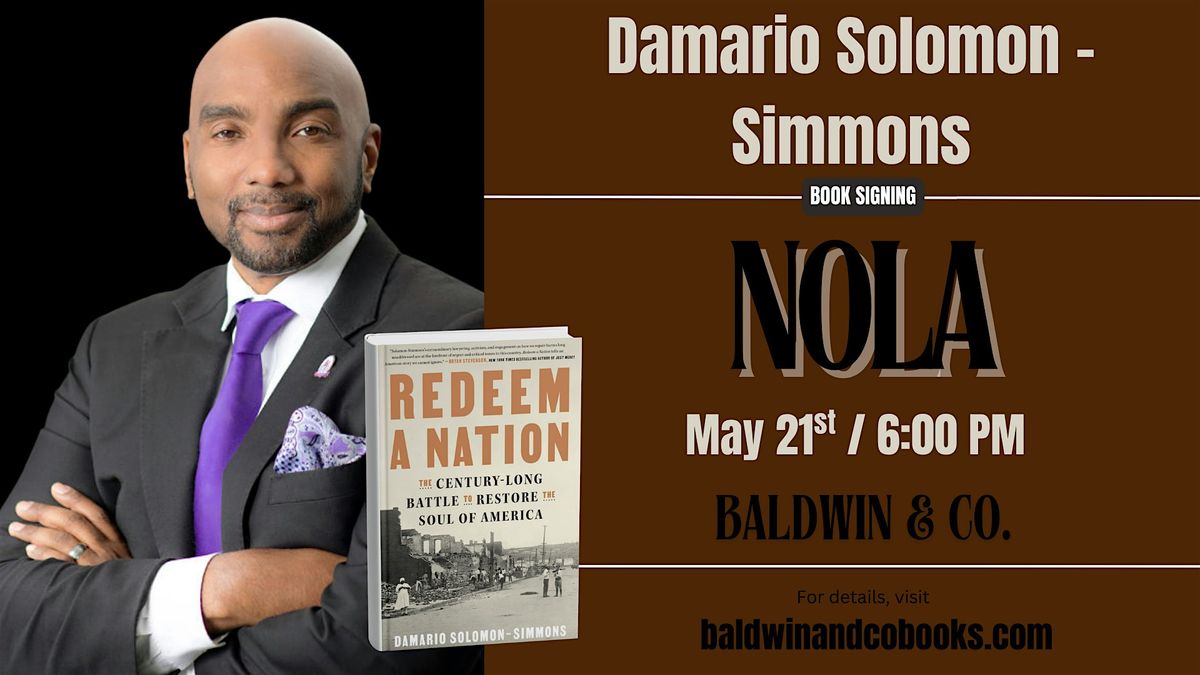
In Redeem a Nation, we follow Solomon-Simmons’s fight for justice, from the courtrooms of Tulsa to our nation’s capital, representing three centenarians: the last survivors of the Tulsa Race Massacre. Documenting a race against the calendar and the courts, Redeem a Nation grapples with the truth about corruption and disenfranchisement in America through this historic legal case for reparations and the deeply moving stories of survivors and descendants of the Massacre.
Yet this isn’t just a story of Tulsa. The community is a microcosm of the continued harm America inflicts through racial violence and economic injustice. The damage of generational poverty and loss of opportunity isn’t some relic of the past. It is happening right now. Redeem a Nation offers a way forward for communities across the nation through systemic change and community love. The Time is now to resist, repair, and redeem a land once promised.
“You think we can win?” Randle asked that day. This story is Solomon-Simmons’s answer.
Despite North Tulsa, Damario Solomon-Simmons' hometown, once being the mecca for Black wealth, north Tulsans don't own land or property, don't have access to inheritance or generational wealth, and mostly live paycheck to paycheck with little opportunity for climbing out of the crushing hole of poverty. We see through young Damario's eyes-and the subtle and direct racism he faces-that Tulsa hasn't shed its racist roots. Combining his own experience and the evocative portrait of a city suffering under one hundred years without repair, Redeem a Nation acknowledges why restorative justice is urgent and critical. We must address the systemic barriers that continue to perpetuate inequality and provide the necessary resources for individuals and communities to thrive. Riveting and unflinching, Redeem a Nation presents a compelling case for reparatory justice and reminds us of our collective responsibility to dismantle the structures that perpetuate inequality and suffering. Redeem a Nation grapples with the monumental story of corruption, disenfranchisement, and poverty in America through the historic, complex legal case for reparations in Tulsa and the deeply personal and evocative stories of the last living victims of the Tulsa Race Massacre and their descendants. It explores the moral obligation to seek justice and rectify both the past and present to forge a more equitable America in the face of its current deconstruction. Redeem a Nation reveals how the damage of generational poverty and loss of opportunity isn't some relic of the past. It is happening right now, in towns and cities all over the United States. From Tulsa to Chicago, Redeem a Nation offers a way forward through real systematic change and community care.
Damario will be joined in conversation with Gary Chambers
Damario Solomon-Simmons is one of the nation’s leading racial-justice attorneys, civil-rights strategists, and movement-builders. For over two decades, he has turned the fight for justice into measurable, historic impact—securing landmark legal victories, shaping national policy, and redefining the conversation around repair and accountability.
Raised in Tulsa’s historic Greenwood community by a single mother, Damario’s journey reflects the very struggle he now champions. Once a high school student who graduated near the bottom of his class and dropped out of college, he rebuilt his life through faith, discipline, and mentorship—eventually returning to the University of Oklahoma, where he played football and graduated with honors, becoming the first African American to receive the Joel Jankowsky Award for Most Outstanding Law Graduate.
Today, he serves as Managing Partner of SolomonSimmonsLaw and Founder & President of Justice for Greenwood (JFG)—the small nonprofit leading the national fight for reparations, legacy justice, and descendant-centered equity. His landmark victories include enforcing the 1866 Treaty to restore citizenship rights to Black Creek Freedmen, architecting Tulsa’s $105 million Road to Repair framework, prompting the U.S. Department of Justice’s first-ever investigation of the Tulsa Race Massacre, and securing historic racial-discrimination settlements for athletes and victims of police violence.
Through Justice for Greenwood, Damario leads a multidimensional movement spanning litigation, policy, genealogy, and storytelling—advancing national recognition through the We Are Greenwood oral-history project and other descendant-centered initiatives. He also represents the last three living survivors of the 1921 Tulsa Race Massacre, ensuring their voices remain central to America’s pursuit of remembrance and repair.
Based in Tulsa, he lives with his wife and creative partner, Mia, and their two dogs, Marley and Beans. Outside the courtroom and classroom, Damario lives a plant-based lifestyle and is deeply committed to fitness, walking, meditation, and fishing—practices that renew his focus and sustain the peace required for his life’s work.
Gary Chambers, an entrepreneur and co-founder of the media outlet, The Rouge Collection, is a noteworthy social justice advocate and community organizer who has been featured in outlets such as 225 Magazine (2017 People to Watch edition), Wired Magazine, The New York Times, CNN, Morning Joe, and Roland Martin Unfiltered for his tireless efforts in advancing the most disenfranchised communities across Louisiana. As an advocate, his work has contributed to advancements in the justice system, healthcare access, and to equality in the municipal contracting process for minority owned businesses.
Louisiana has been burdened with the type of inequity that can only be resolved through fearless representation on its behalf. Chambers has a courageous vision to bring resources back to the people of Louisiana, and is guided by the belief that we can lead this nation from the bottom of the map.
Event Venue & Nearby Stays
1030 Elysian Fields Ave, 1030 Elysian Fields Avenue, New Orleans, United States
USD 0.00 to USD 36.69