
About this Event
Issue
Elicitation is remarkable in its averageness, practicality, and ability to free persons to accomplish themselves. Its core operations are common to sales, marketing, business, negotiations, polling, personal relationships, police investigations, psychological and intelligence operations, social engineering, user recommendation systems, software development, customer sentiment analysis, and artificial intelligence (AI). Its power is not confined to elicitation techniques or human susceptibilities, however. It corresponds to the ability to mindfully avail common sense to associatively evoke a reciprocity of "in-order-to" and "because" motives between the elicitor and his target.
Response
This two-day workshop (1) reduces elicitation to its basic system and phenomenological operations; (2) teaches the thinking, demeanor, and disposition requisite to eliciting effectively and evoking a reciprocity of “in-order-to” and “because” motives between the elicitor and his target; (3) transmutes the analytical understanding of elicitation into an intuitive one that optimizes its operationalization, and; (4) enables a more comprehensive understanding of the phenomenon than is available through standard USG briefings or studies of elicitation techniques and susceptibilities. The workshop includes discovery sessions, knowledge checks, and exercises.
Key Performance Indicators (KPIs)
- Greater elicitation fluency and ability to defend against elicitation attacks.
- Improved sales, negotiation, and marketing.
- Improved ability to understand and manage personal and professional relationships.
- Elucidation of everyday understanding and thinking.
- Improved common-sense acumen and mindfulness.
- Clarification of cognitive operations commonly specified for computational simulation (AI).
Teaching Method
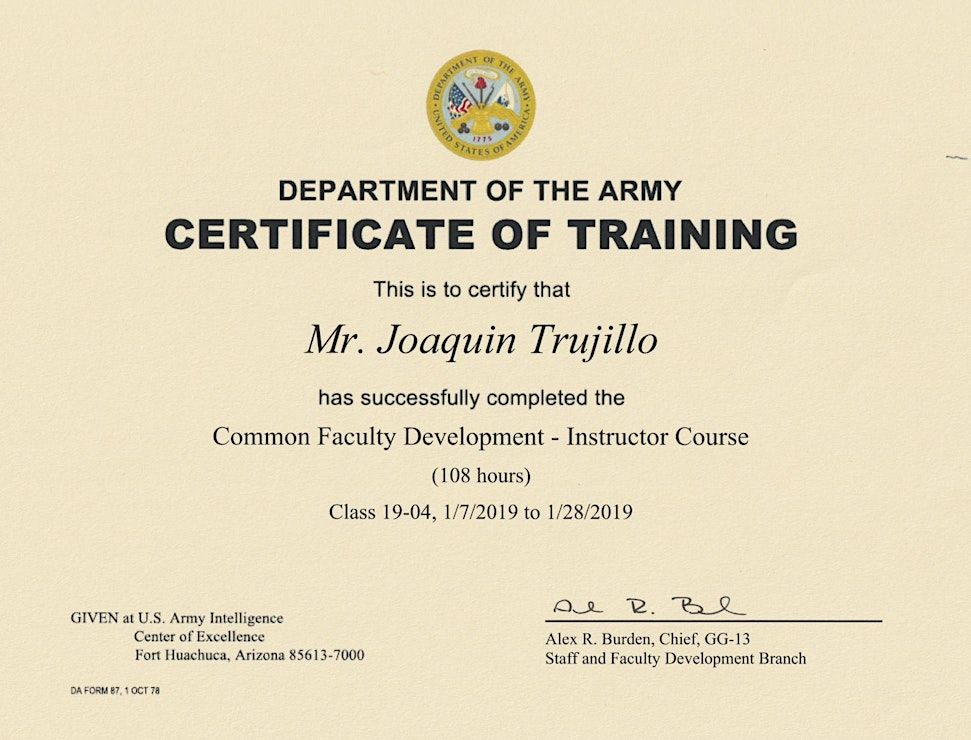
Sigetic training and seminars subscribe to the teaching principles extended upon by the US Army Common Faculty Development - Instructor Course (CFD- IC). The CFD-IC combines the outcomes of the Army Basic Instructor Course (ABIC), the Small Group Instructor Training Course (SGITC), and the Faculty Development Program Phase 1 (FDP1). It is the “gold standard” of adult learning. Its methodology — which includes discovery sessions, knowledge checks, and exercises — enables clients to optimize learning fast. The author obtained his CFD-IC certification in 2019.
Workshop author and presentor
Joaquin Trujillo PhD — Sigetic CEO/CTO — is a former Central Intelligence Agency (CIA) Operations Officer and holds a PhD in Sociology from Florida International University (FIU). His CIA service comprised tours in Europe, the Middle East, one combat zone, and designations as Acting Chief of Station (ACOS) and Acting Chief of Base (ACOB). He regularly coaches US military and Special Forces in the team, leadership, communicative, and high reliability processes ingredient to successful intelligence and psychological operations during war and evaluates their performance against those variables. His scientific work exhibits basic human phenomena — including thinking, intelligence, conscientiousness, common sense, and teams — in advanced technologies and high risk systems. It also discerns the cognitive operations commonly specified for computational simulation (AI).
Contact Information and Cancellation Policy
Sigetic is scientific and operations consulting firm based in Houston, TX. See https://sigetic.com for further information.
Please send queries to Sigetic CEO/CTO — Joaquin Trujillo PhD — at [email protected].
The exact venue address is provided upon registration. Lunch and refreshments are provided.
Public metered street parking is available. A paid private parking garage is also available. The venue is accessible by public transportation.
Full refunds for workshop registration MINUS EVENTBRITE SERVICING AND PROCESSING FEES are available for cancellations executed 48 hours prior to the scheduled course date and time . Cancellations less than 48 hous before the course date and time are not refundable.

Agenda: Day 1
1. Introduction
2. Question of Elicitation
3. Elicitation: Review
4. Cybernetics: Systems
5. The Elicitation System
6. Phenomenology: Consciousness
7. Consciousness to Elicitation
8. Typifications
9. Typical Understanding and Thinking
10. Elicitation: Reciprocity of Motives
11. Common Elicitation Techniques
12. After Action Review (AAR): Medial
Agenda: Day 2
1. Eliciting Effectively
2. Eliciting Intelligently and Mindfully: 8 Components
3. Internal Contradictions
4. Effects
5. Equifinalities
6. After Action Review: Final
Event Venue & Nearby Stays
River Oaks District, River Oaks District, Houston, United States
USD 743.46