

About this Event
Welcome to the In-Person ACBS Chicago 2026 Spring Conference!
Come join us for a day filled with learning and networking at: 25 E Pearson St. CLC L14 ( that's the room number), Chicago, IL 60611. Get ready to connect with fellow professionals in the field and expand your knowledge of Acceptance and Commitment Therapy (ACT) and Contextual Behavioral Science (CBS)!
Don't miss out on this opportunity to immerse yourself in a day of insightful discussions and engaging workshops. Whether you're a seasoned practitioner or just starting out, this event is perfect for anyone looking to deepen their understanding of ACT and CBS. Our morning workshop will be Mapping What Matters: A CBS Approach to Identity, Intersectionality, and Equality followed by the afternoon workshop, ACT for Behavioral Addictions: A Shame-Free Approach. See the agenda below for more details!
CEs are available via the APA for psychologists, social workers, counselors, and marriage and family therapists as well as for BCBAs through Guiding Behavior Counseling (a BACB approved continuing education (ACE) provider) for $15 per workshop, along with the pricing on the event poster.
Mark your calendars and get ready for a day of growth and connection at the ACBS Chicago 2026 Spring Conference!
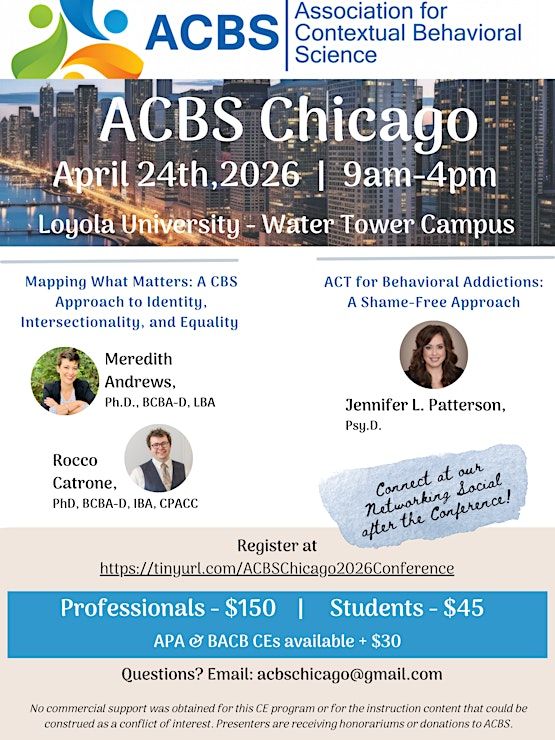
Mapping What Matters: A CBS Approach to Identity, Intersectionality, and Equality will be cofacilitated by Meredith Andrews and Dr. Rocco Catrone!
Meredith Andrews and is a behavioral scientist and educator committed to contextually responsive, human-centered applications of behavior analysis in complex real-world settings. With training in behavior analysis and marriage and family therapy, her interests center on how behavior is shaped by individual learning histories and broader familial and cultural systems. She serves as the Associate Director of Clinical Training in the Applied Behavior Analysis Division at The Chicago School. Her work focuses on training and supervision, language and cognition, mindfulness-based approaches, ethics, and social justice.
Dr. Rocco Catrone (he/him) has worked in the field of disabilities and behavior analysis since 2011, beginning as a program aide in a special education school before serving as an in-home therapist and later pursuing graduate studies at Southern Illinois University–Carbondale (SIU-C). After managing in-home ABA teams, he transitioned to a children’s hospital, focusing on building supportive environments for parents and staff working with children diagnosed with developmental disabilities. Through his research lab, Behavioral Leadership in Education, Novel Science, and Dissemination (BLEND), he develops effective training methods for caregivers and healthcare professionals while also studying disability stigma to create protocols that reduce prejudice and improve support systems. His work has secured thousands of dollars in grant funding and contributed to publications and conference presentations, with a mission rooted in empowering families and promoting inclusive care informed by his lived experience as an individual with learning disabilities.
Mapping What Matters: A CBS Approach to Identity, Intersectionality, and Equity
Abstract and Learning Objectives:
This experiential workshop examines identity and intersectionality through a contextual behavioral science (CBS) lens, with a focus on promoting equity and inclusion across professional and community settings. Designed for a broad ACBS audience (novice to intermediate), the session blends theoretical foundations with hands-on activities, such as identity and resource mapping, to examine how individual and cultural variables shape experiences and access to resources. Participants will leave with tools and concrete steps to support equity and inclusion in the services they provide to their community. By the end of the workshop, participants will:
1. Explain intersectionality through a CBS lens by describing how relational framing contributes to identity construction, social positioning, social stigma, and meaning making across multiple intersecting identities (e.g., disability, race, class, profession).
2. Apply identity mapping as a functional analytic tool, examining how one’s learning history and context influence resource access, experience, and behavior across settings.
3. Construct a resource map that links intersecting identities with community assets to analyze system-based contingencies that amplify or reduce inequity for others.
4. Develop concrete, first-step implementation plans for equitable practice by incorporating identity- and resource-mapping into one’s professional work.
ACT for Behavioral Addictions: A Shame-Free Approach will be led by Jennifer Patterson, Psy.D., LCPC, a psychologist dedicated to providing evidence-based psychotherapy that helps individuals build full and meaningful lives. She is the founder of JPI Psychological Solutions in Chicago, Illinois, where she specializes in treating obsessive-compulsive behaviors, behavioral addictions, anxiety, and depression. Her clinical approach integrates Acceptance and Commitment Therapy (ACT) and other third-wave behavioral models to support lasting well-being.
Dr. Patterson is a recognized ACT trainer, consultant, and author. Her book, The ACT Workbook for Behavioral Addictions, offers practical, values-based tools for individuals and clinicians navigating compulsive and addictive behavior patterns.
Through her expertise in contextual behavioral science, Dr. Patterson continues to shape the field of psychotherapy by providing training, consultation, and guidance to practitioners and organizations seeking to deepen their understanding and application of ACT.
Learning Objectives:
1.Build a foundational understanding of behavioral addictions
- Define behavioral addictions and recognize common presentations.
- Describe prevalence, risk factors, and the biopsychosocial mechanisms that contribute to their development.
- Identify the personal, relational, and societal impacts of behavioral addictions.
2. Strengthen assessment and diagnostic skills
- Use validated screening tools to identify behavioral addictions.
- Apply DSM-5 and ICD-11 criteria through case-based learning to enhance diagnostic accuracy.
3. Understand core ACT principles relevant to addiction treatment
- Explain psychological flexibility and the six ACT processes within the Hexaflex model.
- Describe how ACT conceptualizes addictive behavior and avoidance patterns.
4. Apply ACT interventions to behavioral addictions
- Tailor ACT strategies to assist individual client needs with behavioral addictions.
- Practice ACT-based exercises and interventions for craving management, behavior change, and relapse prevention.
5. Integrate ACT into real-world clinical practice
- Work through case examples to apply ACT from assessment to intervention.
- Identify resources, referrals, and ongoing supports that promote sustainable recovery.
“ACT for Behavioral Addictions: A Shame-Free Approach” offers clinicians a practical, compassionate framework for supporting clients struggling with behavioral addictions, including pornography use, disordered eating, compulsive internet use, and other repetitive patterns that interfere with living well. This training equips therapists with evidence-based strategies to understand the function of addictive behaviors, reduce shame, and create a therapeutic space where clients feel safe enough to explore their struggles honestly.
Grounded in the principles of Acceptance and Commitment Therapy (ACT), the session highlights how mindfulness, acceptance, and values-based action can help clients loosen the grip of urges, cravings, and avoidance. Participants will learn how to apply ACT processes to help clients build psychological flexibility, reconnect with what matters most, and take meaningful steps toward recovery. Through a blend of conceptual teaching and practical application, this course empowers practitioners to guide clients toward lasting change rooted in compassion, clarity, and values-driven living.
Agenda
🕑: 09:00 AM - 12:00 PM
Mapping What Matters: A CBS Approach to Identity, Intersectionality, & Equalit
Host: Meredith Andrews, BCBA-D
🕑: 12:00 PM - 01:00 PM
Lunch break!
Info: Lunch can be obtained among the many restaurants located in downtown Chicago! Feel free to order ahead of time to pick it up or have it delivered!
🕑: 01:00 PM - 04:00 PM
ACT for Behavioral Addictions: A Shame-Free Approach
Host: Dr. Jennifer L. Patterson
🕑: 04:30 PM - 05:30 PM
Social hour!
Info: Join us for some networking and social time following the afternoon workshop! Location TBD!
Event Venue & Nearby Stays
25 E Pearson St, CLC L14, 25 East Pearson Street, Chicago, United States
USD 45.00 to USD 180.00