About this Event
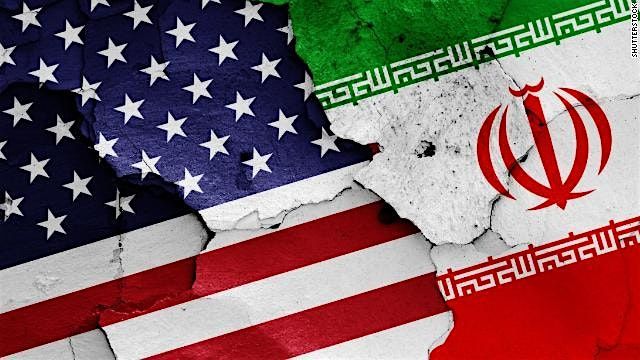
In the first event, Professor Daniel Sargent (UC Berkeley) helped us understand the history of U.S.-Iran relations that got us to this point. In the second event, Professor Stephen Zunes (USF) helped us connect that history to the present.
Finally, in our last event, Professor Scott Sagan (Stanford) will show us what is next. As a nuclear security and nonproliferation expert, Prof. Sagan will guide us through the decisions being made by the U.S. and Iran in the present day and help us understand what we can expect next in this crazy war. We will discuss the nuclear program, military actions, and the desired outcomes of the U.S. and Iran.
_________________________________
Scott D. Sagan is Co-Director and Senior Fellow at the Center for International Security and Cooperation, the Caroline S.G. Munro Professor of Political Science, and the Bass University Fellow in Undergraduate Education at Stanford University. He also serves as Co-Chair of the American Academy of Arts and Sciences’ Committee on International Security Studies. Before joining the Stanford faculty, Sagan was a lecturer in the Department of Government at Harvard University and served as special assistant to the director of the Organization of the Joint Chiefs of Staff in the Pentagon.
Sagan is the author of Moving Targets: Nuclear Strategy and National Security (Princeton University Press, 1989); The Limits of Safety: Organizations, Accidents, and Nuclear Weapons (Princeton University Press, 1993); and, with co-author Kenneth N. Waltz, The Spread of Nuclear Weapons: An Enduring Debate (W.W. Norton, 2012). He is the co-editor of Insider Threats (Cornell University Press, 2017) with Matthew Bunn; and co-editor of The Fragile Balance of Terror (Cornell University Press, 2022) with Vipin Narang. Sagan was also the guest editor of a two-volume special issue of Daedalus: Ethics, Technology, and War (Fall 2016) and The Changing Rules of War (Winter 2017).
Recent publications include “Kettles of Hawks: Public Opinion on the Nuclear Taboo and Noncombatant Immunity in the United States, United Kingdom, France, and Israel”, with Janina Dill and Benjamin A. Valentino in Security Studies (February 2022); “The Rule of Law and the Role of Strategy in U.S. Nuclear Doctrine” with Allen S. Weiner in International Security (Spring 2021); “Does the Noncombatant Immunity Norm Have Stopping Power?” with Benjamin A. Valentino in International Security (Fall 2020); and “Just War and Unjust Soldiers: American Public Opinion on the Moral Equality of Combatants” and “On Reciprocity, Revenge, and Replication: A Rejoinder to Walzer, McMahan, and Keohane” with Benjamin A. Valentino in Ethics & International Affairs (Winter 2019).
In 2022, Sagan was awarded Thérèse Delpech Memorial Award from the Carnegie Endowment for International Peace at their International Nuclear Policy Conference. In 2017, he received the International Studies Association’s Susan Strange Award which recognizes the scholar whose “singular intellect, assertiveness, and insight most challenge conventional wisdom and intellectual and organizational complacency" in the international studies community. Sagan was also the recipient of the National Academy of Sciences William and Katherine Estes Award in 2015, for his work addressing the risks of nuclear weapons and the causes of nuclear proliferation. The award, which is granted triennially, recognizes “research in any field of cognitive or behavioral science that advances understanding of issues relating to the risk of nuclear war.” In 2013, Sagan received the International Studies Association's International Security Studies Section Distinguished Scholar Award. He has also won four teaching awards: Stanford’s 1998-99 Dean’s Award for Distinguished Teaching; Stanford's 1996 Hoagland Prize for Undergraduate Teaching; the International Studies Association’s 2008 Innovative Teaching Award; and the Monterey Institute for International Studies’ Nonproliferation Education Award in 2009.
_________________________________
Perks for Paid Tickets
- Show your ticket at the Cafe bar to receive
- 18% off beer, wine, cocktails, and non-alcoholic cocktails.
- Offer valid only for paid ticket holders.
Manny’s never turns away anyone for lack of funds. If you need a free ticket, just email "grapefruit" along with the event title to [email protected]
Want to support community members? By purchasing a "Pay It Forward" ticket you will allow us to provide free tickets to those who may not be able to afford entry otherwise and ensure we can create a diverse socio-economic audience that represents San Francisco.
Event Venue & Nearby Stays
Manny's, 3092 16th Street, San Francisco, United States
USD 5.15 to USD 15.45