
About this Event
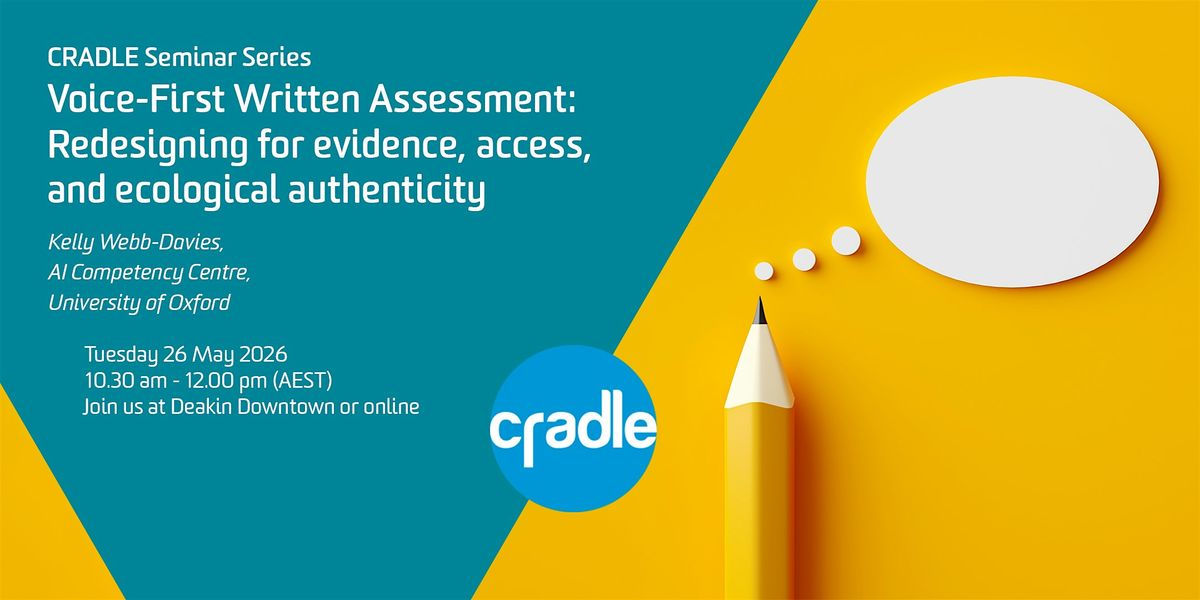
Institutional responses to generative AI in written assessment have often framed it as a problem of authorship. This seminar argues it is more fundamentally a problem of construct representation and linguistic access: even before generative AI, requiring performance in prestige academic prose risked distorting or suppressing students' best thinking, and as a result undermining valid inference about disciplinary reasoning. Now that fluent prose can be generated completely independently of a student's ideational labour, the already unstable link between polished prose and the thinking it was assumed to represent has been entirely severed. Detector-led and disclosure-based responses cannot repair this evidentiary chain.
Voice-First Written Assessment (VFWA) is a response to this evidentiary crisis. It is a two-stage assessment model that reconfigures where and how construct-relevant evidence is secured and interpreted. Stage 1 is ungraded and produced under observed conditions, establishing an authenticated baseline of ideation. Student choice of linguistic repertoire or modality provides a more interpretable representation of students' reasoning. Stage 2 permits unrestricted, optional digital tool use reflecting contemporary writing conditions, and enables linguistically and cognitively accessible methods to refine written work.
The model integrates validity theory, cognitive models of writing processes, and translanguaging scholarship, claiming that where prestige academic English is treated as proxy for intellectual effort, construct-irrelevant variance and underrepresentation are predictably introduced. Translanguaging is therefore not simply accommodation, but is a validity condition: a means of protecting evidentiary access to reasoning.
VFWA establishes minimal core conditions that make it adaptable across subject areas. It has attracted emerging institutional uptake across multiple disciplines and educational sectors. The seminar will present the evidentiary logic and operational design of the model alongside implementation examples and an overview of planned pilot applications.
Join us at the special time of 10.30 am (AEST), in person at Deakin Downtown or online, to learn more about the development and potential applications of VFWA.
About our seminars
For this special presentation, the main seminar session will run for one hour (10.30 am to 11.30 am AEST). This includes the seminar presentation as well as time for audience questions. If you only have an hour to spare, don't worry - you'll get the full experience in this main session!
At the conclusion of the main session, the discussion will continue in an extended Q&A session (approx. 11.30 am to 12.00 pm AEST). All audience members - both in-person and online - are welcome to remain at the seminar and participate in this extended conversation.
For in-person attendees, the seminar concludes with a light lunch and opportunities for informal discussion.
Find out more about CRADLE
Event venue & nearby stays
Deakin Downtown, 727 Collins Street, Melbourne, Australia
 Concerts, fests, parties, meetups — all the happenings, one place.