
About this Event
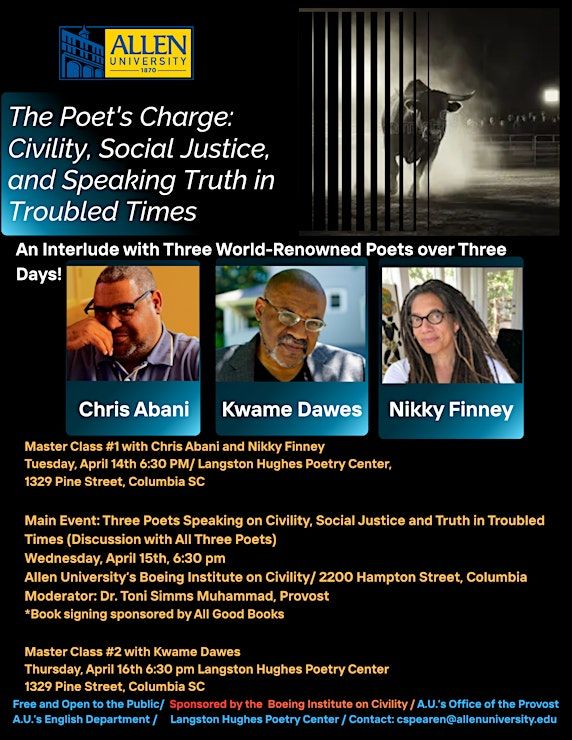
The Poet's Charge: Civility, Social Justice, and Speaking Truth in Troubled Times
A free 3-day event featuring workshops and panel discussion with world-renowned poets Chris Abani, Kwame Dawes, and Nicky Finney
- Tuesday, April 14 @ 6:30pm - Master Class #1 with Chris Abani and Nikky Finney at the Langston Hughes Poetry Center (1329 Pine Street, Columbia, SC)
- Wednesday, April 15 @ 6:30pm - Panel Discussion with Chris Abani, Kwame Dawes, and Nikky Finney at the Boeing Institute for Civility (2200 Hampton Street, Columbia, SC)
- Thursday, April 16 @ 6:30pm - Master Class #2 with Kwame Dawes at the Langston Hughes Poetry Center (1329 Pine Street, Columbia, SC
All events are free and open to the public, but space is limited so select the ticket for the event or events you would like to attend to reserve a seat!
Featured Poets
Chris Abani, born December 27, 1966, in Afikpo, Nigeria, is a Nigerian American writer whose work spans poetry, fiction, and essays. The child of a Nigerian father and an English mother, Abani’s early life was shaped by political upheaval. His family fled Nigeria during the Biafran War and spent several years in England before returning. This transnational experience profoundly informs his writing, which often explores themes of displacement, identity, trauma, and resilience.
Abani demonstrated remarkable literary talent at a young age, publishing his first short story at ten and his first novel, Masters of the Board, at sixteen. The novel’s political content led to his imprisonment, marking the beginning of a series of incarcerations that would deeply influence his later work.
He has since become an internationally celebrated author. His novels include GraceLand, which won the Hurston/Wright Legacy Award, Becoming Abigail, and The Secret History of Las Vegas. His poetry collections—such as Sanctificum, There Are No Names for Red, and Smoking the Bible—are known for their lyrical intensity and ethical engagement.
Abani has received numerous honors, including a Guggenheim Fellowship, the PEN/Hemingway Award, and the Prince Claus Award. A former professor at the University of California, Riverside, he is currently a Board of Trustees Professor at Northwestern University and a member of the American Academy of Arts and Sciences. Based in Chicago, Abani continues to write work that bears witness to human suffering while affirming dignity and hope.
___________________________________
Kwame Dawes is a Ghanaian-born Jamaican poet, scholar, and cultural critic whose work reflects a rich, transnational identity shaped by Africa, the Caribbean, and the United States. He earned his B.A. from the University of the West Indies and a Ph.D. in comparative literature from the University of New Brunswick. Dawes taught for two decades at the University of South Carolina, where he became a distinguished poet-in-residence and a central figure in the region’s literary community.
A prolific and versatile writer, Dawes has published numerous poetry collections beginning with Progeny of Air (1994), which won the Forward Poetry Prize. His subsequent works, including Midlands, Duppy Conqueror, and Back of Mount Peace, explore themes of memory, migration, colonialism, spirituality, and cultural hybridity. His writing often blends personal narrative with political and historical reflection, especially on the legacies of colonialism and the African diaspora.
In addition to poetry, Dawes has written fiction, criticism, and drama, including She’s Gone, which won the Hurston/Wright Legacy Award. He has also been deeply engaged in collaborative and humanitarian projects, notably work addressing HIV/AIDS in Jamaica, which earned him an Emmy Award.
Dawes has played a major role in shaping contemporary literary culture through editing anthologies and directing the Calabash International Literary Festival. He has served as Jamaica’s Poet Laureate and currently teaches at Brown University. His work is widely recognized for its lyrical power and its commitment to cultural dialogue and social justice.
___________________________________
Nikky Finney is an acclaimed American poet and educator whose work powerfully explores the cultural, political, and historical experiences of Black life in the American South. Born in Conway, South Carolina, she is the daughter of civil rights attorney and former South Carolina Chief Justice Ernest A. Finney Jr., and activist Frances Davenport Finney. Growing up in a socially engaged household, Finney developed an early awareness of justice, identity, and storytelling that would shape her lifelong commitment to writing.
Finney earned her bachelor’s degree in English from Talladega College and later pursued African American Studies at Atlanta University. Over a career spanning more than three decades, she has published multiple books of poetry and prose that reflect her deep engagement with memory, place, and social justice. Her collections include On Wings Made of Gauze (1985), Rice (1995), and Head Off & Split (2011), the latter of which won the National Book Award for Poetry. Her more recent work, Love Child’s Hotbed of Occasional Poetry (2020), honors her father while reflecting on centuries of African American resilience and creativity.
Finney taught for over twenty years at the University of Kentucky before joining the University of South Carolina, where she holds the John H. Bennett, Jr. Chair in Southern Literature and Creative Writing. A founding member of the Affrilachian Poets and an active mentor through organizations like Cave Canem, Finney continues to influence new generations of writers. Her work stands as a testament to the enduring power of poetry as a vehicle for truth, remembrance, and cultural preservation.
Sponsored by Allen Univeristy, the Langston Hughes Poetry Center, and the Boeing Institute for Civility. For more information visit or email [email protected]
Event Venue & Nearby Stays
Allen University, 1530 Harden Street, Columbia, United States
USD 0.00