
About this Event
Join us at e-flux Screening Room on Thursday, April 16 at 7pm for "Temporary Exhalations," a screening and discussion that brings together seven moving-image projects developed through Cinemovement Laboratory, an artist-run research and residency initiative for pan-Asian moving-image and performance practices founded in 2015. The screening will be followed by an in-person conversation with Elysa Wendi, a moving-image artist, curator, and co-founder of Cinemovement.
Over the past decade, each session, titled a “Laboratory,” has served as a platform for artists working at the intersection of moving image, cine-choreography, dance, and mediated performance, where the body is not merely a subject but a locus and method of inquiry.
Each Lab operates as a focused, temporary space that facilitates encounters across disciplines, disrupting and expanding each participant’s practice while generating breathing room for projects and research that resist the totalizing forces of legibility. United not by thematic affinities but by a common gestural affect, each of the seven works presented here holds on to a specter—grief, colonial sediment, inherited bodies, unresolved absences—then releases it through the logic of duration and form. A decade on from their initial making, these works arrive here not as complete(d) objects but as ongoing processes—like the pauses that arise amidst urgencies, like temporary exhalations in breaths held too long.
Films
Liao Jiekai, The Mist (Singapore & Vietnam, 2016, 12 minutes)
Two women recollect the distinct sights and sounds of certain memories they hold. This short incorporates mundane gestures, text and soundscape to recreate the trance-like atmosphere of their subconscious.
Elysa Wendi, Jolene Mok , Looking for Charlie (Hong Kong, 2016, 3 minutes)
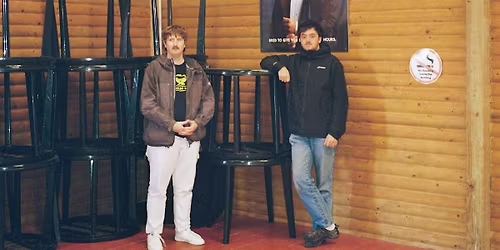
In January 2016, Charlie went missing between 23 floors of a staircase in a Chaiwan industrial building, Hong Kong. Through choreographic structure, two artists transform this search into ritual—ascending and descending, bodies tracing absence through concrete and void.
Lei Yuan Bin, A Dance for Ren Hang (Singapore & Macau, 2018, 9 minutes)
Three dancers reenact photographs by Chinese photographer Ren Hang in a series of tableau vivant. Well known for his taboo-breaking photographs bordering on taboo, Ren killed himself in 2017, a year shy of his thirtieth birthday. This film is an homage to his photographs, which are true representations of his fight with depression.
Lee Wai Shing, A Rock (Hong Kong & Philippines, 2020, 9 minutes)
A man sits by the sea, struggling to be still while voices instruct him to focus. Drawing on the filmmaker's childhood memories of being told not to move by his father, this film reflects on the age-old tension between individual agency and larger, seemingly uncontrollable forces of nature and society.
Veronica Bassetto, Tear Inside (Hong Kong & Indonesia, 2020, 7 Minutes)
A series of portraits of dancers challenged to hold their breath for as long as they can, this work examines the corporeal politics of breathing in relation to airborne toxicity. An apt metaphor on the pressures from broader forces of social discourse, one must inevitably breathe out to breathe in again.
Russell Morton, How Did I End Up Here (Singapore & Hanoi , 2024, 2 minutes)
A short film that delves into the existential theme of perpetual struggle, echoing the myth of Sisyphus. Through the interplay of movement, digital glitches, and a cyclical narrative structure, the film encapsulates the tension between persistence and entrapment within the rhythms of daily life.
jee chan, bendungan (Indonesia & Germany, 2025, 30 minutes)
Through choreographed gestures and intimate interviews, bendungan is a film premised upon the socio-spatial histories of water bodies such as seas, rivers, and the human body. It considers the memory of water, questioning how the sea and its waterways facilitated the Dutch colonial project across the Malay World. What do such watery bodies know, remember and circulate? bendungan is an Indonesian word which can refer to a dam, river bank or sea bank. The film follows three people who live close to water bodies in Indonesia and the Netherlands.
For more information, contact [email protected].
Accessibility
– Two flights of stairs lead up to the building’s front entrance at 172 Classon Avenue.
– For elevator access, please RSVP to [email protected]. The building has a freight elevator nearest to 180 Classon Ave (garage door) leading into the e-flux office space. A ramp is available for steps within the space.
– e-flux has an ADA-compliant bathroom with no steps between the event space and this bathroom.
Event Venue & Nearby Stays
e-flux, 172 Classon Avenue, Brooklyn, United States
USD 7.00 to USD 10.00