 Clara Schumann • Robert Schumann • Louise Farrenc • Fanny Mendelssohn • Felix Mendelssohn
About this Event
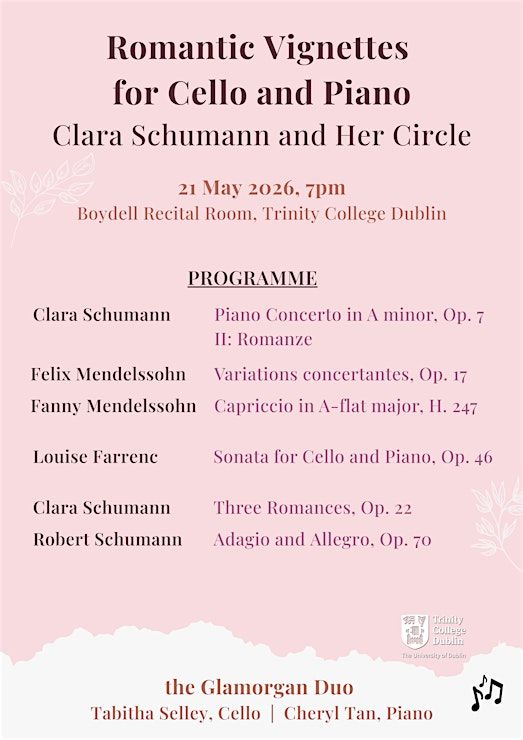
Following their Irish debut at the Whyte Recital Hall in August 2025, (Tabitha Selley, cello; Cheryl Tan, piano) return to present a programme of rarely heard works for cello and piano at Trinity College Dublin. This programme traces a journey from Leipzig, the birthplace of Clara Schumann, to Paris, home to Louise Farrenc and one of the great centres of nineteenth-century concert culture.
This illustrated recital places each work in its historical context, exploring nineteenth-century musical culture through the artistic networks of Clara Schumann (1819-1896). The only known writing for cello and piano by Clara appears most unexpectedly in her Piano Concerto, Op. 7 (1836), whose second movement features a dialogue between piano and solo cello. This work is presented alongside her other significant work for strings — and the last work she wrote — her Three Romances, Op. 22 (1853), originally for violin but heard here in a transcription for cello and piano. Rarely heard in these forms, they are paired with a more familiar piece in the cello repertoire: Adagio and Allegro, Op. 70 (1849) by her husband Robert Schumann (1810-1856).
Clara performed songs by both the Mendelssohn siblings -- Fanny and Felix Mendelssohn -- throughout her childhood. While her Piano Concerto was premiered under the baton of Felix Mendelssohn (1809–1847), Clara only had the chance to meet Fanny Mendelssohn (1805–1847) in Berlin in 1845, after which she held her in high regard; for Clara, Fanny was “such an accomplished woman who could be a real friend“, and her presence was almost sufficient motivation for Clara to move to Berlin.
Abraham Mendelssohn, the Mendelssohn patriarch, is often quoted as having said to his daughter, “Music will perhaps become [Felix’s] profession, while for you, it can and must remain only an ornament. Remain true to these sentiments and to this line of conduct; they are feminine, and only what is truly feminine is an ornament to your sex.” Programming Fanny's Capriccio in A-flat, H. 247 alongside Felix'sVariations Concertantes, Op. 17 — both composed in 1829 — truly reveals how she would, “in his place, have merited equal approval“.
Young Clara met Louise Farrenc (1804–1875) and her husband, musical publisher Aristide Farrenc, during her Paris tour in 1832. While little has been documented about this encounter, Louise played a pivotal role in shaping musical life in Paris. This three-movement Sonata for Cello and Piano, Op. 46 (1854) is Farrenc’s only work for the genre, and one of her final compositions.
At the age of fifteen, Farrenc studied at the Paris Conservatoire — piano, not composition, for women were forbidden from enrolling in composition classes during this time. Indeed, all through the nineteenth century, women pianists at the Conservatoire were given different repertoire than their male counterparts, for it was “too risky to test the belief that women couldn’t play like men”.
As this sonata by Farrenc, and the works presented by Fanny and Clara, demonstrate, however, it may have been far riskier to test the belief that women couldn’t compose like men. We invite you into this world of nineteenth-century romanticism, and to encounter the remarkable creativity and imagination of the women who helped shape its culture.
Event Venue
House 5 Department of Music, Trinity College Dublin, College Street, Dublin 2, Ireland
EUR 0.00 to EUR 17.07