
About this Event
Join us for a totally unique Virtual Reality and interactive audio/video performance featuring work by Jarosław Kapuściński, Associate Professor of Music at Stanford University, whose work focuses on intermedia composition, performance, and Japanese traditional aesthetics.
The evening comprises two parts. The first half features two piano-and-video works by Jaroslaw Kapuściński. The piano performance by new music specialist Keisuke Nakagoshi is carefully tracked by a computer that responds with large-scale video projections that follow the score.
In the 2nd half, Kapuściński dons a VR headset and, while holding two handsets, draws in virtual space (which we see on the full wall projection). The drawing is also tracked and triggers a potential piano score that responds directly to the drawing process. At the conclusion of the performance, audience members will also be able to experience the drawing and interactive music while wearing the VR headset.
“Juicy”(2009, piano and interactive projection, 10 min).
Fruits and music—an unexpected pairing? Both burst with color and form, both awaken the senses in immediate and powerful ways. In this intermedia performance, sight and sound intertwine to reveal their surprising connection.
“Side Effects”(2017, piano and visual projection, 17 min).
Side Effects started as a photographic project by Kacper Kowalski, exploring the complex relationship between humanity and nature as seen from a perspective 150 meters above the ground. This estranged perspective on some of the most common spaces revealed fresh metaphoric and structural dimensions that inspired Kapuściński to propose an intermedia collaboration. What if specially composed music performed live in concert interpreted the images and guided the viewers through a rich world of sometimes unexpected emotions, meanings, and abstract visual forms? The ten movements refer in different ways to the four seasons and the material categories of air, wood, water, fire, and earth.
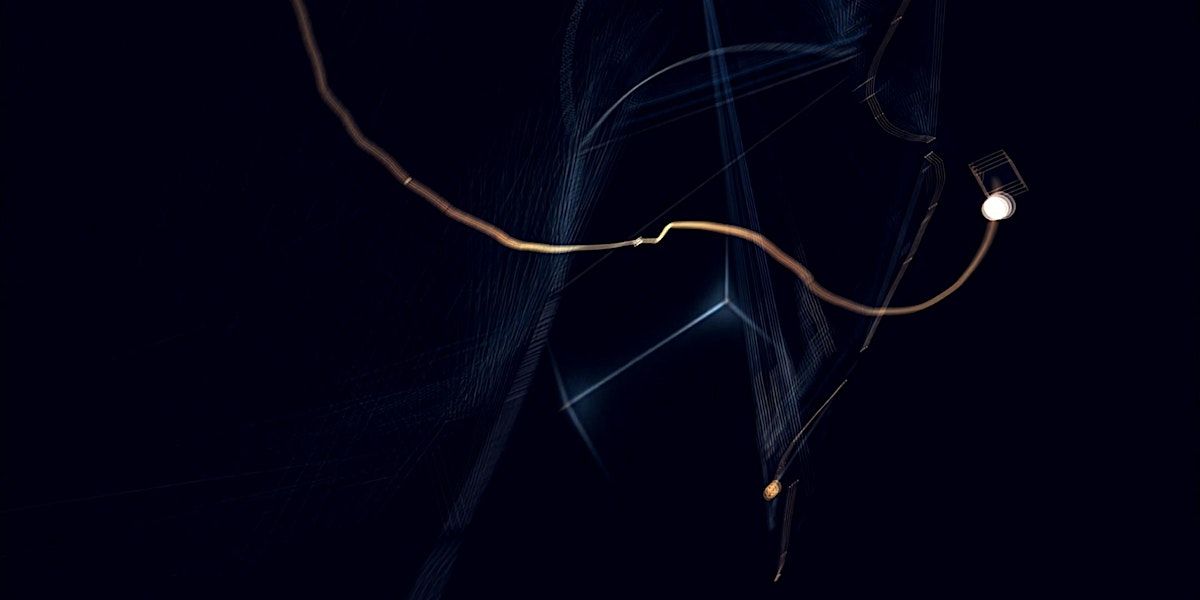
“Point Line Piano”(2024) is a VR project that reimagines piano music by fusing its modes of composing, playing, and listening. As you interact with it, your ears, eyes, and hands act together. You start by drawing lines freely in the space around you, sparking musical notes that are notched as points on the lines as you draw them. These notes quickly accumulate, forming distinct melodic phrases and rhythms, while the computer generates an intricate audiovisual dance all around you. The work enables a spatial and full-body experience of abstraction not found in any other medium. In a live concert setting it can also be used as an audiovisual instrument.
Info and trailer:
Jarosław Kapuściński is an Associate Professor of Music at Stanford University, where he is also affiliated with the Department of East Asian Languages and Cultures. His research focuses on intermedia composition, performance, and Japanese traditional aesthetics.
Kapuściński has received grants and commissions from numerous international organizations, including the National Endowment for the Arts, the Governor General of Canada, and Institut National de l’Audiovisuel (INA) in France. His works have been awarded prizes at festivals in Canada, France, Switzerland, and the United States, and have been presented at venues such as New York MOMA, Spoleto USA, EMPAC NY, Logan Center in Chicago, ZKM in Karlsruhe, Reina Sophia Museum in Madrid, WRO Media Biennale, Warsaw Autumn Festival, Creative Media Center in Hong Kong, Benz Arena in Shanghai, and National Art Centre in Ottawa.
In addition to his artistic work, Kapuściński has collaborated on scholarly websites about Japanese Gagaku music (gagaku.stanford.edu) and Noh Theater (noh.stanford.edu).
https://jaroslawkapuscinski.com/
Keisuke Nakagoshi is a pianist and composer who trained at the San Francisco Conservatory of Music, where he studied with David Conte and Paul Hersh. A recipient of multiple top honors, he was selected to represent the Conservatory at the Kennedy Center’s Conservatory Project.
He has performed at leading venues including the Kennedy Center, Carnegie Hall, the Hollywood Bowl, and Davies Symphony Hall, and made his solo debut with the San Francisco Symphony under Herbert Blomstedt. A dedicated collaborator, he is co-founder of the piano duo ZOFO, whose debut album received a Grammy nomination.
Nakagoshi is currently Pianist-in-Residence at the San Francisco Conservatory of Music and serves as pianist for Opera Parallèle, West Edge Opera, and the San Francisco Contemporary Music Players.
https://www.kskpiano.com/bio
Kacper Kowalski has been observing and photographing landscapes from an aerial perspective for over 30 years. After becoming an architect and having worked in the profession for four years, he eventually decided to commit to flying and photography. As a paraglider, a pilot of small aircraft, and a gyrocopter, Kacper spent over 5000 hours in the air. The flight is for Kowalski not only a way to capture the world beneath, but becomes a spiritual journey that reveals universal truths about the relationship between man and nature, about the past and the present, and about one’s own personal truth and the way to get there. He has received numerous awards, including the World Press Photo award (three times), the Picture of the Year International POYi award (six times), and dozens of others. His first book, Side Effects, was published in 2014, OVER was self-published in 2017, followed by Arché in 2021, and Event Horizon in 2022 (1605 Publishers). His works have been exhibited in group and solo exhibitions internationally, and the books have won prizes and been nominated, including at Les Prix du Livre at Rencontres d’Arles. The project Event Horizon was on display at the SFO Museum in San Francisco in 2023.
Marc Downie and Paul Kaiser have collaborated as OpenEndedGroup since 2001. Working in a wide variety of media and venues, they make art for façade, gallery, dance, stage, 3D cinema, print, and virtual reality. Their works respond to a wide range of materials — drawing, film, motion capture, photography, music, and architecture. They frequently combine three signature elements: non-photorealistic 3D rendering, the incorporation of body movement through motion capture and other means, and the autonomy of artworks directed or assisted by artificial intelligence.
OpenEndedGroup’s films, installations, stage works, and VR pieces have premiered at venues including MoMA, Lincoln Center, the Barbican, the Isabella Stewart Gardner Museum, the Brooklyn Academy of Music, the Hayward Gallery, Sadler’s Wells, and at the Berlin, New York, and Rome film festivals. Eight of their 3D digital films were the first of their kind to enter MoMA’s permanent collection.
https://openendedgroup.com/
Event Venue & Nearby Stays
Dresher Ensemble Studio, 2201 Poplar Street, Oakland, United States
USD 23.18