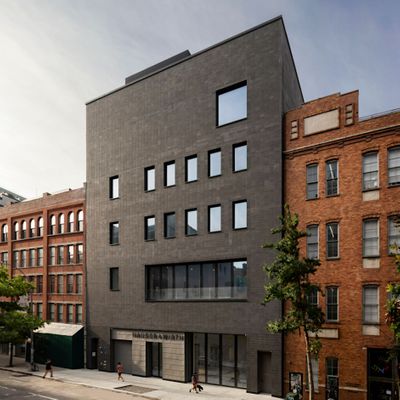

About this Event
On the occasion of ‘Firelei Báez. feet squelching on wet grass, nourished by uncertainty,’ the artist’s first exhibition with Hauser & Wirth in New York, please join us for a rich conversation, in the historic Great Hall at The Cooper Union, touching on art, the cosmos, nature, world building and more with Firelei Báez, artist Jeffrey Gibson and curator Candice Hopkins.
On the heels of two major solo museum exhibitions in 2025, Firelei Báez’s exhibition at our 22nd street gallery in Chelsea unveils an ambitious, enveloping constellation of radiant new paintings and works on paper, along with new large-scale bronze sculptures. Across two floors, Báez extends her ongoing engagement with colonial legacies and the natural, spiritual and cosmic reverberations of the African diaspora. A storyteller and world maker, Báez works within the tradition of history painting while quietly undoing the very conventions through which histories are fixed and made legible. In this presentation, she subtly shifts her focus away from the discernible, if chimerical, figures that occupy her previous bodies of work to achieve a more atmospheric sensibility, one that invites a broader, deeper understanding of how bodies and nature shape our experience of being in the world.
Reservations are required for this free event co-presented with The Cooper Union School of Art.
Photo: Portrait of Candice Hopkins. Photo: Thatcher Keats; Portrait of Firelei Báez. Photo: Dana Scruggs; Portrait of Jeffrey Gibson. Photo: Emiliano Granado © Jeffrey Gibson Studio.
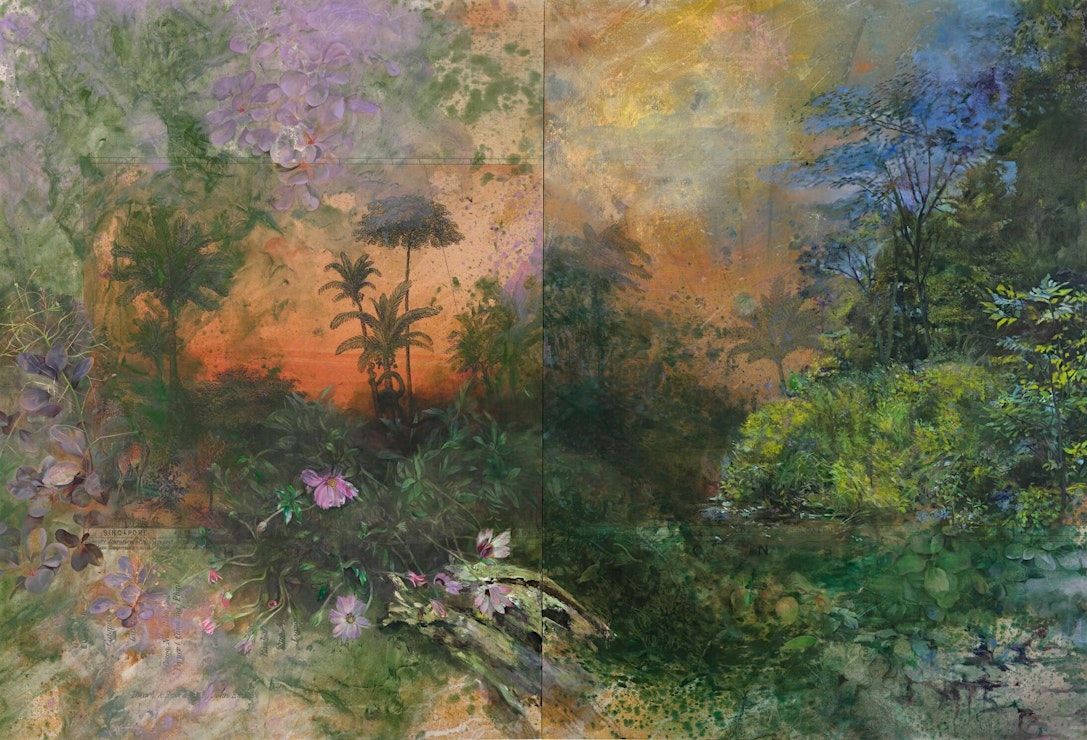
Image: Firelei Báez, View of Nature (1), 2026 © Firelei Báez. Photo: Elisabeth Bernstein
About Firelei Báez
Firelei Báez draws upon African diasporic histories, reimagining them to explore new possibilities for the future. Báez received an MFA from Hunter College, a BFA from The Cooper Union School of Art, and attended the Skowhegan School of Painting and Sculpture. Since 2024, Báez has been the subject of her first major U.S. survey, organized by the Institute of Contemporary Art, Boston, and presented at the Vancouver Art Gallery and the Des Moines Art Center, before traveling to the Museum of Contemporary Art Chicago, where it remains on view through May 2026. Her work has been featured in major international exhibitions, including ‘The Milk of Dreams’ at the 59th Venice Biennale (2022), curated by Cecilia Alemani, and the inaugural installation of the ICA Watershed in Boston (2021). Recent solo exhibitions have been held at the Louisiana Museum of Modern Art, Humlebæk; Kunstinstituut Melly (formerly Witte de With Center for Contemporary Art), Rotterdam; The Museum of Modern Art, New York; The Studio Museum in Harlem; The Andy Warhol Museum, Pittsburgh; and Pérez Art Museum Miami.
Báez has participated in numerous group exhibitions at institutions including the National Gallery of Art, Washington, DC; the Art Gallery of Ontario, Toronto; the Cleveland Museum of Art; the Baltimore Museum of Art; and the Rockbund Art Museum, Shanghai. She is the recipient of several major awards, including the Herb Alpert Award in the Arts (2020), the Artes Mundi Prize (2021), the Philip Guston Rome Prize (2021), and The Cooper Union President’s Citation (2022). Her work is held in prominent public and private collections worldwide, including the Baltimore Museum of Art; Crystal Bridges Museum of American Art; Dallas Museum of Art; Fine Arts Museums of San Francisco; The Solomon R. Guggenheim Museum; Institute of Contemporary Art, Boston; Nasjonalmuseet, Oslo; Pérez Art Museum Miami; San Francisco Museum of Modern Art; Tate, London; the Whitney Museum of American Art, New York; and The Metropolitan Museum of Art.
About Jeffrey Gibson
Jeffrey Gibson is an interdisciplinary artist, curator, and convener celebrated for his work in painting, installation, video, and performance. For over two decades, he has examined how language, pattern, and music construct meaning, synthesizing Indigenous and Western traditions through vibrant color, complex patterning, and layered sound. A member of the Mississippi Band of Choctaw Indians and of Cherokee descent, Gibson represented the U.S. at the 2024 Venice Biennale with his acclaimed exhibition the space in which to place me, which made its U.S. debut at The Broad in Los Angeles in May 2025. In June 2025 he unveiled a site-specific installation at Kunsthaus Zurich, and recently presented four figurative sculptures in The Genesis Facade Commission: Jeffrey Gibson, The Animal That Therefore I Am at the Metropolitan Museum of Art. His work is held in many permanent collections, including the Museum of Modern Art, the National Gallery of Art, Whitney Museum of American Art, Museum of Fine Arts Boston, Smithsonian National Museum of the American Indian, National Gallery of Canada, Denver Art Museum, and Portland Art Museum. He lives in New York’s Hudson Valley and is artist-in-residence at Bard College.
About Candance Hopkins
Candice Hopkins is a citizen of Carcross/Tagish First Nation and lives in Red Hook, New York. Her writing and curatorial practice explore the intersections of history, contemporary art, and Indigeneity. She is Executive Director & Chief Curator of Forge Project, Taghkanic, New York, and Fellow in Indigenous Art History and Curatorial Studies, Bard College. She is curator of the exhibitions Indian Theater: Native Performance, Art, and Self-Determination Since 1969, at the Hessel Museum of Art, and the touring exhibitions Soundings: An Exhibition in Five Parts, co-curated with Dylan Robinson, and ᑕᑯᒃᓴᐅᔪᒻᒪᕆᒃ Double Vision, featuring textiles, prints and drawings by Jessie Oonark, Janet Kigusiuq, and Victoria Mamnguqsualuk. She was the Senior Curator for the inaugural 2019 and 2022 editions of the Toronto Biennial of Art and part of the curatorial team for the Canadian Pavilion at the 58th Venice Biennale, featuring the work of the media collective Isuma; as well as documenta 14, Athens and Kassel; and Sakahàn: International Indigenous Art, National Gallery of Canada, Ottawa. Her notable essays include “The Gilded Gaze: Wealth and Economies on the Colonial Frontier,” in the documenta 14 Reader; “Outlawed Social Life,” in South as a State of Mind; and “The Appropriation Debates (or The Gallows of History),” in Saturation: Race, Art, and the Circulation of Value (New Museum/MIT Press, 2020).
About The Great Hall of The Cooper Union
The Great Hall of The Cooper Union, located in The Foundation Building, 7 East 7th Street, between Third and Fourth Avenues, has stood for more than a century as a bastion of free speech and a witness to the flow of American history and ideas. When the hall opened in 1858, more than a year in advance of the completion of the institution, it quickly became a destination for all interested in serious discussion and debate of the vital issues of the day.
The Great Hall was the platform for some of the earliest workers' rights campaigns and for the birth of the NAACP, the women's suffrage movement and the American Red Cross. To the Great Hall's lectern has come a pageant of famous Americans — rebels and reformers, poets and presidents. Before they were elected, Presidents Lincoln, Grant, Cleveland, Taft, Theodore Roosevelt and Barack Obama all spoke there. Besides Woodrow Wilson, two other incumbent presidents have spoken in the Great Hall: William Jefferson Clinton, who, on May 12, 1993, delivered a major economic address on reducing the federal deficit and Barack Obama, who, on April 22, 2010, gave an important speech on economic regulation and the financial markets.
During the past century's times of tremendous upheaval, it was through meetings in Cooper's famous auditorium that the politics and legislation necessary to build a humane city took shape.
Event Venue & Nearby Stays
The Great Hall at Cooper Union, 7 East 7th Street, New York, United States
USD 0.00