
About this Event
The Centre for Culture and Technology is proud to present its third annual Fellows Day conference. This conference convenes our 2025-26 Artist-in-Residence, Xuan Ye, and our Visiting Faculty Fellows: Katherine Behar (CUNY), Joshua Scannell (the New School), and Luke Stark (Western University).
Following a talk by the Artist-in-Residence, the Fellows will present new scholarship engaging with the Centre's annual programming theme, "Artificial Stupidity", in conversation with Ye's solo exhibition "" presented at the Centre in September 2025.
After the conference, join us on the patio of the U of T Faculty Club (41 Willcocks St.) for a celebratory reception to close our programming year! Food & drink will be served. Come by between 6:30-8:30PM; register here.
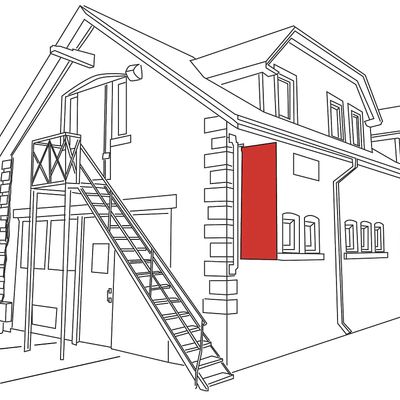
**Please note: due to a film production, the Alumni Hall parking lot where the Centre's Coach House is open will be closed. The building can still be accessed on foot; we recommend entering via the pathway off of St. Joseph St. by the Kelly Library.
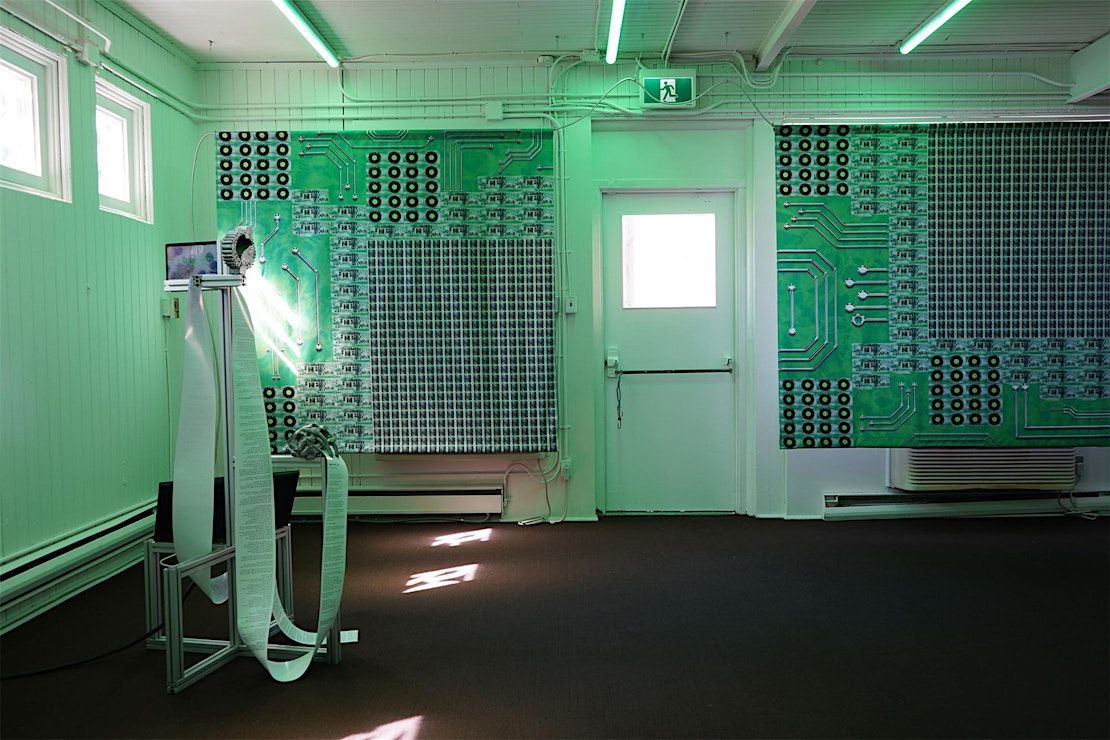
Xuan Ye: ERROAR! (solo exhibition). Installation view at the Centre for Culture and Technology at the University of Toronto (2025), photo by Xuan Ye.
About the speakers:
makes noise as a compass, navigating the eddies of art, music, and technology. Their practice unfolds in vibrational world-building via software, sound, image, installation, performance, publication and teaching. Through improvisation and computation, X traces the material and metaphysical waves across the technological, biological, and ecological resonances to evoke illegible pulses and dissonant pauses that stutter meaning, tremble systems. Their work has been exhibited at the MOCA Toronto (2022), UCCA Shanghai (2022), UQAM and the Venice Architecture Biennale (2021), MUTEK Montreal (2021), and the Goethe-Institut Beijing (2018), among others. They have been recognized with awarded residencies at ZHdK (2024) and Pro Helvetia (2023) and have received grants and scholarships from the Canada Council for the Arts and the SSHRC. Their practice has also been critically featured and reviewed in Canadian Art (Winter 2020), ArtAsiaPacific (Issue 111), the Goethe-Institut (Montreal), KUNSTFORUM International (Issue 257), and Musicworks (Issue 136). Hailing from China, X lives in Toronto/Tkaronto and serves as an Assistant Professor at the University of Waterloo.
Katherine Behar is an interdisciplinary artist and writer who explores gender, race, and labor in contemporary digital culture. Beall Center for Art+Technology presented her major solo exhibition Ack! Knowledge! Work! (2024). Katherine Behar: Data's Entry | Veri Girişi (2016), a comprehensive survey exhibition and catalog, was presented by Pera Museum. Additional solo exhibitions include Shelf Life (2022), Backups (2019), Anonymous Autonomous (2018), E-Waste (2014, catalog/traveling), and numerous others collaborating as "Disorientalism." Behar's books include Object-Oriented Feminism, And Another Thing: Nonanthropocentrism and Art, and Bigger than You: Big Data and Obesity. She is Professor of New Media Arts at Baruch College and The Graduate Center of the City University of New York (CUNY).
Joshua Scannell is Assistant Professor of Media Studies at the New School's School of Media Studies. His work looks at how ubiquitous computational media reorganizes governmentality and sensoria in the 21st century. He is interested in understanding how changing digital technologies transform the relationship between the body and its environment, and how these transformations are harnessed to racial and sexual techniques of organizing populations for political and economic exploitation. His current monograph, The Carceral Surround (University of Minnesota, Forthcoming) theorizes the enmeshment of digital carceral technologies with speculative imaginaries of state power.
Luke Stark is an Assistant Professor in the Faculty of Information and Media Studies at Western University in London, Canada, and co-director of Western’s Starling Centre for Just Technologies and Just Societies. Stark’s research explores the history and contemporary effects of artificial intelligence (AI) systems designed to interact with humans, the conceptual and philosophical limits of key components of AI systems such as logical inference and interactivity, and the ways in which human values like equality, justice, and privacy can be supported in the design of digital technologies. Luke’s scholarship has appeared in numerous journals including New Media & Society, Social Studies of Science, American Literature, JASIS&T, and The Information Society, and in the proceedings of Association for Computing Machinery (ACM) conferences including on Computer-Human Interaction (ACM CHI), Fairness, Accountability, and Transparency (ACM FAccT), and the AAAI/ACM Conference on AI, Ethics, and Society. His current book project Reordering Emotion: Histories of Computing and Human Feeling from Cybernetics to Artificial Intelligence is under contract with the MIT Press.
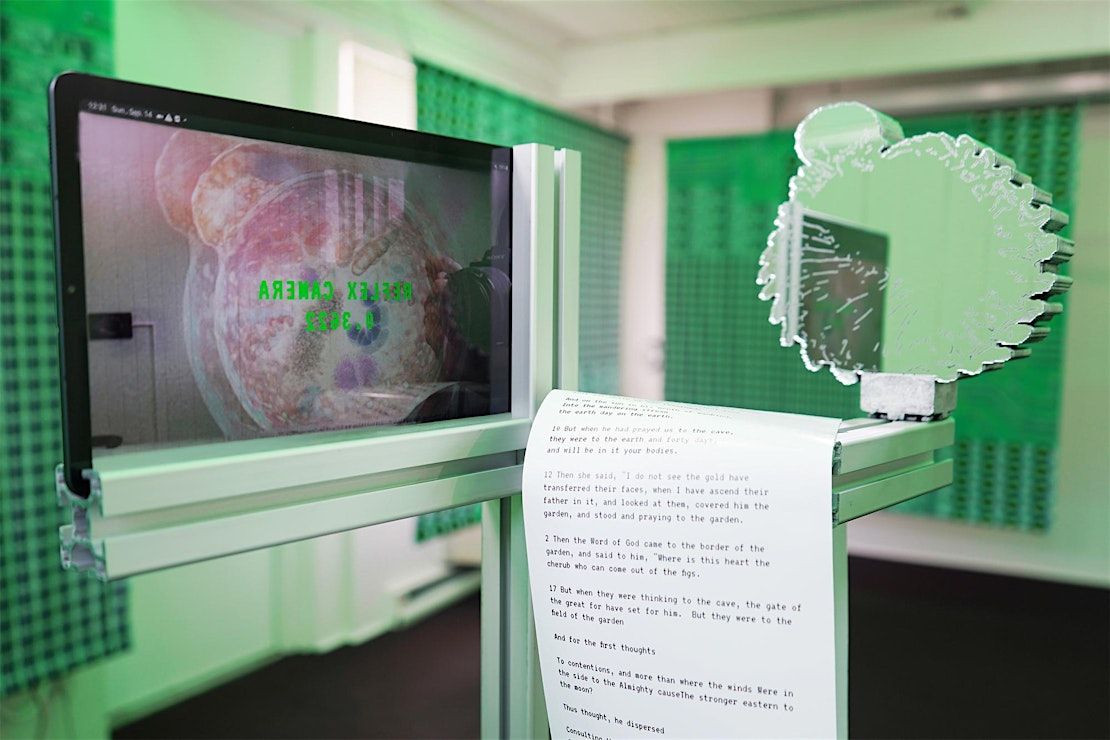
Xuan Ye, 𝘌𝘙𝘙𝘖𝘈𝘙! 04 - 𝘛𝘩𝘦 𝘖𝘳𝘢𝘭 𝘓𝘰𝘨𝘪𝘤 (2019/25). Installation detail at the Centre for Culture and Technology at the University of Toronto (2025), photo by Xuan Ye.
About the exhibition:
Since 2018, Xuan Ye’s ERROAR! series transforms the hallucinations, biases, and glitches of human-machine coupling into multimedia installations. Here, data shrinks, training slows, and renders fray, spilling errant stories and frequencies that rewire our perception, affect, and imagination. These works materialize the “cognitive distortion” of artificial neural networks as speculative artifacts, forming a future archaeology of now where technological errors are paleocybernetic fossils, calcified as evidence of a recursive hunger. In this self-devouring loop, objectivity is swallowed and regurgitated as resistance. Every algorithmic stumble is a fossil-in-waiting, and every glitch is an escape route. With the latest installment of this ongoing series, ERROAR! expands into absurdist speech opera, remixing machine-generated quasi-English into a chorus of algorithmic dysfluency.
Produced as part of the fourth annual Artist-in-Residence Program and curated by Talia Golland, this solo exhibition responds to the Centre’s 2025–2026 programming theme “Artificial Stupidity", which engages the politics, aesthetics, and economics of machine learning to put pressure on the construction of these technologies as artificial intelligence.
Xuan Ye: ERROAR! was presented at the Centre's Coach House from September 6 - October 26, 2025.
Exhibition documentation
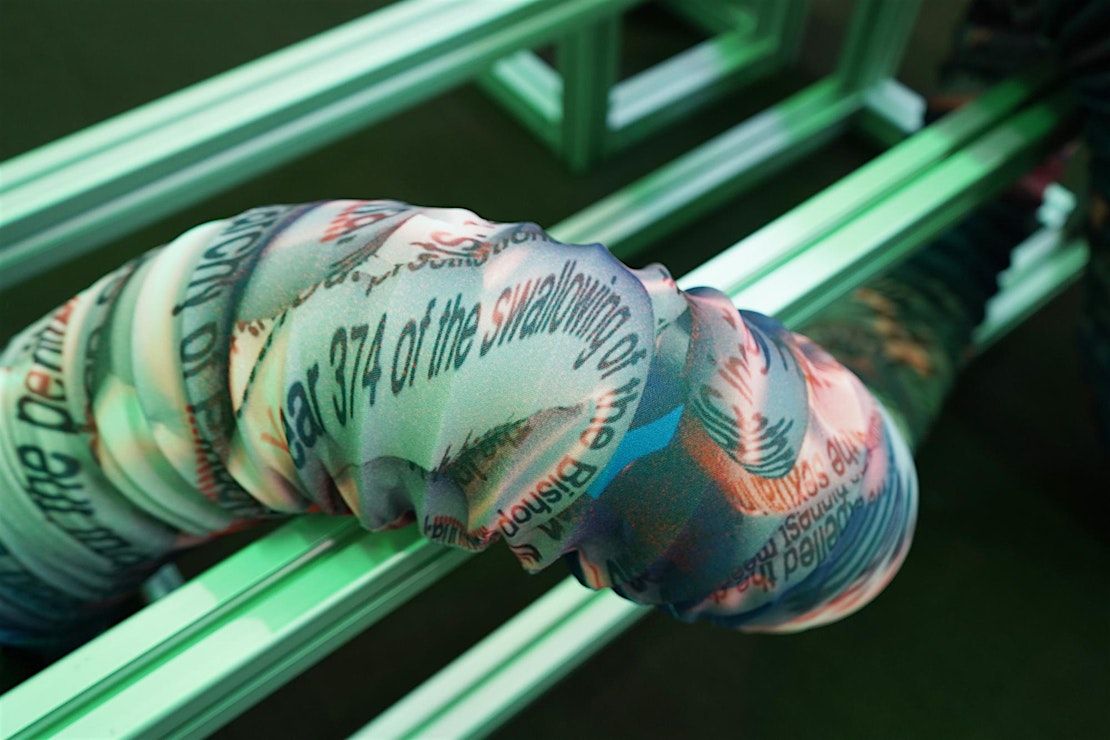
Xuan Ye, 𝘌𝘙𝘙𝘖𝘈𝘙! 05 - 𝘎𝘢𝘳𝘳𝘶𝘭𝘰𝘶𝘴 𝘎𝘶𝘵𝘴 (2019/25). Installation detail at the Centre for Culture and Technology at the University of Toronto (2025), photo by Xuan Ye.
About the Centre for Culture and Technology:
The Centre for Culture & Technology is dedicated to theoretical, aesthetic, and critical inquiry into the impacts of contemporary media on our interconnected world. This project is informed by the Centre’s location in the Coach House, a multi-use heritage building that was once Canadian media theorist Marshall McLuhan’s office and salon on the University of Toronto campus. The Centre draws inspiration from McLuhan’s humanistic intellectual and institutional legacy, continuing his stated goal of “investigation into the psychic and social consequences of technologies”.
The Centre promotes the study of media aesthetics in an expanded sense, examining the ways technological media shape contemporary experience by elaborating its histories, its problems, its infrastructures, and its politics. Offering both a setting and a framework, the Centre provides space and programming for scholars working in humanistic media studies across the three campuses of the University of Toronto and in the GTA. The Centre also supports the production of and conversation about contemporary media art, fostering aesthetic experimentation as a mode of inquiry.
Centre for Culture and Technology at the University of Toronto
39A Queens Park Crescent East
Toronto, ON M5S 2C3
www.cultureandtech.utoronto.ca
[email protected]
Instagram @uoftculturetech
Event Venue & Nearby Stays
The Centre for Culture and Technology - University of Toronto, 39A Queen's Park Crescent East, Toronto, Canada
USD 0.00