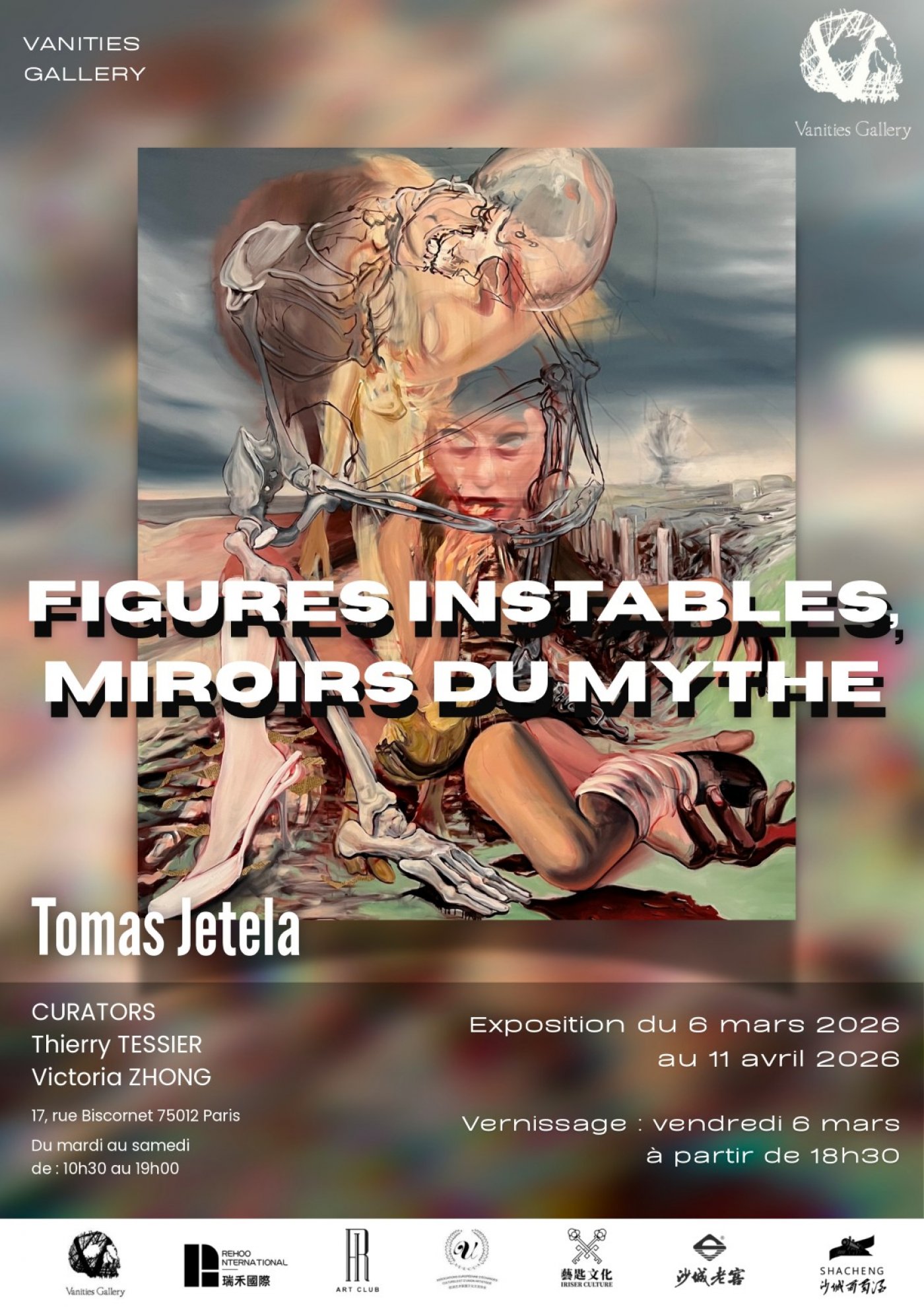
« UNSTABLE FIGURES, MIRRORS OF MYTH »
Solo exhibition from March 6, 2026 to April 11, 2026
Opening reception: Friday, March 6, 2026, from 6:30 pm
Vanities Gallery is pleased to announce the presentation, in March, of an exhibition dedicated to the Czech artist Tomas Jetela (born 1986, Prague). This exhibition forms part of the gallery’s curatorial program, which focuses on contemporary pictorial practices that question the historical, symbolic, and critical foundations of the image.
Trained at the Academy of Fine Arts in Prague (AVU), in the studios of Michael Rittstein and Jiří Lindovský, Tomas Jetela has developed over more than a decade a pictorial body of work in which the human figure remains central. His practice draws upon a broad range of references from Western art history, mythology, and modern thought, which he confronts with a critical reading of the present.
Figurative Painting and Learned Heritage
Tomas Jetela’s practice is rooted in a conscious continuity with the major traditions of European painting. The human figure appears as a site of both construction and deconstruction, traversed by historical, cultural, and perceptual tensions. The bodies represented belong neither to descriptive naturalism nor to formal abstraction, but to an intermediate space where visual memory intersects with contemporary instability.
The use of non-naturalistic colors, altered flesh tones, and anatomical disproportions recalls the mannerist explorations of the second School of Fontainebleau (c. 1559–1597), from which Jetela appears to retain chromatic freedom and formal complexity. This lineage manifests itself in a departure from classical mimesis, in favor of an image conceived as an intellectual construction.
Composite Faces and Fragmented Identity
The treatment of the face constitutes one of the structural axes of the works presented at Vanities Gallery. Tomas Jetela’s figures are at times marked by areas of erasure, blurring, or discontinuity. This process reflects a conception of identity as an unstable process, subject to contradictory forces.
This approach may be placed in dialogue with the work of Francis Bacon (1909–1992), with whom Jetela shares an interest in facial deformation as a site of tension between appearance and disappearance. In Jetela’s work, however, such alteration does not result in a dramatization of the body, but rather in an inquiry into the loss of symbolic legibility within an image-saturated world.
Assemblages, Metamorphoses, and Anamorphoses
The influence of Giuseppe Arcimboldo (1526–1593) is evident in the logic of assemblage that permeates many of the works. Figures appear composed of heterogeneous elements, as though their unity were always provisional. The face thus becomes a space of mental projection rather than a site of immediate identification.
To this logic is added an implicit use of anamorphic processes, comparable to the effects produced by convex mirrors or so-called “witch’s mirrors.” Certain compositions impose a fragmented and unstable reading, engaging the viewer in an experience in which meaning is never revealed from a single point of view.
Surrealism and Perceptual Ambiguity
Tomas Jetela’s painting also engages in dialogue with the legacy of Surrealism, notably with the work of Salvador Dalí (1904–1989). This dialogue does not take the form of formal imitation, but rather manifests itself through perceptual ambiguity, the superimposition of symbolic registers, and the coexistence of multiple temporalities within a single image.
The scenes depicted function as mental spaces, where mythology, religion, popular culture, and contemporary references converge without a stable hierarchy. This coexistence generates an open field of interpretation, in which the image remains fundamentally equivocal.
Ancient Myths and Critique of the Present
The recurring mythological figures—Bacchus, Venus, bacchantes, Madonnas—do not constitute a historicist rereading. They are displaced into a contemporary context in which their symbolic charge is tested. Myth becomes a critical tool, revealing mechanisms of desire, power, and consumption.
Certain works introduce a reflection on the art system itself. The reference to Maurizio Cattelan (born 1960), notably through the evocation of the banana affixed with adhesive tape, points to a critique of the art market and its systems of value. In Jetela’s work, this critique is articulated within the very language of painting, a medium historically associated with the commodification of the image.
Painting and Non-Mercantilism
This position finds resonance in the thought of André Breton (1896–1966). In the Manifesto of Surrealism (1924), Breton asserts: “Beauty will be convulsive or it will not be.”1 This statement echoes Tomas Jetela’s approach, whose painting resists any aesthetic stabilization or reduction to a decorative or mercantile function.
Painting here remains a space of critical tension, in which the image retains a capacity for disturbance and questioning. Classical Culture as an Active Structure The exhibition presented in March at Vanities Gallery highlights an artist for whom classical culture does not function as a mere iconographic reference, but as a structure of thought. Mastery of the major narratives of art history enables Tomas Jetela to produce images in which each figure operates as a node of references, displacements, and contradictions.
By presenting this exhibition, Vanities Gallery reaffirms its commitment to contemporary painting that interrogates its own historical foundations while offering a critical reading of the present world.
Event Venue
vanities gallery, 17 Rue Biscornet, 75012 Paris, France, Paris