

About this Event
Forest bathing, also known by the Japanese term shinrin-yoku, is a mindful practice of spending slow, intentional time in a forest or natural setting to support mental, emotional, and physiological well-being. These special forest bathing experiences will be nourishing to the soul, offering a safe space to wander, reflect, and restore.
Owen Rose Garden is home to over 400 varieties of roses, and the oldest and largest black Tartarian cherry trees in the United States, adding deep historical resonance to the site. Seasonal bloom gatherings (like Hanami) encourage group interactions, which support oxytocin release, improving social connectedness and reducing loneliness. Here we slow down and observe Nature's power to shift our internal state with a 45 minute guided session of Shinrin-yoku, forest bathing or immersive forest therapy.
What to Expect
We begin with a guided mindfulness meditation, then experience the Owen Rose Garden through a series of exploratory invitations that encourage grounding and playfulness with nature. Walks will conclude with shared reflections. It is not hiking or exercise-focused. The emphasis is on sensory immersion: noticing the textures of bark, the sound of wind and birds, the scent of soil and leaves, and the quality of light. You move gently, pause often, and allow the environment to regulate your nervous system rather than trying to “do” anything. Forest Bathing is not a workout or a wilderness survival event. It is a deliberate recalibration of the human nervous system through relationship with nature and is especially effective for stress recovery, mental fatigue, and emotional depletion.
Origins
The practice emerged in Japan in the 1980s as a public health intervention to counter rising stress and burnout associated with urbanization and work culture. It has since become a structured therapeutic modality in many countries.
How it works
Forest bathing activates the parasympathetic nervous system (rest-and-digest). Research links it to:
- Reduced cortisol and blood pressure
- Improved mood and emotional regulation
- Enhanced immune function (associated with exposure to phytoncides—volatile organic compounds released by trees)
- Improved attention and cognitive clarity
What a session looks like
A typical session lasts 60 - 90 minutes and includes:
- Slow, silent walking
- Guided sensory invitations (listening, touching, breathing)
- Periods of stillness or reflection
- Group Integration & coherence
Within A Powerful Convergence Zone
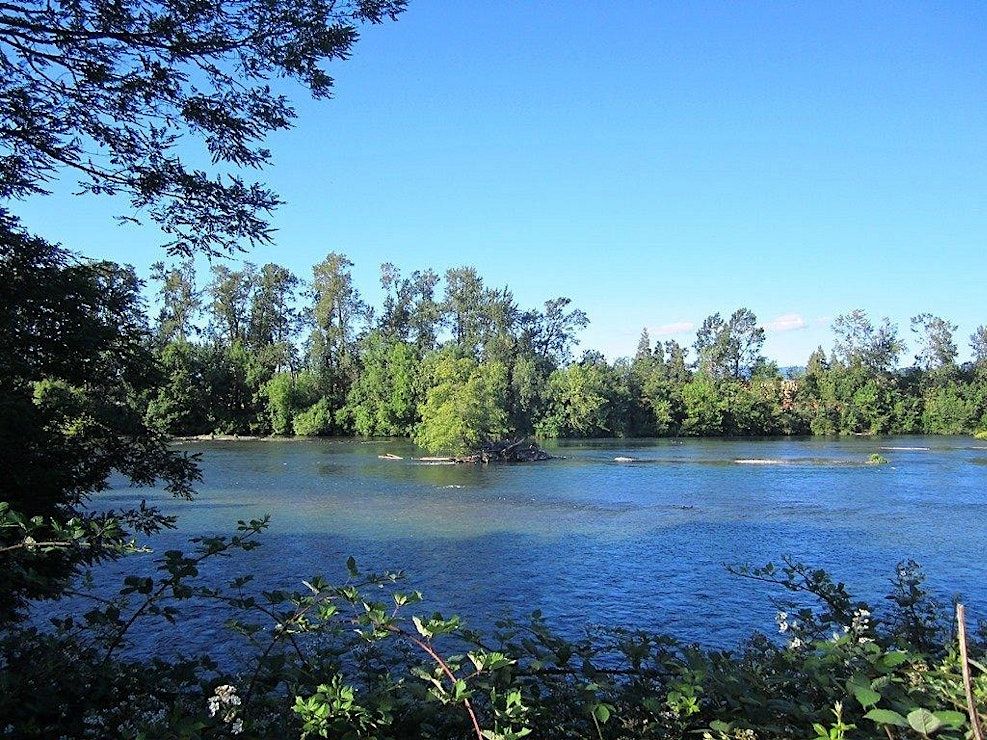
Owen Rose Garden is the meeting point of several powerful natural systems. This landscape looks gentle, but it was shaped by floods, fire, and movement. The soils beneath your feet arrived in cataclysmic waves. The river has never been still. The abundance people depend on here is cultivated through deep ecological knowledge and integration. Here, moving water, flood-shaped land, riparian forest, and open sky overlap in a way that is rare in modern urban environments.
The Willamette River, where these convergence zones concentrate life, moderates between these extremes, and creates a sense of coherence that the human nervous system instinctively recognizes. Long before cities existed, places like this signaled safety, nourishment, and continuity. For most of human history, survival depended on finding landscapes where water was reliable, food sources were diverse, and visibility allowed early detection of danger. Convergence zones provided all three. They supported fishing, foraging, travel, and social gathering, while also offering refuge from climatic extremes. Air near rivers tends to be cooler in summer and less stagnant year round. These microclimatic effects reduce physiological stress and support easier respiration. Some research also suggests that moving water increases negative air ions, which subtly influences mood and alertness.
For the nervous system, this combination creates what psychologists call soft fascination. Attention is engaged without effort. The mind does not need to control the experience. This is why listening to the river often feels grounding rather than distracting, and why stillness near water gives you a sense of being fulfilled. Cultivated gardens increase wellbeing by creating spaces that engage the senses and provide a break from the demands of daily life. The vibrant colors, varied textures, and fragrant scents of flowers stimulate visual and olfactory senses, which can reduce stress and promote relaxation. Being in a garden encourages mindful observation and slows the pace of movement, allowing individuals to shift attention away from cognitive overload and into a state of restorative presence.
Gardens also support psychological and social wellbeing by offering a sense of connection to nature and the cycles of growth and renewal. They provide peaceful spaces for reflection, contemplation, and gentle movement, which can improve mood and reduce symptoms of anxiety and depression. The presence of plants and flowers in urban settings can enhance the perception of safety and beauty, fostering feelings of comfort and care. Shared gardens encourage social interaction and community engagement, which strengthens social bonds and a sense of belonging within urban environments.
The body learned, over thousands of generations, that these environments were places where vigilance could soften without increasing risk. When you arrive here, your body is responding to those same conditions. Even if you consciously experience this as a park or garden, your nervous system interprets it more deeply. It registers abundance, predictability, and balance. That recognition is the foundation of how Nature begins to work before any instruction is given.
We pause for a guided mindfulness meditation atthe Garden, then experience the Willamette River, through a series of exploratory invitations that encourage grounding and coherence with nature. There is nothing to do, except to observe. Walks will conclude with shared reflections - what occurred to you during the walk? What leaves feel to your feet? What breezes swept across the passages? What will you take forward? It is not hiking or exercise-focused. The emphasis is on sensory immersion: noticing the textures of bark, the sound of wind and birds, the scent of soil and leaves, and the quality of light. You move gently, pause often, and allow the environment to regulate your nervous system rather than trying to “do” anything productive.
Symbiotic Tree Species & Ecosystems
Along the Willamette River, in the zone considered Wetland, towering black cottonwood, red alder, and willow form a living corridor that stabilizes riverbanks, filters sediment, and cools the water with shade. These fast-growing trees are adapted to flooding and shifting soils, creating habitat for birds, insects, amphibians, and fish. Fallen leaves and woody debris feed aquatic food webs, linking forest, river, and wetland into a single system of nutrient exchange. Moving away from the river, upland, the landscape opens into meadows and upland edges where Oregon white oak, bigleaf maple, and scattered Douglas-fir take hold.
Each of these six species work harmoniously, accomplishing a different purpose within the landscape. Black cottonwood is the keystone riparian tree of the Willamette Valley. One of the tallest broadleaf trees in western North America, often reaching very large sizes, it stabilizes floodplains, cools waterways, and initiates forest succession after floods. One of the tallest broadleaf trees in western North America, often reaching very large sizes. Red alder is a pioneer and transformer species, notable for its ability to fix nitrogen and enrich depleted soils. They are known as healers of the forest, and one of the first trees to grow back after a fire. They prepare the land for longer-lived forests. Willow thrives where land and water meet and is deeply associated with flexibility, intuition, and healing. Many species produce salicin, a precursor to aspirin, historically used for pain relief. Ecologically, they prevent erosion, shelters wildlife, and signals healthy wetlands.
Oregon white oak is especially important ecologically: its open canopy allows sunlight to reach the ground, supporting diverse grasses, wildflowers, and pollinators. Dense, rot-resistant white oak wood was historically critical for shipbuilding, barrels, and durable timber structures. Oak woodlands host hundreds of insect species, which in turn sustain birds and mammals. White oak was sacred to the Druids, who believed oak trees housed powerful spirits and were conduits to the divine. Bigleaf maple enriches the soil with large, nutrient-rich leaves, while Douglas-fir anchors higher ground and provides year-round structure and shelter. Native American tribes used its large leaves in medicine and saw it as a symbol of strength. These transitional zones are among the most biologically productive in the valley. Each of these trees work to create this setting, and in their way, they teach us how to evolve and thrive in many areas of life.
Intelligent Design
These trees teach that resilient systems are layered, regenerative, flexible, and multifunctional. Red alder acts as the healer and restorer, rebuilding soil and conditions so other species can thrive. Douglas fir represents long-term endurance, combining immense size with fire-resistant protection and the capacity to shelter life through disturbance. Willow embodies adaptability and emotional intelligence, bending with forces rather than resisting them, while bigleaf maple offers broad shelter and surface efficiency, capturing light, water, and space with generosity. Black cottonwood expands the system outward, dispersing life, medicine, and genetic material across landscapes, and white oak anchors everything with longevity, strength, and multi-generational stability.
Pioneer species like alder prepare the ground; long-lived species like oak and Douglas fir provide structure and memory; flexible species like willow absorb shock; expansive species like maple and cottonwood maximize reach and coverage. Applied to human design, whether cities, organizations, or technology, this working ecosystem suggests we should build systems that restore after disruption, protect without rigidity, distribute resources efficiently, and endure across time. The lesson is clear: resilience emerges not from domination or speed, but from intelligent cooperation with environmental forces.
Bridges to the Other Side
Spanning Interstate 5 and the Willamette River, multiple bridges reconnect to Alton Baker Park and the Whilamut Natural Area with the base of Skinner Butte, restoring a sense of continuity long interrupted by modern infrastructure. Named for Whilamut—the Kalapuya name for the Willamette River, meaning “the place where the river widens” these bridges acknowledge the deep Indigenous presence and the river’s role as a life-giving artery rather than a boundary.
Symbolically, the Whilamut Passage marks a crossing of worlds. On one side lies the open floodplain and meadow of the valley floor; on the other, the volcanic rise of Skinner Butte, an ancient landmark used for orientation, lookout, and story. To cross here is to move between river and stone, movement and stillness, past and present.
The bridge becomes a moment of pause, reminding walkers that the Willamette Valley has always been a place of passage not just for salmon, but of seasons, stars, and of people, long before highways and cities, and long after them as well.
From this vantage point, visitors can observe how water, forest, and floodplain interact, how the river shapes land, nourishes habitat, and moderates climate. The passage functions as a literal and symbolic wildlife crossing, stitching together fragmented ecosystems while inviting humans to slow down and witness the living system beneath them.
Skinner's Butte, a geological and cultural landmark, offering a rare window into deep time. Formed by ancient volcanic activity, the butte is composed primarily of basalt, remnants of eruptions that occurred millions of years ago as lava flowed and cooled across the region. Its prominence makes it an anchor point in an otherwise open floodplain, shaping local wind patterns, vegetation zones, and wildlife movement. From its slopes and summit, one can read the valley’s structure: river corridors, terraces, and distant ridgelines, all revealing how water, fire, and stone collaborated to form the landscape.
Skinner Butte held strategic and symbolic importance for Indigenous peoples, including the Kalapuya. Elevated ground in the valley was used for orientation, lookout, and seasonal awareness, offering clear views of river movement, weather systems, and animal migration. Such places were often associated with story, ceremony, and cosmological understanding, serving as points where earth and sky felt especially close. The butte’s visibility from across the valley suggests it functioned as a reference marker, both practical and symbolic, helping people situate themselves within a living, animate landscape.
Today, Skinner Butte remains a threshold between worlds: river and upland, ancient and modern, wildness and city. Standing at its base or summit, visitors experience a shift in perspective, an ascent that mirrors a cognitive and emotional widening of view. The butte reminds us that the Willamette Valley is not only shaped by rivers and soil, but also by stone that endures, holding memory across millennia.
Tips for your Forest Bath
Our session will be held outdoors with limited indoor or covered options available for inclement weather. Please dress appropriately with sturdy footwear.
Timing: Arrive 10 - 15 minutes prior for check in. Your guide will be wearing a green vest.
Duration: 1.5 Hours. Total walking time is approximately 35 minutes.
Safety: This is an easy walking tour with flat surfaces and slow pace. Remain close to the group and avoid wandering off the paths.
What to Bring: Supplies; Water (or water bottle for collecting spring/well water), snacks, yoga mats, walking stick, journals, sunscreen, disposable camera/binoculars, poncho, wipes/tissues, hand sanitizer. (Cash if you’d like to tip your guides). Clothing; Layers, waterproof walking/hiking boots in the Fall/Winter, water shoes, gloves, hat, towel.
Photography & Research: Bridges, waterfalls, and shorelines are ideal for capturing misty landscapes or atmospheric conditions in the Valley.
Respect & Preservation: Avoid entering residential and private driveways. Stick to trails and campsites, and avoid disturbing wildlife or historical structures. We encourage silence during forest bathing and riverside stops to maximize energetic and sensory experiences.
Event Venue & Nearby Stays
Owen Rose Garden, 300 North Jefferson Street, Eugene, United States
USD 33.80