
About this Event
Forest bathing, also known by the Japanese term shinrin-yoku, is a mindful practice of spending slow, intentional time in a forest or natural setting to support mental, emotional, and physiological well-being. These special forest bathing experiences will be nourishing to the soul, offering a safe space to wander, reflect, and restore.
Owen Rose Garden is home to over 400 varieties of roses, and the oldest and largest black Tartarian cherry trees in the United States, adding deep historical resonance to the site. Seasonal bloom gatherings (like Hanami) encourage group interactions, which support oxytocin release, improving social connectedness and reducing loneliness. Here we slow down and observe Nature's power to shift our internal state with a 45 minute guided session of Shinrin-yoku, forest bathing or immersive forest therapy.
What to Expect
We begin with a guided mindfulness meditation, then experience the Owen Rose Garden through a series of exploratory invitations that encourage grounding and playfulness with nature. Walks will conclude with shared reflections. It is not hiking or exercise-focused. The emphasis is on sensory immersion: noticing the textures of bark, the sound of wind and birds, the scent of soil and leaves, and the quality of light. You move gently, pause often, and allow the environment to regulate your nervous system rather than trying to “do” anything. In short, forest bathing is a deliberate recalibration of the human nervous system through relationship with nature and is especially effective for stress recovery, mental fatigue, and emotional depletion.
Origins
The practice emerged in Japan in the 1980s as a public health intervention to counter rising stress and burnout associated with urbanization and work culture. It has since become a structured therapeutic modality in many countries.
How it works
Forest bathing activates the parasympathetic nervous system (rest-and-digest). Research links it to:
- Reduced cortisol and blood pressure
- Improved mood and emotional regulation
- Enhanced immune function (associated with exposure to phytoncides—volatile organic compounds released by trees)
- Improved attention and cognitive clarity
A typical session lasts 60 - 90 minutes and includes:
- Slow, silent walking
- Guided sensory invitations (listening, touching, breathing)
- Periods of stillness or reflection
- Optional group sharing at the end
Forest Bathing is not:
- Not a workout
- Not wilderness survival
- Not goal-oriented or outcome-driven
Explore A Living Museum
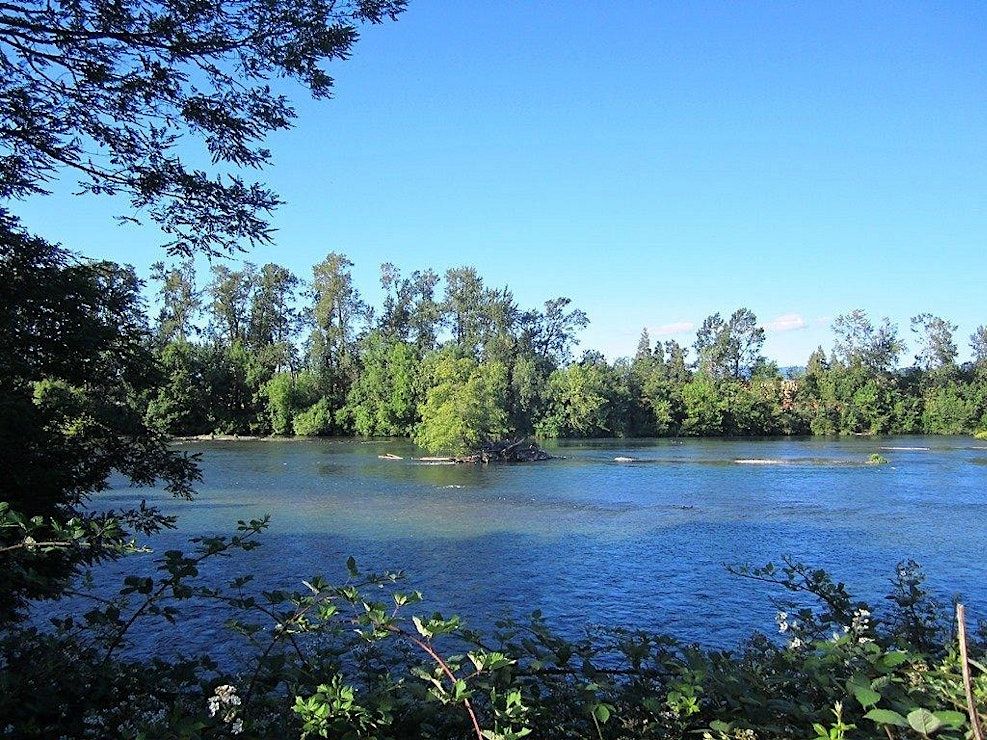
Alton Baker Park, Eugene’s largest urban park, spans over 400 acres along the eastern banks of the Willamette River. It is a vibrant space where recreation, culture, and ecology converge, offering walking and biking trails, open meadows, wetlands, and river access. The park provides opportunities for visitors to connect with nature while enjoying recreational activities, including picnicking, sports, kayaking, and birdwatching, making it a cornerstone of Eugene’s community life. Its expansive landscapes offer a sense of openness and freedom, while subtle ecological features like restored wetlands, oak savanna groves, and native plantings, invite visitors to observe the seasonal rhythms of the valley. Alton Baker Park is also a cultural and educational hub, incorporating art, history, and indigenous heritage throughout its design. The park contains interactive installations, interpretive signage, and access points to the Whilamut Natural Area, connecting visitors to the ancestral lands of the Kalapuya people.
Features like the Eugene Solar System Trail and Kalapuya Talking Stones integrate science, cosmology, and storytelling, allowing visitors to move between ecological observation and narrative reflection. Trails guide walkers past wetlands, meadows, and river viewpoints, where each turn offers both sensory immersion in the landscape and insight into the valley’s human and natural history. Beyond recreation and education, Alton Baker Park functions as a living classroom and ecological corridor. Seasonal floods, river meanders, and native wildlife are all part of a dynamic ecosystem that demonstrates the interconnectedness of land, water, and life. Whether observing migratory birds, walking the trails, or reflecting by the river, visitors will experience the valley as a living system, one shaped by both human history and natural cycles.
Foundations & Futures
The Prefontaine Trail at Alton Baker Park is a measured running and walking loop named in honor of Steve Prefontaine, the legendary University of Oregon distance runner who trained extensively along the Willamette River corridor. It reflects Eugene’s deep identity as TrackTown USA, where running is not just a sport but a cultural practice woven into daily life and landscape. The trail is a wood-chip and soft surface loop, traditionally measured at approximately two miles, designed to be forgiving on the body compared to pavement. It winds through riparian forest and open meadow within Alton Baker Park, closely paralleling the river in places. This surface and setting intentionally support endurance training, recovery runs, and contemplative movement, echoing Prefontaine’s philosophy of relentless effort paired with intimacy with place.
Nike was co founded in 1964 as Blue Ribbon Sports by Phil Knight, a University of Oregon alumnus, and Bill Bowerman, the university’s legendary track and field coach. Knight was a middle distance runner at Oregon, and Bowerman was not only his coach but a relentless innovator who believed that better equipment could unlock human potential. Bowerman famously experimented with shoe designs to make them lighter and more responsive, including pouring rubber into his wife’s waffle iron to create what became the iconic waffle sole. These early experiments directly tied athletic performance, design, and Oregon’s running culture together. The University of Oregon served as Nike’s living laboratory. Bowerman tested shoes on his athletes, refining designs based on real training and competition rather than theory. This approach linked Nike’s product philosophy to Oregon’s identity as TrackTown USA, where the pursuit of excellence, experimentation, and embodied performance were central values. Many of Nike’s early athletes and innovations emerged from this environment, embedding the university into the company’s DNA.
Over time, the relationship evolved into a broader partnership shaping campus identity and global sport culture. Nike has been a major supporter of University of Oregon athletics, funding facilities, research, and high visibility uniform design, most notably in football and track. This partnership helped transform Oregon into a national model for the fusion of sport, branding, innovation, and place. At its core, the Nike Oregon connection reflects a shared philosophy that performance is not abstract, but forged through discipline, experimentation, and deep relationship with landscape and movement.
Art & History
Temporary and permanent murals along trail access points: often depict river life, ancestral figures, and ecological restoration stories. The Path of Birds sculpture honors the Willamette River corridor as a primary migratory flyway, a living artery used by birds for thousands of years. Birds have long been understood by Pacific Northwest tribes as messengers between earth and sky, carrying knowledge, warnings, and seasonal signals. This artwork marks movement itself as sacred, reminding visitors that the valley is not static ground but a passage shaped by wings, wind, and cyclical return. Positioned along a walking route, the sculpture invites people to move with awareness, mirroring the instinctual navigation of birds who follow invisible lines of memory and magnetism.
Riverbend reflects the defining gesture of the Willamette River: its willingness to curve, slow, and change course. Ecologically, river bends are places of renewal and abundance, where sediment settles, habitats diversify, and life concentrates. The sculpture translates this principle into form, echoing the river’s patience and adaptive intelligence. It reminds viewers that resilience in natural systems comes not from rigidity, but from responsiveness to terrain, time, and flow. Riverbend serves as a quiet teaching piece, inviting reflection on how landscapes and lives are shaped through gradual, continuous movement. The Spirit of the River sculptures give form to the idea that the Willamette is not merely water, but a living presence. For Indigenous peoples of the region, rivers were understood as beings with agency, memory, and spirit, deserving respect and reciprocity. This artwork embodies that worldview, suggesting motion, breath, and continuity rather than containment. Positioned near the water’s edge, it acts as a focal point for reflection, reminding visitors that the river connects mountains to sea, past to future, and human life to larger ecological and cosmological cycles.
These installations tell a cohesive story of how the Kalapuya, Klamath, Salishan, and other Pacific North West indigenous peoples lived with a clear and common understanding of their purpose and place in the greater cosmos, by weaving Intent (prayer), and Integrity (right relationship), with movement and flow in the form of dance. The Star Dance is a recurring ceremonial motif found across multiple Indigenous cultures, including the Pacific Northwest, Plateau, Plains, and Southwest, each expressing a shared understanding that humans, stars, ancestors, and seasonal cycles are intimately connected. At its core, a Star Dance refers to ritual movement aligned with the night sky. Dancers orient themselves to specific stars, constellations, or celestial events such as solstices, heliacal risings, or seasonal star returns. The dance is a way of mirroring cosmic motion on the ground, reinforcing the belief that human life participates in the same order that governs stars, planets, and time. In many traditions, stars are understood as ancestors, spirit beings, or original people, and dancing beneath them renews relationship, memory, and balance between worlds.
Symbiotic Tree Species & Ecosystems
Along the Willamette River, in the zone considered Wetland, towering black cottonwood, red alder, and willow form a living corridor that stabilizes riverbanks, filters sediment, and cools the water with shade. These fast-growing trees are adapted to flooding and shifting soils, creating habitat for birds, insects, amphibians, and fish. Fallen leaves and woody debris feed aquatic food webs, linking forest, river, and wetland into a single system of nutrient exchange. Moving away from the river, upland, the landscape opens into meadows and upland edges where Oregon white oak, bigleaf maple, and scattered Douglas-fir take hold.
Each of these six species work harmoniously, accomplishing a different purpose within the landscape. Black cottonwood is the keystone riparian tree of the Willamette Valley. One of the tallest broadleaf trees in western North America, often reaching very large sizes, it stabilizes floodplains, cools waterways, and initiates forest succession after floods. One of the tallest broadleaf trees in western North America, often reaching very large sizes. Red alder is a pioneer and transformer species, notable for its ability to fix nitrogen and enrich depleted soils. They are known as healers of the forest, and one of the first trees to grow back after a fire. They prepare the land for longer-lived forests. Willow thrives where land and water meet and is deeply associated with flexibility, intuition, and healing. Many species produce salicin, a precursor to aspirin, historically used for pain relief. Ecologically, they prevent erosion, shelters wildlife, and signals healthy wetlands.
Oregon white oak is especially important ecologically: its open canopy allows sunlight to reach the ground, supporting diverse grasses, wildflowers, and pollinators. Dense, rot-resistant white oak wood was historically critical for shipbuilding, barrels, and durable timber structures. Oak woodlands host hundreds of insect species, which in turn sustain birds and mammals. White oak was sacred to the Druids, who believed oak trees housed powerful spirits and were conduits to the divine. Bigleaf maple enriches the soil with large, nutrient-rich leaves, while Douglas-fir anchors higher ground and provides year-round structure and shelter. Native American tribes used its large leaves in medicine and saw it as a symbol of strength. These transitional zones are among the most biologically productive in the valley. Each of these trees work to create this setting, and in their way, they teach us how to evolve and thrive in many areas of life.
Intelligent Design
These trees teach that resilient systems are layered, regenerative, flexible, and multifunctional. Red alder acts as the healer and restorer, rebuilding soil and conditions so other species can thrive. Douglas fir represents long-term endurance, combining immense size with fire-resistant protection and the capacity to shelter life through disturbance. Willow embodies adaptability and emotional intelligence, bending with forces rather than resisting them, while bigleaf maple offers broad shelter and surface efficiency, capturing light, water, and space with generosity. Black cottonwood expands the system outward, dispersing life, medicine, and genetic material across landscapes, and white oak anchors everything with longevity, strength, and multi-generational stability.
Pioneer species like alder prepare the ground; long-lived species like oak and Douglas fir provide structure and memory; flexible species like willow absorb shock; expansive species like maple and cottonwood maximize reach and coverage. Applied to human design, whether cities, organizations, or technology, this working ecosystem suggests we should build systems that restore after disruption, protect without rigidity, distribute resources efficiently, and endure across time. The lesson is clear: resilience emerges not from domination or speed, but from intelligent cooperation with environmental forces.
Bridges to the Other Side
Spanning Interstate 5 and the Willamette River, the passage reconnects Alton Baker Park and the Whilamut Natural Area with the base of Skinner Butte, restoring a sense of continuity long interrupted by modern infrastructure. Named for Whilamut—the Kalapuya name for the Willamette River, meaning “the place where the river widens”—the bridge acknowledges the deep Indigenous presence and the river’s role as a life-giving artery rather than a boundary.
Symbolically, the Whilamut Passage marks a crossing of worlds. On one side lies the open floodplain and meadow of the valley floor; on the other, the volcanic rise of Skinner Butte, an ancient landmark used for orientation, lookout, and story. To cross here is to move between river and stone, movement and stillness, past and present.
The bridge becomes a moment of pause, reminding walkers that the Willamette Valley has always been a place of passage not just for salmon, but of seasons, stars, and of people, long before highways and cities, and long after them as well.
From this vantage point, visitors can observe how water, forest, and floodplain interact, how the river shapes land, nourishes habitat, and moderates climate. The passage functions as a literal and symbolic wildlife crossing, stitching together fragmented ecosystems while inviting humans to slow down and witness the living system beneath them.
We pause for a guided mindfulness meditation, then experience the Whilamut Natural Area, through a series of exploratory invitations that encourage grounding and coherence with nature. There is nothing to do, except to observe. Walks will conclude with shared reflections - what occurred to you during the walk? What leaves feel to your feet? What breezes swept across the passages? What will you take forward? It is not hiking or exercise-focused. The emphasis is on sensory immersion: noticing the textures of bark, the sound of wind and birds, the scent of soil and leaves, and the quality of light. You move gently, pause often, and allow the environment to regulate your nervous system rather than trying to “do” or force anything productive.
Tips for your River Walk & Nature Immersion
Our session will be held outdoors with limited indoor or covered options available for inclement weather. Please dress appropriately with sturdy footwear.
Timing: Arrive 10 - 15 minutes prior for check in. Your guide will be wearing a green vest.
Duration: 1.5 Hours. Total walking time is approximately 55 minutes.
Safety: This is an easy walking tour with flat surfaces and slow pace. Remain close to the group and avoid wandering off the paths.
What to Bring: Supplies; Water (or water bottle for collecting spring/well water), snacks, yoga mats, walking stick, journals, sunscreen, disposable camera/binoculars, poncho, wipes/tissues, hand sanitizer. (Cash if you’d like to tip your guides). Clothing; Layers, waterproof walking/hiking boots in the Fall/Winter, water shoes, gloves, hat, towel.
Photography & Research: Bridges, waterfalls, and shorelines are ideal for capturing misty landscapes or atmospheric conditions in the Valley.
Respect & Preservation: Avoid entering residential and private driveways. Stick to trails and campsites, and avoid disturbing wildlife or historical structures. We encourage silence during forest bathing and riverside stops to maximize energetic and sensory experiences.
Event Venue & Nearby Stays
Alton Baker Park, 200 Day Island Road, Eugene, United States
USD 28.46