
About this Event
Join us for a conversation with Amit Chaudhuri to celebrate three of his titles, published with NYRB. He will be in conversation with Mark Krotov, followed by a signing.
PLEASE NOTE: RSVPs are encouraged but not required. Seating is limited and will be first come, first served. Doors open at 5:30 pm.
Can't attend? Order your signed copy of , , and (please specify that you would like it signed in the comments box at checkout).
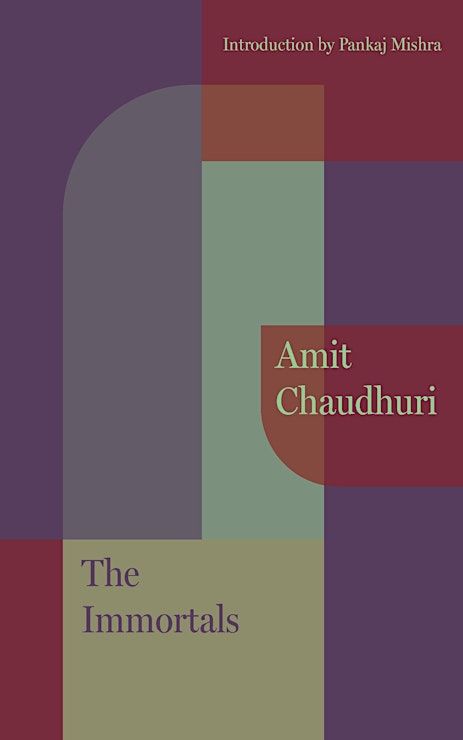
Two families in 1980s Bombay—one making ends meet in the old world of Indian classical music, the other thriving in a booming new world of corporate luxury—intersect in this lyrical novel of art and commerce, capturing a city (and country) in a state of change.
Music is central to the work of Amit Chaudhuri, who is well-known as a musician and performer himself. In his brilliantly exploratory novels, character and action develop not through the conventions of plot but through the free play of paragraph, sentence, and phrase, and in The Immortals it is music that supplies the theme for a series of entrancing fictional variations. Shyamji is the scion of a celebrated Rajasthani dynasty of singers—his father, an Indian classical musician, became renowned as the "heavenly singer"—but his own sights are set on a level of material well-being his father could not achieve. In 1980s Bombay, the business capital of India, he scrapes by as a music teacher to the rich. Among his students are Mallika, the wife of a corporate executive, and her son, Nirmalya, who will embrace the cause of Indian classical music, threatened by the modern world of money, with the fanatical devotion only a sixteen-year-old can muster. Comic and lyrical, the novel is at once a Bombay novel—"the Bombay novel," as Pankaj Mishra calls it in his introducion—a story of growing up, a picture of a milieu, and a resonant tribute in kind to the most mysterious and universal of the arts.
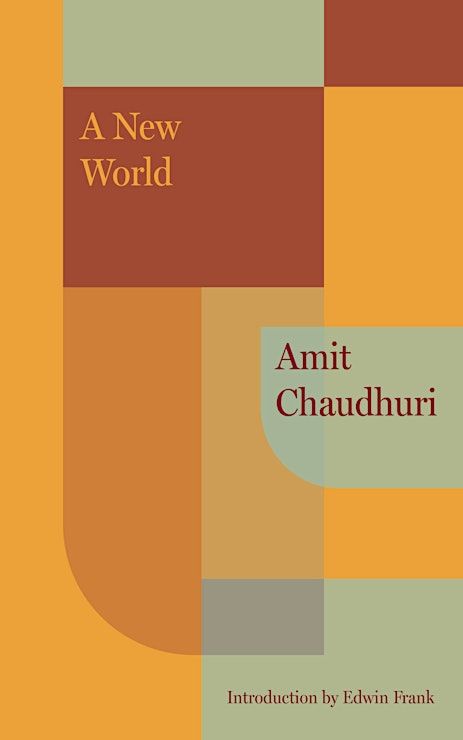
A newly divorced professor returns home to Calcutta and contends with his disconnection from his son, his parents, and life itself in this atmospheric, lushly descriptive novel of loss and the difficulty of continuing on in spite of it.
A New World is a tale of a man recovering from a difficult divorce and a story about the way we live now. Set in the 1990s, the book describes a world become, in the wake of the Cold War, more international and interconnected in which, at the same time, connection has grown ever more tenuous and harder to sustain. Jayojit, born and bred in India, is a professor of economics at a college in the American Midwest. His ex-wife has moved to California, taking their young son, Bonny, with her. For summer vacation, Jayojit has brought Bonny to Calcutta to visit his mother and father, a retired admiral in the Indian navy. The heat of summer has moved in when the two arrive; the monsoon will come before they leave. During the course of this stay, Jayojit will brood over the past and try to imagine the future, while enduring the inconveniences and misunderstandings and absurdities of family life and occasionally venturing out, alone or with Bonny, to explore the changing landscape of the city. Present throughout Chaudhuri's pages are questions central to life and to the life of the novel: What is freedom and what is responsibility? What, beyond the commotion of the moment, are the commonalities that bind us together?
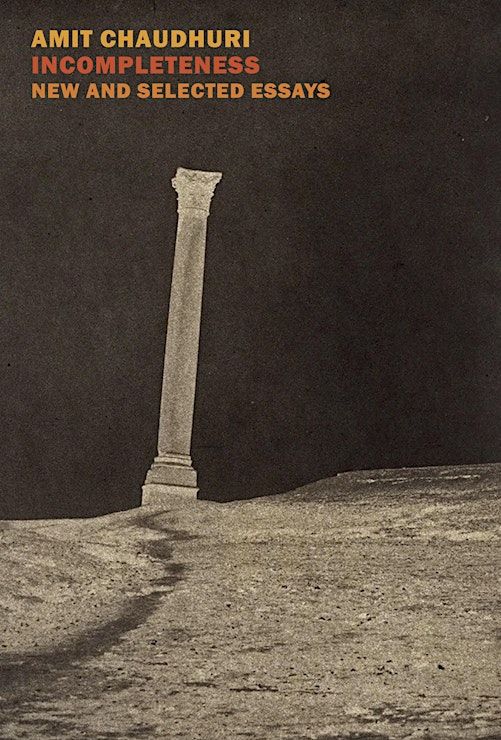
Essays on everything from the music of Joni Mitchell to D. H. Lawrence to globalization, from one of India’s preeminent writers.
“I’m an Indian, so of course I write about India. But then, again, I don’t write about India. I’m not interested in writing about India. This means I’m not entirely, or comfortably, a part of the history of the Indian novel in English either. Nor can I be part of a history that’s now been appropriated by literary journalism and publishing houses: of the form of the novel. It’s not that I’m resistant to appropriation. I’m unfit for appropriation. This may be a good place to be in.”
A brilliant prose stylist and keen innovator of literary form, Amit Chaudhuri is one of the most singular voices in contemporary letters whose essays, like his fiction, defy categorization and display a sensibility uniquely his own. Incompleteness gathers some of Chaudhuri’s best essays and criticism from more than two decades. In these pieces, Chaudhuri writes on everything from Rabindranath Tagore and Joni Mitchell to the troubles with Indian modernity, to globalisation’s appropriation of narrative storytelling over poetic incompleteness. Drolly humorous, and filled with unexpected insight, Incompleteness is incontrovertible proof that Chaudhuri is one of our most original and gifted interpreters of the world after globalization.
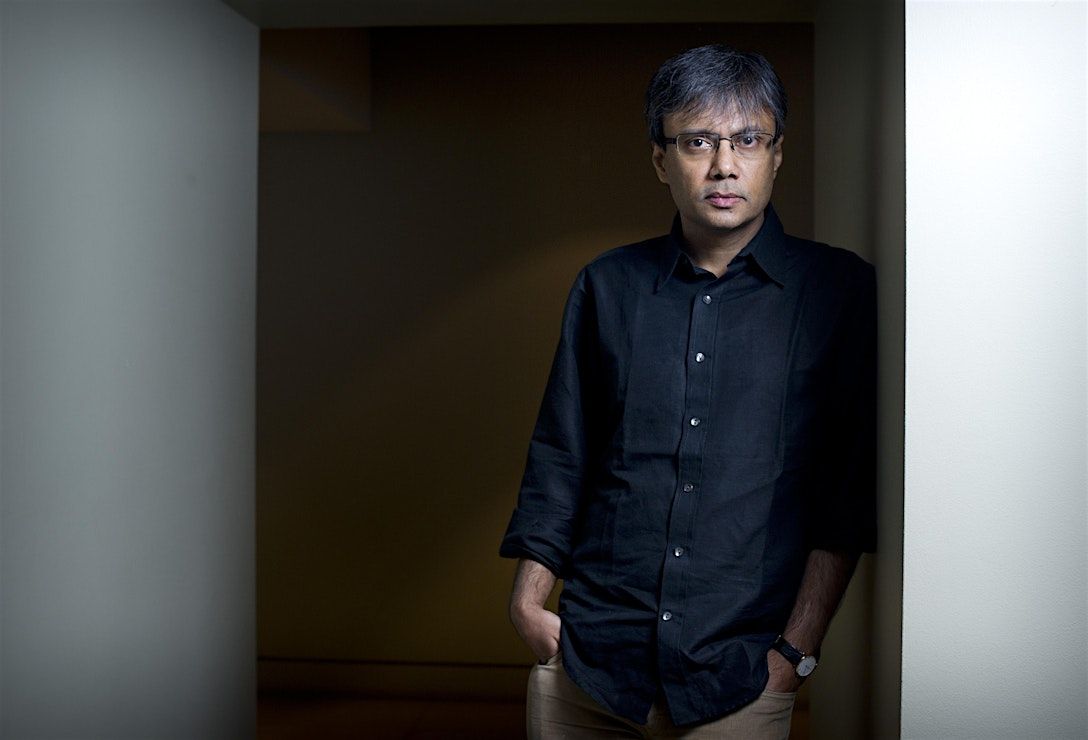
Amit Chaudhuri is a novelist, essayist, poet, and musician. A fellow of the Royal Society of Literature, he lives in Calcutta and the United Kingdom. He has written nine novels; four books of essays; a study of D.H. Lawrence’s poetry; a book of short stories; two works of nonfiction; and four volumes of poetry. Formerly a professor of contemporary literature at the University of East Anglia, Chaudhuri is now a professor of creative writing and the director of the Centre for the Creative and the Critical at Ashoka University, as well as the editor of literaryactivism.com. He has made several recordings of Indian classical and experimental music, and has been awarded the Commonwealth Writers’ Prize, the Los Angeles Times Book Prize for Fiction, the Indian government’s Sahitya Akademi Award, and the James Tait Black Prize.

Mark Krotov is the coeditor and publisher of n+1 and the coeditor of The Intellectual Situation (n+1 Books, 2024).
Event Venue & Nearby Stays
Rizzoli Bookstore, 1133 Broadway, New York, United States
USD 0.00