About this Event
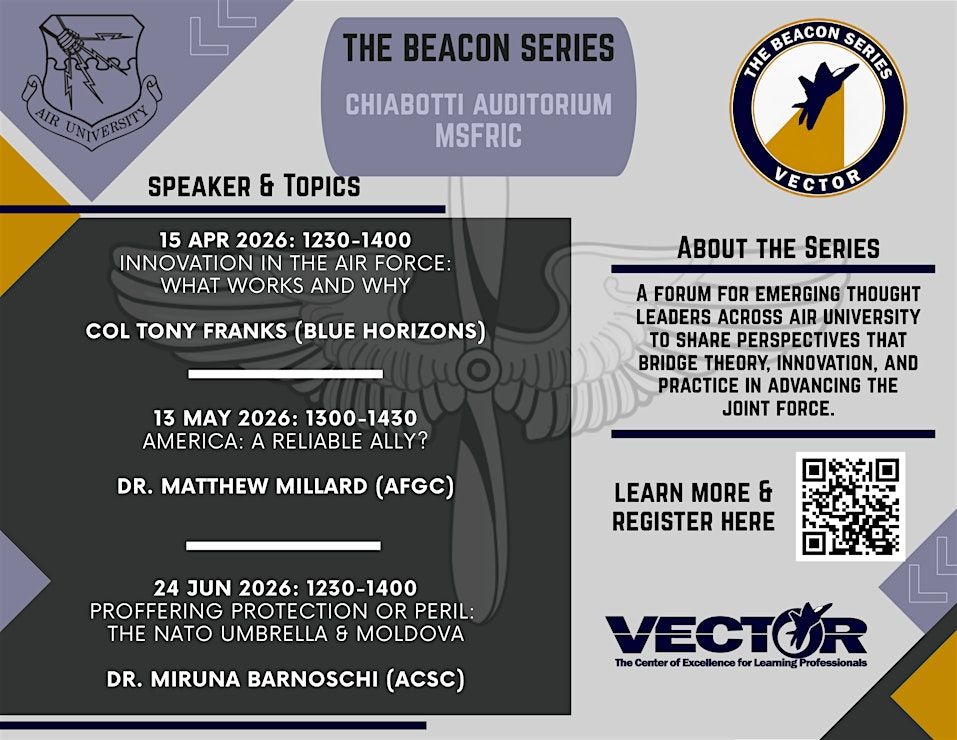
The Beacon Series is a 3-part forum in Q2 2026 where Air University learning professionals engage with emerging ideas, innovative scholarship, and critical debates shaping the future of teaching, learning, and leadership.
Each session spotlights thought leaders from across AU, offering a platform for faculty perspectives, research insights, and professional dialogue that connect scholarship to practice. The series highlights how intellectual curiosity and academic rigor inform today’s challenges—bridging theory, innovation, and application in ways that advance the joint force and elevate AU’s mission.
Through faculty-led talks, panels, and roundtables, The Beacon Series creates a scholarly exchange that inspires reflection, fosters inquiry, and strengthens the community of learning at Air University. Designed to illuminate key questions in strategy, leadership, and technology, the Beacon Series offers a consistent space for AU’s educators and students to encounter ideas in action.
Session 1: "Innovation in the AF, What Works and Why" — Col Tony Franks (Blue Horizons) lecture will be a quick history of AF innovation over the last few decades, and what the AF has been doing over the last decade to incorporate new and emerging technologies into the AF enterprise. Lecture will discuss innovation units, how they transition technology into AF requirements and program sustainment. Lecture will discuss successes and failures along this decade-long journey and what is next for AF innovation.
Session 2: "America: A Reliable Ally?" — Dr. Matthew Millard (AFGC), examines the question whether the United States is a reliable ally or not. Using quantitative evidence from the Alliance Treaty Obligations and Provisions dataset, Dr. Millard monadically and dyadically examines all alliances in the international system going back to 1816 to determine whether the United States makes a reliable formal ally. Dr. Millard identifies six alliances that the United States was involved in that ended irregularly and examines the formation, lifecycle, and termination of those alliances.
Session 3: "Proffering Protection or Peril: The NATO Umbrella and Moldova" — Dr. Miruna Barnoschi (ACSC), examines whether extending NATO’s security umbrella to Moldova would enhance regional stability or instead heighten geopolitical risk. Drawing on historical analysis of and process tracing NATO’s post-Cold War partnership mechanisms, regional security dynamics in the Black Sea area, and Russia’s strategic interests in the post-Soviet space, Dr. Barnoschi evaluates the strengths, weaknesses, opportunities, and threats associated with Moldova’s deeper integration into the Euro-Atlantic security architecture. Particular attention is given to NATO cooperation programs, the unresolved Transnistria conflict, and the strategic implications of expanding Western security commitments into a region historically viewed as within Russia’s sphere of influence. Dr. Barnoschi ultimately explores whether NATO engagement in Moldova functions as a stabilizing form of extended deterrence or as a potential trigger for renewed geopolitical confrontation.
Agenda
🕑: 12:30 PM - 02:00 PM
Session 1 (15 Apr 2026)
Info: Location: Chiabotti
Speaker: Col Tony Franks
Title: Innovation in the AF, What Works and Why
Col Tony Franks lecture will be a quick history of AF innovation over the last few decades, and what the AF has been doing over the last decade to incorporate new and emerging technologies into the AF enterprise. Lecture will discuss innovation units, how they transition technology into AF requirements and program sustainment. Lecture will discuss successes and failures along this decade-long journey and what is next for AF innovation.
🕑: 01:00 PM - 02:30 PM
Session 2 (13 May 2026)
Info: Location: Chiabotti
Speaker: Dr. Matthew Millard
Title: America: A Reliable Ally?
In "America: A Reliable Ally?", Dr. Matt Millard examines the question whether the United States is a reliable ally or not. Using quantitative evidence from the Alliance Treaty Obligations and Provisions dataset, Dr. Millard monadically and dyadically examines all alliances in the international system going back to 1816 to determine whether the United States makes a reliable formal ally. Dr. Millard identifies six alliances that the United States was involved in that ended irregularly and examines the formation, lifecycle, and termination of those alliances.
🕑: 12:30 PM - 02:00 PM
Session 3 (24 June 2026)
Info: Location: Chiabotti
Speaker: Dr. Miruna Barnoschi
Title: Proffering Protection or Peril: The NATO Umbrella and Moldova
In “Proffering Protection or Peril: The NATO Umbrella and Moldova,” Dr. Miruna Barnoschi examines whether extending NATO’s security umbrella to Moldova would enhance regional stability or instead heighten geopolitical risk. Drawing on historical analysis of and process tracing NATO’s post-Cold War partnership mechanisms, regional security dynamics in the Black Sea area, and Russia’s strategic interests in the post-Soviet space, Dr. Barnoschi evaluates the strengths, weaknesses, opportunities, and threats associated with Moldova’s deeper integration into the Euro-Atlantic security architecture. Particular attention is given to NATO cooperation programs, the unresolved Transnistria conflict, and the strategic implications of expanding Western security commitments into a region historically viewed as within Russia’s sphere of influence.
Event Venue & Nearby Stays
Air University Library (AUL), 600 Chennault Circle, Montgomery, United States
USD 0.00