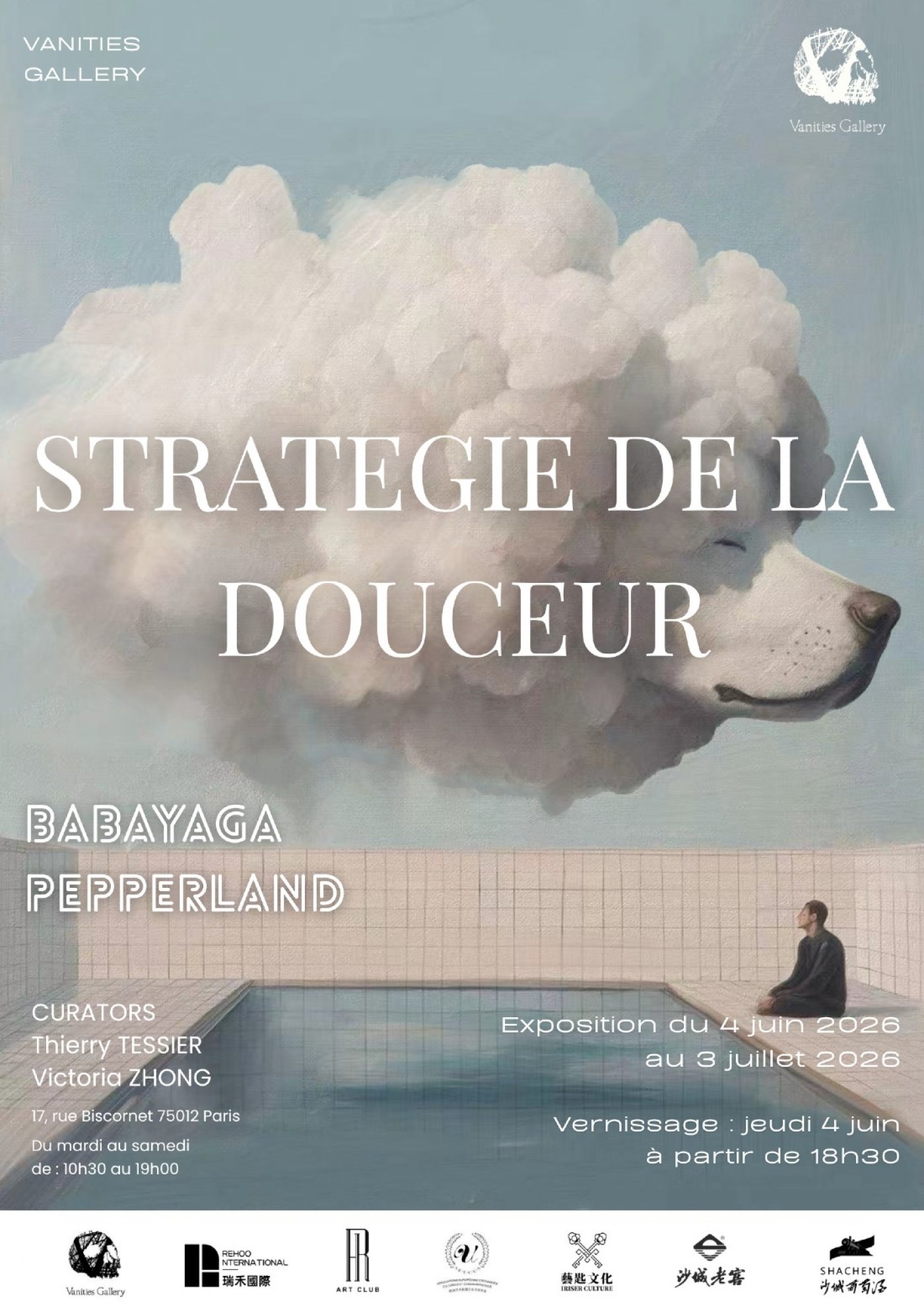
“STRATEGY OF SOFTNESS”
Solo Exhibition — June 4 to July 3, 2026
Opening Reception: Thursday, June 4, 2026, from 6:30 p.m.
There is something in the work of Babayaga Pepperland that resists classification — and it is precisely this resistance that constitutes its strength. An illustrator based in Épinal and trained at the École des Beaux-Arts de Metz, she practices digital painting on a graphic tablet with a rigor and sensitivity that challenge anyone still inclined to oppose digital media to artistic depth. Vanities Gallery is pleased to present her first solo exhibition in Paris, on view from June 4 to July 3, 2026.
Dolls in a World That Did Not Choose Them
The guiding thread running through Babayaga Pepperland’s work rests upon a metaphor she herself articulates with disarming clarity: her characters are dolls.
Each female figure she composes — strong women, lost women, women transforming into animals — is a doll placed within a world she never chose to inhabit.
This sense of displacement, of estrangement from oneself, of feeling like a spectator to one’s own life, permeates all the works presented: New Bag, She Rains, Princess, The Secret., My Friend, On the Ground, Through, The Tiny Invisible — suspended scenes poised between tenderness and unease, between fairy tale and news report.
What the artist herself describes as an “almost confessional” practice nevertheless bears nothing of emotional excess. Everything is controlled, layer by layer, silence by silence. Color — warm, muted, at times saturated to the point of alarm — becomes an emotional language where faces often remain veiled, masked, or turned away. There is something profoundly truthful in this restraint: truth is not spoken, it is shown.
“I am not sure what I am. Perhaps I am a doll someone forgot to finish.” — Sylvia Plath, The Bell Jar, 1963
This sentence by Sylvia Plath could well serve as an epigraph to the entirety of Babayaga Pepperland’s work. Not through literary imitation, but because both women share the same conviction: that unfinished, undomesticated femininity constitutes a truth more profound than any polished image.
Artistic Lineage: Between Paula Rego and Leonora Carrington
One cannot help but think of Paula Rego (1935–2022) — the Portuguese painter long underestimated and now recognized as one of the major voices of the twentieth century — when contemplating Babayaga Pepperland’s figures. Rego populated her canvases with animal-women, unsettling dolls, and domestic scenes charged with subterranean violence. She too employed the language of fairy tales to express the unspeakable: submission, resistance, the female body as the stage for opposing forces. The same tension structures Babayaga Pepperland’s compositions, except that digital media grants her a chromatic palette Rego herself might never have dared, along with a narrative fluidity entirely characteristic of her generation.
More unexpected — and perhaps even more revealing — is her affinity with Leonora Carrington (1917–2011), the British surrealist painter and writer exiled in Mexico, whose work intertwined esotericism, animal metamorphosis, and untamed femininity. Carrington populated her paintings with witches, hyenas, and bird-women without ever yielding to folklore: her figures inhabited parallel worlds that commented with surgical precision on the absurdities of reality. This is precisely what Babayaga Pepperland achieves. As she herself explains, she draws nourishment from fairy tales, esotericism, and “the things people sweep under the rug.” Even her pseudonym — borrowed from the witch of Slavic folklore and a forgotten vinyl record by William Sheller — reveals the essence of this strategy: to attract through disturbance in order to reveal more deeply.
What Distinguishes Her: Softness as a Weapon
Where Paula Rego embraced at times a brutal directness, and Leonora Carrington cultivated an overtly dreamlike strangeness, Babayaga Pepperland chooses a third path: softness as a strategy of revelation. In her own words, she creates “gentle images to tell somewhat harsh stories.” This softness is not a concession to the viewer; it is a benevolent trap. We enter her images as we enter a children’s tale — through the beauty of the colors, the grace of the silhouettes, the tenderness of the gazes — only to find ourselves confronted with truths we might rather not see.
For her, digital painting is not a shortcut but a philosophical choice: it enables this layer-by-layer process, this slow construction of an image that may at any moment be dismantled, reworked, or nuanced. It is, as she says, a way of “bringing order to one’s thoughts, transforming obsessions into images.” The work is therapeutic without ever becoming indulgent.
At Vanities Gallery, the exhibition brings together approximately fifteen prints on Dibond — a matte, durable medium that enhances the chromatic density of her compositions without flattening them. From large-scale works (up to 110 × 70 cm) to more intimate pieces (20 × 20 cm), the exhibition unfolds like a kind of encyclopedia of displaced femininity: an emotional bestiary in which metamorphosis is always possible, and never reassuring.
Event Venue
vanities gallery, 17 Rue Biscornet, 75012 Paris, France, Paris