
About this Event
During this year’s Archive Day, NADD explores the deep interconnectedness of craftsmanship and archival processes. We examine how craft, archiving, remembrance and resistance converge in contemporary creation and archival practices. Our focus is on the creators of archives and the crafts they document, preserve and reinterpret.
Crafts are often based on years of experience and practical knowledge passed down from generation to generation. This challenges conventional archival practices, while simultaneously raising questions about preservation, authorship, labour and cultural memory in artisanal traditions.
Through interactive presentations, workshops, show-and-tells and more, we address questions such as: what is the distinction between design and craft? What is the relationship between craft and cultural identity? What role do crafts play in forms of resistance and activism? How are traditions actualised, reinvented or challenged? Could archival practices themselves be considered a form of creation? And, perhaps most importantly, how do you archive craft?
Contributions come from Carlien Macnack on radical quilting; Tula Zandvliet and Julia van der Veen on reinterpreting the Dogtroep archives; Tracé and Erfgoed Limburg on connecting the heritage of Boerenbont ceramics; Hanka van der Voet on feminist labour histories; and the Rijksakademie van beeldende kunsten on preserving material practices in the studio.
Programme
- 10:00 – Joint opening, moderated by Marsha Simon
- 11:30 – Lunch and hands-on sessions
- 13:30 – Parallel panels / workshops I
- 15:30 – Parallel panels / workshops II
- 17:00 – Drinks and opening of the Collection Gallery and Just In #2 exhibitions
Tickets are valid for the whole day and grant access to two workshops in the afternoon. Tickets include lunch and beverages.
About NADD
NADD stands for Network Archives Design and Digital Culture and is a growing network of museums, creators, archives, designers, researchers and collectives. By combining forces within the network, NADD makes design and digital culture archives visible, accessible and future-proof.
Full programme
10:00 – 11:30 Plenary session: Unruly Craft Archives
Opening lecture: All Work is Women's Work
This presentation will explore how multi-modal creative practice can transform archival research into a dynamic site of feminist knowledge production. Focusing on the forgotten history of De Naaistersbond (the Seamstresses’ Union), one of the Netherlands’ first all-female labour unions, in early 20th-century Amsterdam, it considers how we might critically and materially republish the archive to bring forgotten histories to life for contemporary activism.
Show-and-tell: The Dogtroep Archives
Dogtroep was a collective of artists, makers and technicians based in Amsterdam who influenced the theatre in the Netherlands and beyond. They were renowned for their experimental, large-scale, site-specific performances, as well as their handcrafted costumes and props. Drawing on a vast private archive of analogue photographs, sketches, publications and moving images, Tula Zandvliet and designer Julia van der Veen have breathed new life into the material by translating archival forms and techniques into costume designs and a publication that celebrate craftsmanship, creativity and innovation.
Lecture: How Craft Knowledge Shapes Creative AI
In this participatory lecture, Siddhi Gupta invites the audience to envision an ‘archive of the future’ that redefines the role of craftspeople as knowledge holders, exploring how their practices can inform our interactions with Creative AI. The lecture engages with three case studies of craft practices in India, examining how these practices have shaped technological thinking.
11:30 – 13:00 Show-and-tell-and-make lunch sessions
Join one of six parallel interactive sessions, in which designers and practitioners will share their work over a picnic lunch, followed by a hands-on workshop or interactive discussion.
- Chinouk Flique Da Miranda’s Unruly Webring will activate a feminist archive through a distributed webring model that establishes links based on textual intimacy rather than hierarchy.
- Lara Bongard’s Girl with the Tablecloth will transform a Shabbat heirloom into a living archive exploring memory, food and diasporic identity.
- The Art of Spinning by Akash Kumar will explore the concept of embodied craft by hand-spinning cotton, focusing on touch, rhythm and material knowledge.
- Zyanya Arellano’s Textile Fanzine as Living Archive will explore the heritage of Mexican textiles, inviting participants to transform their memories into stitched and collaged textile zines.
- Carlien Macknack’s Radical Quilting will engage with Afro-Surinamese patchwork traditions to explore themes of care, reuse and material storytelling through collective making.
*13:30 – 15:00 Parallel sessions block #1
Workshop: Art of the Altar
This workshop will draw on Altaring Archives, a project which explores how Black queerness can be found, imagined and re-inscribed within Dutch cultural archives. Through collage and altar-making, participants will engage with archival fragments, such as photos, texts and ephemera, in order to honour overlooked histories. Focusing on photo frames and matchboxes as intimate sites of reverence, the workshop will encourage collective practices of remembrance, connection and everyday care.
With Mo Futures.
Workshop: GLINA³ Tracing from Screen to Page
This workshop will reconnect the digital screen with the hand, craft and the archive. Participants will select symbols from early digital culture (1990–2020) and trace them by hand, slowing down perception and restoring the sense of touch. These tracings will then be used to shape clay tiles, which will later be assembled into a collective mural. As the process unfolds, discussions will address AI, digital memory and archival gaps, transforming screen-based images into a shared, tactile archive.
With Aleksandra Chargeshvili and Timo Bega.
Performance panel: Colonial Haunting in Craft Archives
This performance panel will explore the traces of colonial history found in craft archives, examining how embodied, sonic and material practices can challenge the concept of archival neutrality. Three lecture performances will explore textile and VOC museum collections, discarded clay pipes and colonial objects of dispossession. Through audio narration, gestures and ritual re-performance, hidden labour and micro-histories will be revealed, presenting the archive as a site of colonial afterlives and of collective re-engagement with violent histories.
With Rupsa Nag (Talking to the Wall), NonTemporal Collective (Technosol), and Ritvik Khushu (The Criminal Tribes).
Roundtable discussion: Curtating Craft – From Archives to Audiences
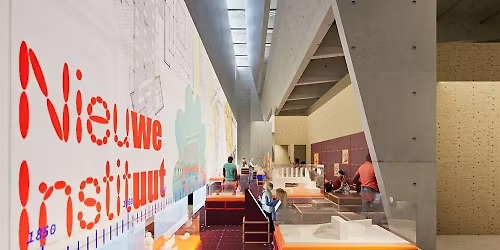
This roundtable discussion will explore how design and craft archives are curated, connected and made accessible to audiences. In the new Collection Gallery at the Nieuwe Instituut, an interactive installation featuring projections, mirror panels and artefacts drawn from almost 700 archives brings over 150 years of design history to life. The installation reveals layered narratives in which disciplines, users and time intersect. Building on this curatorial approach, the discussion will present a case study focusing on the Sphinx archive and the Boerenbont décor in collaboration with Tracé – the Limburg Society Archive and partner museums. This will highlight how reconnecting dispersed collections can reveal hidden relationships, strengthen accessibility and open new interpretative pathways for design and craft history.
With Clara Stille-Hardt (Collection Gallery, Nieuwe Instituut ), Bibi Bodegom (NADD) and Nico Randeraad (Tracé – the Limburg Society Archive).
*15:30 – 17:00 Parallel sessions #2
Roundtable discussion: Fantastical Archives and AI Reconstuctions
This roundtable discussionwill explore the intersection of AI, archiving and craft as situated design practices, in which memory is actively created rather than simply retrieved. Through three case studies – the speculative reconstruction of a lost feminist film using generative AI and collage; slow AI postcard workshops that resist the isolating logic of AI; and the AI-assisted reconstruction of a found slide archive – the concept of the archive emerges as fragmented, haunted and co-authored. Together, these projects present designers as pivotal contributors to archival systems in which AI serves as a medium for collective interpretation, material engagement and speculative remembrance, rather than automation or certainty.
With Aurélie Petit (Black Pudding), Inte Gloerich (Visual Methodologies Collective) and Tianyi Zheng (We No Longer Remember How We Got Here)
Workshop: Tools as Craft Knowledge
This session explores tools as archives of craft knowledge, formed through the collaboration between makers, materials and local ecosystems. Drawing on research in Germany and Sweden, it will examine the reconstruction of historical fibre-processing tools as an archival practice. Following a presentation and demonstration, participants will have the opportunity to experience first-hand how knowledge is embedded, shared and sustained through collective making by taking part in a hands-on spindle-making activity.
With Elena Wise
Workshop: Friction as Form
Friction as Form is a practice-based workshop that will explore friction as a narrative principle in digital culture. Contrasting with the platform logic of speed and smoothness, participants will engage with prototypes that introduce glitches, delays and contradictions into scrolling, transcription and video. Through hands-on interaction with their own devices, participants experience digital disruption as a form of crafted storytelling. The session will include collective reflection on how friction can reshape narrative, memory and archiving, as well as how resistant digital experiences can be understood as a form of contemporary craft.
With Aimain Hassani
Roundtable discussion: Craft in Motion: Archiving and Experimentation in Workplaces
This roundtable session will examine how craft is renewed through experimentation, documentation and technology. The Rijksakademie van beeldende kunsten Tech Fellowship rethinks traditional techniques through material research, collaboration and sustainability. TextielLab Amsterdam frames archiving as a dynamic practice that captures the processes of creation, iteration and technological mediation. A case study from ROC Mondriaan will reveal how the reconstruction of frivolité lace can uncover overlooked knowledge and correct misclassification. Craft emerges as a living, evolving practice that is shaped by preservation, innovation and embodied expertise.
With Damianos Zisimou and Elena Štrok (Rijksakademie) Katja van der Steen (ROC Mondriaan) and Asli Aydin Aksan (TextielLab Amsterdam/Waag FutureLab)
17:00 – 18:00 Closing and Drinks
We will end the day together with music, drinks and conversation.
All day:
The Archive Doctors
Visit our resident Archive Doctors for a one-to-one consultation on how to archive your own work, with the help of our How to Archive Better manuals.
*These afternoon sessions will provide an opportunity to delve deeper into some of the day’s key themes. Participants can choose to attend one workshop or panel discussion per block. Please note that workshop places are limited and will be allocated on a first-come, first-served basis, so kindly register your preference on arrival at the symposium.
Event Venue & Nearby Stays
Nieuwe Instituut, Museumpark 25, Rotterdam, Netherlands
EUR 0.00 to EUR 35.00