
About this Event
3-DAY MOKUHANGA WORKSHOP
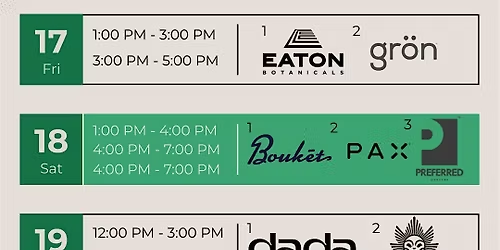
April 17 - 19
Instructors: April Vollmer, Patty Hudak, Cameron Bailey & Florence Neal
This class is an introduction to traditional Japanese woodblock printing. Each participant will cut and print an edition of 10 prints to learn about this non-toxic technique. Mokuhanga provides precise registration and great control over color, as well as a connection to an important chapter in the history of printmaking.
SCHEDULE:
Friday, April 17, 5 - 8pm
- Introduction, viewing mokuhanga prints from the Kentler Flatfiles, discussion, sample printing and reviewing student drawings for transfer
Saturday, April 18, 10am - 5pm (lunch break 1-2pm)
- Morning carving, afternoon proofing and preparation for edition printing
Sunday, April 19, 10am - 5pm (lunch break 1-2pm)
- Morning edition printing, afternoon cleanup followed by an exhibition of finished work and discussion
All materials will be provided, just bring a design sketch and any tools you already have!
VOCABULARY:
Moku means wood, and hanga can be translated as printing, mokuhanga was the default printing technique of Japan during the Edo period. Ukiyo-e is generally translated as “pictures of the floating world.” The sophisticated multi-color prints made by groups of master craftsmen during the Edo Period (1603 to 1867) were printed using the mokuhanga technique.
BAREN the traditional Japanese printing tool. The shin is the inner coil of the baren, made from thin strips of bamboo sheath twisted together in strands, which are again twisted into a long cord. The cord is coiled and tacked together with fine string and placed in the ategawa, a 5” round, shallow backing disk made from layers of washi. The two parts are wrapped with a bamboo sheath called the takenokawa, which holds them together. Baren varieties include the Kurosaki disk baren (all plastic, white), the Yoshida baren (plastic shin, wood ategawa), Murasaki Baren (synthetic cord shin), the ball bearing baren, and the hon baren (true baren), with a washi ategawa and bamboo sheath shin.
KENTO registration marks cut into the block at the depth of a sheet of paper line up the paper on successive color blocks. Kagi kento is the right angle cut in the lower right hand corner of the block, the Hikitsuke kento is the straight line cut on the long side of the block. Kento marks are always cut on the long side of the block so paper is held more easily for placement.
Event Venue & Nearby Stays
Kentler International Drawing Space, 353 Van Brunt Street, Brooklyn, United States
USD 450.00