
About this Event
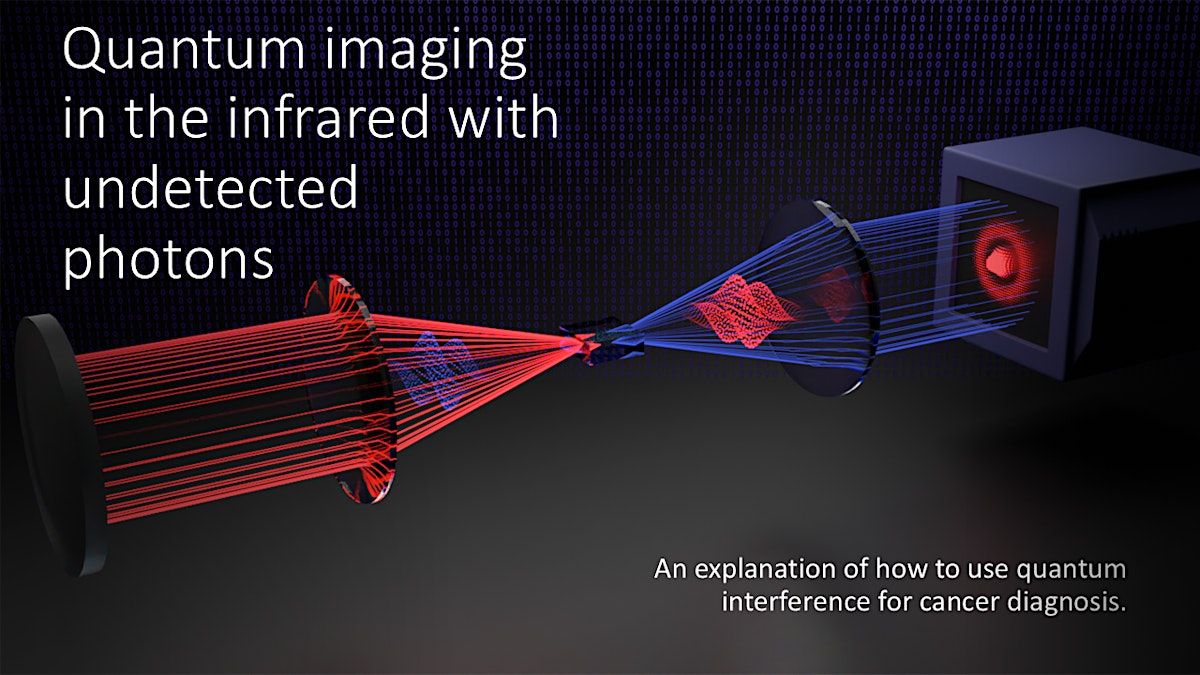
Quantum imaging in the infrared with undetected photons
Imagine a particle (such as a photon of light) that can travel along two possible paths that then overlap. If we have no way to tell which path it took, the particle behaves as if it took both paths at once. We see this through interference, a pattern built up from many single-particle detections that reveals this wave-like behaviour.
The key idea is that when the two possibilities are indistinguishable, we observe interference, as though each particle explored both options. As the paths become more and more distinguishable, the interference effect gradually fades. When the paths are completely distinct and we could, in principle, know which way the particle went, the interference disappears. This principle does not only apply to physical paths in space, but to any situation where there are two quantum possibilities that cannot be told apart.
If our two possibilities instead involve special sources that produce pairs of linked (entangled) photons, we can do something remarkable: separate probing from detecting. Thanks to interference between the different possibilities, one photon in the pair can be used to probe an object, while the other photon (which never touches the object) is used to detect its presence.
This raises an important question: why is this useful?
The infrared (IR) region of the electromagnetic spectrum contains a great deal of information, especially about the chemical composition of materials. This makes it extremely valuable for applications such as medical imaging and cancer diagnostics. However, infrared imaging is technically challenging. Infrared cameras are often expensive and less advanced than visible-light cameras, and anything warm emits infrared radiation, creating a strong thermal background that can overwhelm the signal we are interested in.
Our approach offers a way around these challenges. By using a pair of photons that are different wavelengths (one infrared and one visible) we can probe the object with infrared light, where the useful information lies, but we only need to detect visible light, using standard, high-performance visible-light cameras. In this way, we gain the advantages of infrared imaging without many of its practical drawbacks.
This new quantum imaging technology is being developed at Imperial College London, with the specific goal of creating an advanced technique for cancer diagnosis.
Dr Nathan Gemmell is a Research Fellow at Imperial College London. He completed his PhD in Infrared Single-Photon Sensing at Heriot-Watt University, followed by postdoctoral positions at the University of Glasgow and the University of Sussex. His research has covered a broad range of topics, including kilometre-range LiDAR imaging, dosimetry for photodynamic therapy, quantum ghost imaging, miniature cryocooler development, ion traps, and attitude determination for small satellites. Since 2020, he has been based at Imperial, where he develops nonlinear interferometers to realise “imaging with undetected photons” systems as part of the UK’s Quantum hub for Sensing, Imaging, and Timing (QuSIT).

Agenda
🕑: 01:45 PM - 02:00 PM
Arrival
🕑: 02:00 PM - 03:00 PM
Introduction, Acknowledgments, Talk and Questions
🕑: 03:00 PM - 04:00 PM
Questions, Discussions and Networking
Event Venue & Nearby Stays
JA327, John Anderson Building, 107 Rottenrow East, Glasgow, United Kingdom
GBP 0.00