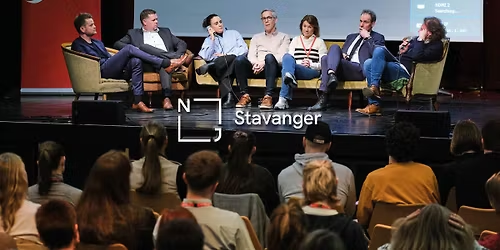
Stavanger Secession 2026 - To Live and Think Like Pigs
Kuratert av Pernille Dybvig og Charles Teyssou
Utstillingsåpning 10.04 18:00 - 20:00
Utstillingsperiode 10.04 - 25.04
Åpningstider: Tors-Fre 13:00 - 17:00 /Lør - Søn 12:00 - 16:00
REBECCA ACKROYD
ANG SIEW CHING
COOP HIMMELB(L)AU
THEO DEUTINGER
CARSTEN HÖLLER
SEBASTIAN JEFFORD
STEFFEN JØRGENSEN
ROALD KYLLINGSTAD
KEN LUM
KRISTOFFER MYSKJA
DEBORAH STRATMAN
HANNE TYRMI
XU ZHEN.
(for English, see below)
Stavanger Secession 2026 - To Live and Think Like Pigs tar utgangspunkt i grisen: dyret med den raffinerte luktesansen, men som også brukes som skjellsord; det foraktede pattedyret; cyborgkroppen som stadig modifiseres av den globaliserte agroindustrien; og tegneseriedyret, med sin syntetiske, rosa hud. Grisen er på mange måter et verdensvesen. Den bærer på en sannhet, ikke bare om modernitetens tilslørte makt og vold, men også om menneskehetens evne til å innskrive sine mest uutholdelige trekk i en annens kropp: grådighet, fråsteri, urenhet, overflod og skitt. Å leve og tenke som grisen er å eksistere i skjæringspunktet mellom industriell automatisering, masseforvaltning av kropper, antroposentrisme, og i prosesser hvor det er den andre som blir gjort til en avskyelighet.
For tredje år på rad vender hovedutstillingen til Stavanger Secession tilbake til Ølhallene på Tou Scene. Gjennom et utvalg av video, installasjon, skulptur, litteratur og tegning av norske og internasjonale kunstnere, arkitekter, forfattere og filmskapere, vil utstillingen undersøke en serie av perspektiver og ringvirkninger knyttet til årets tematikk.
Konsensus
Denne utgaven av festivalen har hentet sin tittel fra Gilles Châtelets bok med samme navn. Châtelet, som var matematiker, filosof og polemiker, beskriver den gjennomsnittlige vestlige borger gjennom det kognitive husdyret - mettet av komfort, overflod og underholdning 24/7. Han sporer den langsomme forråtnelsen av libertariansk optimisme fra 1960-tallet (1) til den libertarianske kynismen på 1990-tallet (2). Videre argumenterer Châtelet for hvordan denne kynismen senere ble brukt av den liberale motreformasjonen for å drive Vesten mot ulike former for teknopopulisme (3). Man kan knapt sies å ha vært mer klarsynt, slik man i dag observerer utviklingen av den stadig tettere alliansen mellom eliten i Silicon Valley og den ekstreme høyrefløyen på den andre siden av Atlanteren.
For å si det med hans egne ord: "To have moved from cannon fodder to consensus flesh and to informational paste is certainly a 'progress.' But these fleshes spoil quickly: consensual raw material is essentially putrescible and turns into a populist unanimity of silent majorities, which is never innocent." (1) Sinnet kan minne om kroppen, innsåpet og automatisert. Innkapslet i en kultur drevet av forestillinger om nytte og sunn fornuft, adlyder sinnet et premiss som holder middelmådighet i live. Når løftet om konsensus har etablert seg som et mål i seg selv, avsløres modernitetens besettelse av ensartethet og renhet, og derigjennom motviljen mot tvedydighet og annerledeshet.
Skam
Skam er en av de sterkeste følelsene vi har. Skammen ved å være menneske, konfrontert med vår moralske vulgaritet. Skam er den menneskelige masken vi tar på oss når vi avviser vår dyriske natur. Slik Georges Bataille poengterte:
"Today, as though clinging to what is essential, we tenaciously hold onto the dissimilarities that set us apart from the animal. Anything that recalls the animality persisting within us unfailingly appalls us and, like a prohibition, makes us recoil in horror."(2)
I kontrast til Reinsdyrtiden, hvor man svøpte seg i dyrets prestisje og ofte gjemte sitt eget ansikt bak masken av et dyr, oppstod mennesket da dette ble erstattet med den profane masken av Homo faber. "There is no other way to escape the ignoble than by becoming-animal (growling, burrowing, sneering, convulsing): thought itself is sometimes closer to a dying animal than to a living, even democratic, human being."(3)
Makt
Porcile av Pier Paolo Pasolini forteller den tragiske historien om Julian, sønnen til en velstående italiensk industriarbeider, som nekter å følge i farens fotspor og å delta i de progressive mai 68-protestene som kjæresten hans er en del av. Filmen har blitt beskrevet som en fortelling om umuligheten av å unnslippe de suverene maktformene i kapitalismens komplekse samfunn (4). Denne umuligheten utspiller seg gjennom Julians manglende evne til å velge det ene over det andre (4). I stedet for å ta et valg som imøtekommer faren eller kjærestens ønske, rømmer han til en svinesti i skogen bortenfor familiens villa hvor han gjør det utenkelige og innleder sex med grisene. Grisen blir her omgjort til en frastøtende fantasi, hvor Julian ikke bare nekter å ta stilling til situasjonen han står i, men også forsoner seg gjennom det unevnelige, uangripelige og uanstendige, det være både i et kapitalistisk, liberalt og reaksjonært samfunn. Grisen, som vanligvis er et objekt utsatt for en automatisk død, blir her omgjort til et symbol på åpenbaring, funnet på baksiden av frihetens emblem.
For å kunne bedre forstå besynderlighetene ved denne påstanden, må man vende tilbake til forbindelsen mellom grisen og den moderne arbeideren, slik den kommer til uttrykk i utviklingen fra slakterhus til fabrikk. Som Henry Ford bemerket, var slakterhusene i Chicago de første i historien til å introdusere konseptet samlebånd. I nyere tid har Vasile Stănescu videre observert hvordan det ikke bare er grisen, men også mennesket, som på det tidspunkt ble underlagt kapitalismens konformitet:
"Animals, as living beings, were largely irregular and messy... In order to make sure the animals were processed correctly, a large number of workers were required. But the workers, as living beings as well, were largely irregular and messy. You have on the one hand a huge series of technological innovations: the overhead drag line, the conveyor belt, automatic shifters, etc.; and on the other hand, you have to use these workers that are a friction to the capitalist desire for speed and control. The companies didn't just need hogs to submit; they needed to figure out how to make the workers submit as well."(5)
/
EN
Stavanger Secession 2026 – To Live and Think Like Pigs takes the pig as its point of departure: the animal endowed with a refined sense of smell but also the insult; the vilified mammal; the cyborg body genetically modified by globalized agro-industry; and the cartoon figure with synthetic pink skin. The pig is a world-being, carrying a truth not only about the obscuring power of modernity and its violence, but also about humanity’s capacity to inscribe its most unbearable traits into the bodies of others: greed, gluttony, impurity, excess, and filth. To live and think like pigs is to exist at the intersection of industrial automation, the mass management of bodies, the comfort of anthropocentrism, and the process through which the other is rendered abject.
For the third year in a row, the main exhibition of Stavanger Secession returns to Ølhallene at Tou Scene and will explore the following sentiments through a selection of video, installation, sculpture, literature and drawing by Norwegian and international artists, architects, authors and filmmakers.
Consensus
This edition takes its title from the eponymous book by Gilles Châtelet. A mathematician, philosopher, and polemicist, Châtelet describes the cognitive livestock that the average Western citizen has become at the dawn of market democracies—satiated by comfort, abundance, and cathodic 24/7 entertainment. He traces the slow “putrefaction of libertarian optimism” (1) in the 1960s into the “libertarian cynicism” (1) of the 1990s. The latter rapidly “became the close auxiliary of the liberal Counter-Reformation, pushing the West toward forms of techno-populism” (1). Hardly could one be more clear-sighted, as the alliance between the Silicon Valley elite and the extreme right wing is rapidly intensifying on the other side of the Atlantic. To put it in his words: “To have moved from cannon fodder to consensus flesh and to informational paste is certainly a ‘progress.’ But these fleshes spoil quickly: consensual raw material is essentially putrescible and turns into a populist unanimity of silent majorities, which is never innocent.”(1) Minds resemble bodies, soaped and motorized. They obey a culture of usefulness and common sense, both notions serving as vectors of a premium mediocrity. For the promise of consensus, conceived as an end in itself, reveals modernity’s obsession with uniformity and purity, and thus a hatred of ambiguity and otherness.
Shame
Shame is one of the most powerful feelings. The shame of being human, confronted with our moral vulgarity. Shame is the human mask we put on when we abjure our animality. “Today, as though clinging to what is essential, we tenaciously hold onto the dissimilarities that set us apart from the animal. Anything that recalls the animality persisting within us unfailingly appalls us and, like a prohibition, makes us recoil in horror.”(2) In contrast to the men of the Reindeer Age who, cladding themselves with the prestige of the beast, almost always concealed their features behind an animal mask whenever they depicted themselves, human beings were born by substituting this mask with the profane one of the homo faber. “And there is no way to escape the ignoble but to play the part of the animal (to growl, burrow, snigger, distort ourselves): thought itself is sometimes closer to an animal that dies than to a living, even democratic, human being.”(3)
Power
Porcile by Pier Paolo Pasolini tells the tragic story of the son of a wealthy Italian postwar industrialist who refuses to follow the path of his father or to join the progressive May ’68 protests embodied by his girlfriend. “The film can be described as a film about the impossibility of escaping sovereign forms of power in advanced capitalist society. This impossibility materializes in Julian’s incapacity to enter history either on the side of the fathers or on that of the students’ protests. Instead of demonstrating with the students or conforming to his father’s will, Julian decides not to undertake either of these possibilities. He rather prefers to disappear into the pigsty located in the forest of his father’s villa, performing the unsayable act of having sex with the pigs.”(4) The pig is an abject fantasy. Julian not only refuses what is presented to him but reconciles himself with something unspeakable, unimaginable, and incorruptible by capitalist society, whether liberal or reactionary. The pig, normally the object of automated death, becomes the symbol of a negative epiphany and the inverted emblem of freedom.
To grasp the oddity of this claim, one must recall the indelible link between the pig and the modern worker contained in the evolution of the modern slaughterhouse into the factory. As Henry Ford noted, the Chicago slaughterhouse was the first moving line ever installed. In that regard “Animals, as living beings, were largely irregular and messy... In order to make sure the animals were processed correctly, a large number of workers were required. But the workers, as living beings as well, were largely irregular and messy. You have on the one hand a huge series of technological innovations: the overhead drag line, the conveyor belt, automatic shifters, etc.; and on the other hand, you have to use these workers that are a friction to the capitalist desire for speed and control. The companies didn’t just need hogs to submit; they needed to figure out how to make the workers submit as well.”(5)
/
1- Gilles Châtelet, To Live and Think Like Pigs: The Incitement of Envy and Boredom in Market Democracies. Trans. Robin Mackay. London: Urbanomic / MIT Press, 2020.
2- Georges Bataille, “The Representation of Man: Man Clad in the Glory of the Beast,” in Visions of Excess: Selected Writings, 1927–1939, ed. and trans. Allan Stoekl (with Carl R. Lovitt and Donald M. Leslie Jr.). Minneapolis: University of Minnesota Press, 1985, pp. 83–102
3- Gilles Deleuze & Félix Guattari, What Is Philosophy? Trans. Graham Burchell and Hugh Tomlinson. New York: Columbia University Press, 1994, p. 108.
4- Filippo Trentin, Pasolini’s Anti-Relationality: Porcile and the Negative Turn in Queer Theory.
5- V. Stănescu, Slaughterhouse capitalism: Animal resistance, effeminate rice eaters, and solidarity as the basis for animal liberation, 2025
Image: Porcile (Pigsty). 1969. Italy. Written and directed by Pier Paolo Pasolini. Courtesy Cinecittà Luce/Movietime/MoMA
Event Venue
Tou, Kvitsøygata 25, 4014 Stavanger, Norge, Stavanger, Norway
Tickets

Concerts, fests, parties, meetups - all the happenings, one place.