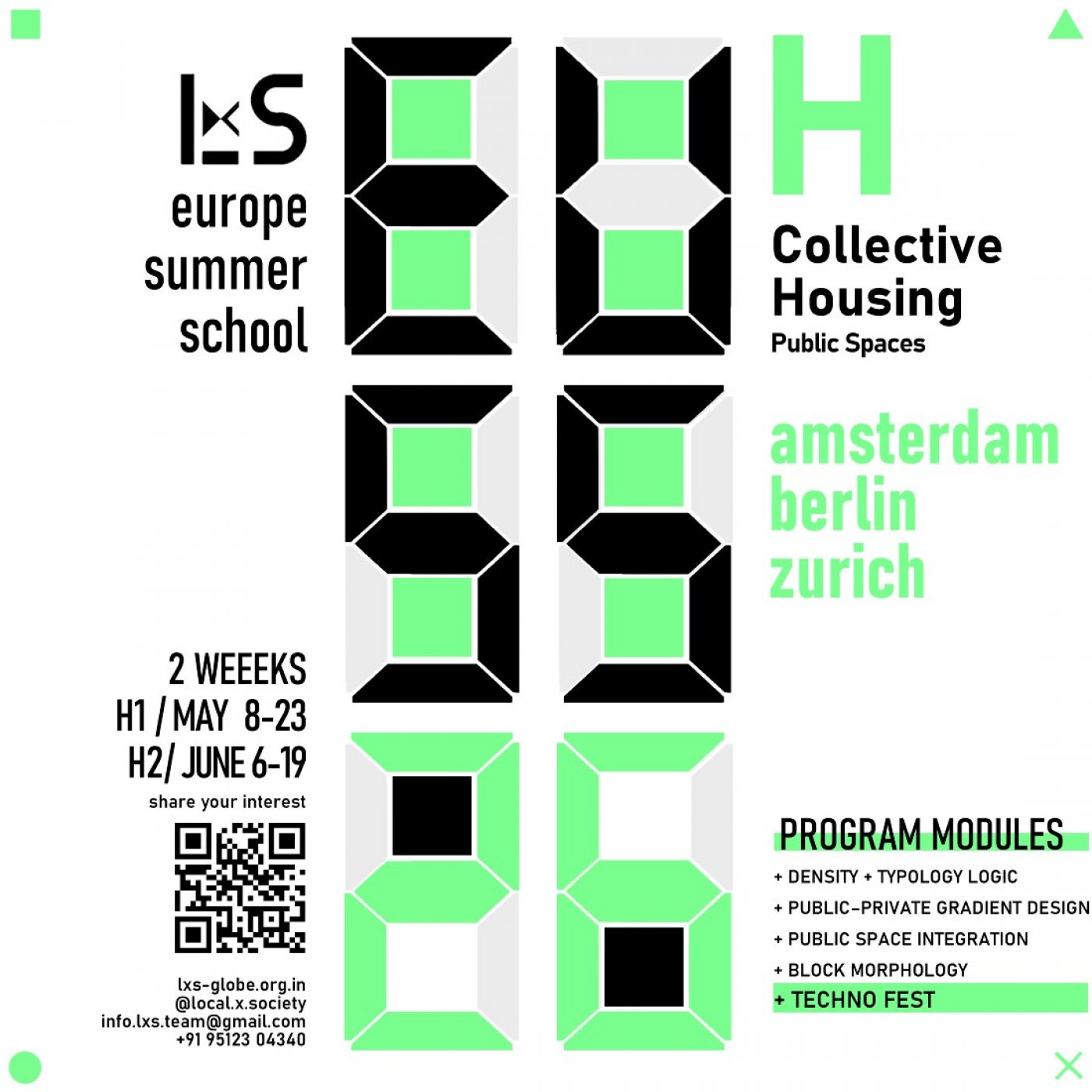
Collective Housing and Public Spaces
-- LEARNING MODULE --
< UNIT → CLUSTER → BLOCK → STREET → CITY >
Collective housing is understood as a multi-scalar system, where architectural decisions at the level
of a single dwelling influence shared spaces, urban form, and public life. This course is structured to
move progressively across scales—from the interior logic of housing units to the collective life of
streets and cities—allowing students to understand housing not as isolated buildings, but as urban
infrastructure.
< UNIT Vs CLUSTER — “DENSITY AS SPATIAL INTELLIGENCE >
At the smallest scale, students learn how density is shaped through unit design and clustering
strategies rather than numbers alone. The focus is on typological logic, methods of unit aggregation,
and the spatial relationships formed between individual dwellings and shared semi-private spaces,
shaping patterns of use, privacy, and social interaction.
< PUBLIC–PRIVATE GRADIENTS — FROM HOME TO COLLECTIVE LIFE >
Collective housing depends on carefully calibrated transitions between private and shared domains.
Students study how architecture structures everyday social life through spatial sequencing—moving
from domestic interiors to collective spaces—using gradients of privacy, thresholds, courtyards,
galleries, and shared amenities to mediate interaction, belonging, and retreat.
< BLOCK MORPHOLOGY & EDGE CONDITIONS — HOUSING AS URBAN FABRIC >
At the block and street scale, housing operates as a fundamental component of urban form. Students
examine block typologies and morphologies, focusing on active edges, ground-floor conditions, and
street interfaces, and how housing projects shape public space, continuity, and the character of the
city.
< DESIGN DEVELOPMENT — “HOUSING + PUBLIC REALM >
Students synthesise learning across scales to develop a housing concept embedded within the public
realm through diagrammatic reasoning.
< CITY & FUTURE MODELS — “HOUSING AS URBAN SYSTEM >
At the city scale, students investigate housing as an integrated urban system shaped by mobility
networks, landscape structures, and sustainability frameworks. The focus is on emerging and hybrid
housing typologies and on understanding how residential architecture participates in future patterns
of living.
Event Venue
Zürich, Zürich, Switzerland, Zurich
INR 48000.00