

About this Event
Emerging Neuroscientists Seminar Series: Dr Sonja Blumenstock
This event will take place on Thursday 5 March 2025 at 12pm (BST).
The seminar will be held at 25 Howland Street, London, W1T 4JG. This central location provides easy access for attendees.
Don't miss out on this informative and engaging event. Register now to secure your spot!
Talk Title: Restoring motor performance through targeted circuit intervention in Huntington’s disease mice
Abstract:
Precise motor control is essential for an animal’s well-being. It emerges from coordinated activity across interconnected brain networks and depends on a fine balance between excitation and inhibition within local circuits. When these interactions break down, motor control fails. Neurodegenerative movement disorders such as Huntington’s disease (HD) offer a window into failure modes of brain circuits — and into the possibility that dysfunctional circuit states might be actively reshaped.
HD is marked by progressive motor impairment and early dysfunction of cortical and striatal circuits, long before widespread neuronal loss. This raises a central question: do motor symptoms reflect irreversible degeneration, or maladaptive circuit dynamics that could, in principle, be corrected? While alterations in synaptic connectivity and excitatory–inhibitory balance have been implicated in HD, it remains unclear (i) which neuronal subtypes are selectively vulnerable, (ii) how their activity dynamics change during behavior and across disease progression, and (iii) whether precise modulation of specific circuit elements can restore functional network activity.
To address these questions, we used longitudinal in vivo two-photon calcium imaging to examine the activity of VIP, SST, and PV inhibitory interneurons, as well as corticostriatal projection neurons, in the motor cortex of HD model mice during spontaneous and learned movements across disease stages. We found pronounced, neuron-type-specific dysfunction. This included a marked hypoactivity of VIP interneurons that tracked behavioral decline. Finally, we demonstrate that optogenetic activation of VIP interneurons can normalize corticostriatal activity and produces sustained improvements in motor performance.
Together, these findings show how cell-type-specific circuit dysfunction contributes to impaired motor performance in neurodegeneration. More broadly, they identify inhibitory interneurons as levers for reshaping cortical network states and restoring behavior, even in the context of ongoing disease.
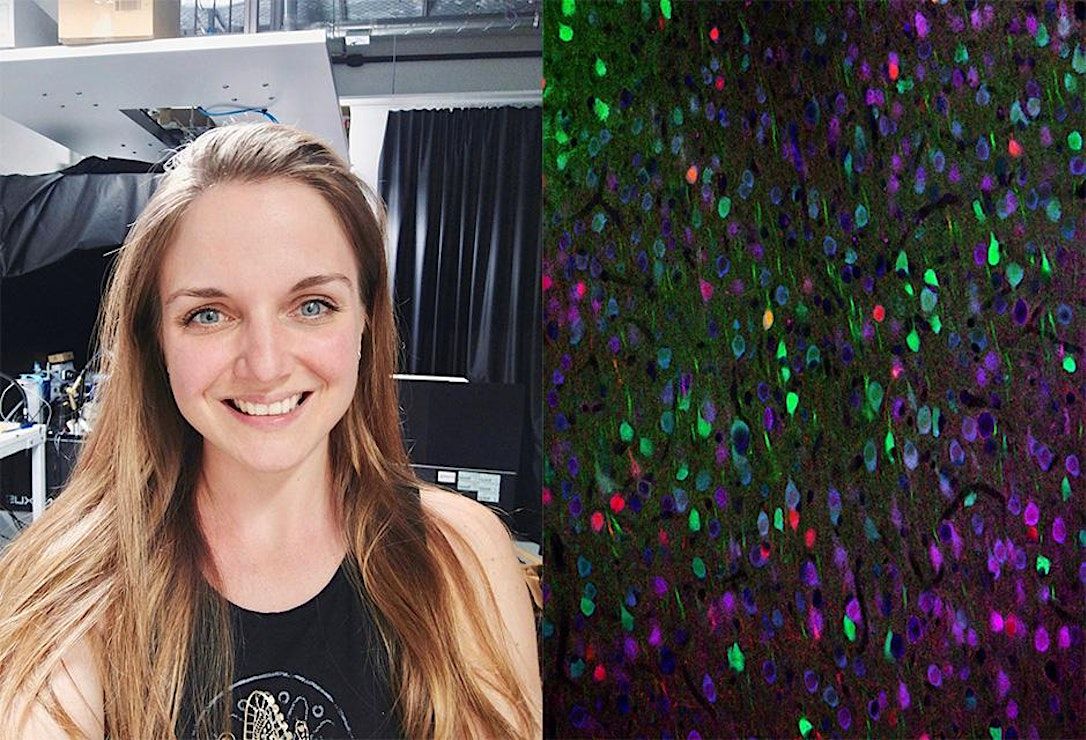
About the speakers: Sonja Blumenstock
Sonja completed her undergraduate training in Biochemistry and earned a Master’s degree in Experimental and Clinical Neuroscience at the University of Regensburg, Germany. She received her PhD in 2017 from the German Center for Neurodegenerative Diseases (DZNE), where she investigated mechanisms of synaptic decline in neurodegeneration. She subsequently joined the laboratory of Irina Dudanova at the Max Planck Institute of Biological Intelligence as a postdoctoral researcher, focusing on molecular and circuit signatures of Huntington’s disease. In 2021, she established a research collaboration with the laboratory of Takaki Komiyama at the University of California San Diego as a Visiting Scholar and formally joined the lab in 2024 as an Assistant Project Scientist. Her research integrates longitudinal in vivo imaging, optogenetics, and behaviour to uncover cell-type-specific circuit mechanisms underlying motor control and neurodegenerative disease.
Event Venue & Nearby Stays
Sainsbury Wellcome Centre, 25 Howland Street, London, United Kingdom
GBP 0.00