About this Event
This event is also being streamed via Zoom - please make sure you pick the correct ticket type for your booking. In-person attendees must book in advance as there is limited space. Thank you.
The recording for this lecture will not be available.
To pay via bank transfer, contact: [email protected]
Zoom attendees will receive the link to join in the confirmation email from Eventbrite.
When Power Speaks Ancient Egyptian: European Monarchs as Egyptian Pharaohs, or the Craze for Neo-hieroglyphic Inscriptions in 19th Century Europe
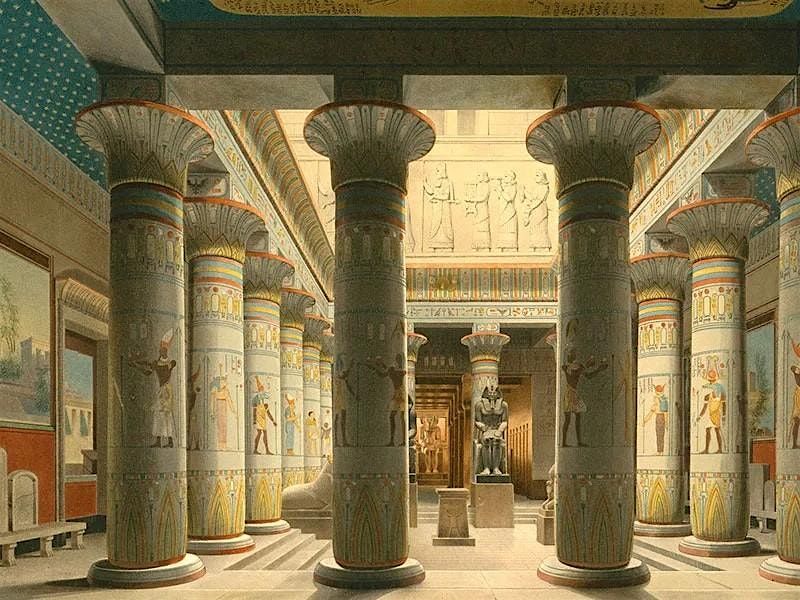
Through Champollion’s decipherment in 1822, ancient Egyptian hieroglyphs ceased to be the silent script they had been for centuries, and started speaking again. Over just a couple of decades, an ever-increasing number of scholars began to translate the myriad texts left behind by the ancient Egyptians, to thus reconstruct their lives and the country’s ancient history. But, what is less known is that Champollion himself, alongside several of his contemporaries, applied his knowledge of hieroglyphs and the ancient Egyptian language not only to read the ancient texts, but also to create new ones. Throughout the 19th century, Egyptologists composed brand new hieroglyphic inscriptions to celebrate their own rulers, in a mix of intellectual divertissement and self-interested cosying-up to heads of state or politicians (often, the very sponsors of their academic pursuits). Such inscriptions were not simply printed in books, but were incorporated in major architectural projects of the time, which included, for example, London’s Crystal Palace (celebrating Queen Victoria and Prince Albert), Berlin’s Egyptian Museum (in honour of the King of Prussia), the Egyptian galleries in the Vatican Museums, or even two pairs of granite obelisks in Rome (to flatter the Pope and members of the Roman aristocracy). This lecture will tackle this unique and little-known aspect of European Egyptomania—the craze for ‘neo-hieroglyphic’ inscriptions—by presenting and discussing surprising examples from all corners of Europe, at the crossroads of academic Egyptology and European politics.
Dr Luigi Prada is Associate Professor of Egyptology at Uppsala University, Sweden. He works primarily on textual and cultural-historical studies, with a focus on the later phases of Egypt's history and language(s) / scripts. He has published extensively on a variety of topics, including ancient Egyptian dreams and divination, scribal education and schooling, graffiti and rock inscriptions, ancient translations (Graeco-Egyptian), obelisks, hieroglyphic inscriptions (from the Old Kingdom to the Roman Period), cursive scripts (hieratic and demotic), Coptic, ancient rudeness and insults. Prior to Uppsala, he has held academic positions in the UK (Oxford and the British Academy), Germany (Heidelberg), and Denmark (Copenhagen). He is active in the field, both in Egypt as Assistant Director of the Oxford-Uppsala Epigraphic Project in Elkab, and in the Sudan. He is constantly engaged in public outreach, through public lectures and as a consultant for international exhibitions (most recently, the Getty exhbition ‘Beyond the Nile: Egypt and the Classical World’ in Los Angeles). He is an Honorary Research Associate in Egyptology at the Griffith Institute, Oxford.
Event Venue & Nearby Stays
The Renfield Training and Conference Centre Glasgow, 260 Bath Street, Glasgow, United Kingdom
GBP 11.55