
About this Event
The presentation will take place in the Koret Auditorium at the de Young Museum in San Francisco. Attendance in person is free.
Eventbrite tickets are for those who cannot attend in person and would like to view the live Zoom broadcast. A recording will be available for 14 days following the talk. Textile Arts Council Members: You do NOT need to purchase a ticket, your link will be emailed to you.
With nothing more than yarn and cards, it is possible to weave bands of great complexity and beauty that delight the eye and intrigue the mind. People who love the intricacy of pattern and structure are drawn to card weaving. This lecture will focus on my creative work using this ancient craft in which simple cards, or flat tablets, form the “loom”. I began my journey as a loom weaver in the 1960s, and I continue to work as one today. But today, I will focus on my work in card weaving.
The title of today’s lecture comes from a book by Mary Meigs Atwater, first published in 1954, titled Byways in Handweaving: An Illustrated Guide to Rare Weaving Techniques. Card weaving is the first chapter and describes many variations found in different parts of the world. I didn’t understand her instructions, but I knew this was something amazing. Thus, my journey began, and eventually led to historical research, a book, other books, exhibitions, a tenure-track teaching job, and a body of work.
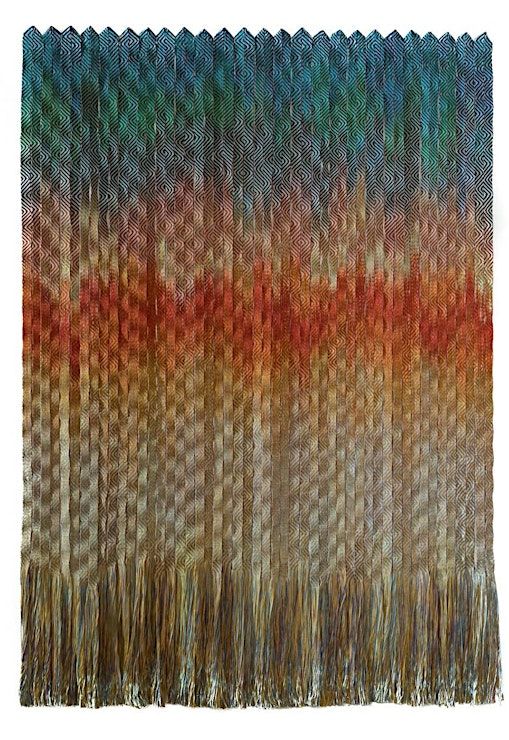
My card-woven work involves assembling narrow bands into a whole. I work in natural fibers: smaller with fine silk threads, and larger with wool, cotton, and linen. Currently, I am working with white mercerized cotton thread. I prepare the warp threads and then, using the soda-soak technique with Fiber Reactive dyes, I paint them. Frequently, I work in layers, separating and combining painted threads to create distinct patterns and color movement as they form a woven whole.
This lecture will introduce you to the complex technique and describe some of the woven structural possibilities that have influenced my work - how one technique, one byway, led to lifelong engagement and a lifetime body of work
Candace Crockett taught in the Art Department at San Francisco State University for more than thirty years. She was head of the Textiles Area and for the two years preceding her retirement, Department Chair. After many years of splitting her time between San Francisco and Italy she is now dividing her time between San Francisco and her studio in rural Nevada.
An important theme in her career as an artist involves using historical and ethnic techniques and imagery in fresh new ways. The fabrics of William Morris, card woven textiles from Turkey, Kuba designs from equatorial Africa, and Ikat fabrics from the world over, have been important influences in her work.
Although she began as a loom weaver, she started working with card weaving in the 1960s and continues to explore its many possibilities. She also continues to do loom work as well as dyeing and printing on thread and fabric.
She is the author of two books, Card Weaving and The Complete Spinning Book, and is the coauthor, with Marcia Chamberlain, of Beyond Weaving, a book on off-loom techniques.
She has exhibited widely, having a major retrospective exhibition in 2010 at the Ducal Palace in Massa, Italy, and a second solo exhibition in Bagnone, Italy. In 2013 she was included in a major exhibition at the Petaluma Art Center, titled Four Weavers. Recently, in 2025, she participated in the Honeycomb project based in Reno, Nevada.
In 1997 Candace was the principal curator for the exhibition The Fabric of Life: 150 Years of Fiber Art History in Northern California in the Art Department Gallery at San Francisco State University and was one of the essayists for the catalogue.
Learn more about the Textile Arts Council.
Event Venue & Nearby Stays
de Young Museum, 50 Hagiwara Tea Garden Drive, San Francisco, United States
USD 7.18 to USD 17.85