

About this Event
Summary
Abstract
Research at intersection of biology, mechanics, and electronics – i.e. Biomechatronics – is now recognized as a burgeoning field of study. The last two decades have heralded breakthroughs in robotic interface with the nervous system to replace limbs, enhance the senses, treat neurodegenerative disease, and even augment human strength. However, gaps remain in the fusion of neuroscience and engineering leading to differing visions to achieve the promise of cybernetics.
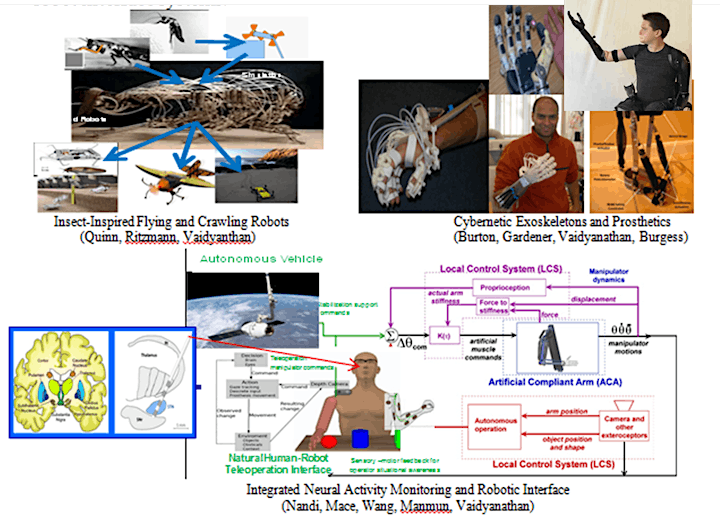
In his inaugural lecture, Ravi Vaidyanathan will contrast methodologies for the enhancement of engineering (robotic) design based upon biological studies, with emphasis systems thinking in neurorobotics and human augmentation (cybernetics). The core hypothesis is that complex behaviour emerges from the interaction of an entity with its environment as a result of sensory-motor activity; a breadth of subsystems must be tuned and adapted to achieve this objective. Architectures founded upon biological inspiration will be summarized with specific examples from his work in insect-inspired robots (bugs), medicine (body parts), and human performance (bionics).
Further information:
ICL Biomechatronics Website: http://www.biomechatronicslab.co.uk/
BBC Click Broadcast: https://www.bbc.co.uk/news/av/technology-38651446
Parkinson’s Telemedicine Press Coverage: https://www.bbc.co.uk/news/technology-57342760
Human-Robot Interface Systems:
Biography
Ravi Vaidyanathan joined Imperial College London (ICL) in 2012. His laboratory (http://www.biomechatronicslab.co.uk/) has pioneered a range of biomechatronic systems with applications ranging from human performance, smart environments, and neurorobotics. Professor Vaidyanathan has authored 100+ refereed publications, 6 pending or issued patents and has been featured for innovation by groups including: the Royal Academy of Engineering (RAEng), the BBC, New Scientist, The Engineer, Inc. Magazine, IEEE Institute, Flight Global Magazine, The Times of India, The Discovery Channel, and the Tokyo Broadcasting Company. In 2021 his work in Parkinson's Disease and Dementia won awards from both Google and Sony for globally innovation. His research has supported the formation of 4 new companies in medical and consumer sectors. Professor Vaidyanathan has been invited to present his research at the US Pentagon, UK Parliament and the UK Prime Minister’s Residence at 10 Downing Street. He completed his PhD at Case Western Reserve University (USA) . Prior to his post at Imperial he has held two industrial directorships as well as academic positions at the University of Bristol and the US Naval Postgraduate School.
For any queries related to the event, please contact [email protected]
Please note, Imperial College London processes your data according to the Events Privacy Notice. If you have any questions or concerns about this, please contact [email protected]
Event Venue & Nearby Stays
Virtual event/Lecture Theatre 200, City and Guilds Building (dependent on ticket type), Imperial College London, London, United Kingdom
GBP 0.00