
About this Event
Theory vs. Stamp Collecting: Delivering Large-Scale & Diverse Cognitive Science
"Physics is science; everything else is stamp collecting.” This apocryphal line, often attributed to Nobel laureate Ernest Rutherford, is a reminder that explanation rather than accumulation is meant to be a scientist’s higher calling. Yet in the field of cognitive science today, we inhabit a landscape rich with potential explanations for mind and brain. Some are narrative, others formal and computational, and they span many levels of description. They range from accounts of narrow phenomena through to grand unifying frameworks akin to those in physics, such as the free energy principle, which aims to account for all of perception, action and cognition.
Such endeavours are of course vital for progress. However, there is growing evidence that for some basic phenomena, we need more (and quite different) stamps to know which theories deserve to survive. In this talk, I draw on a few highly selective(!) studies using methods from virtual reality to neuroimaging, mainly the 101-year-old technique of scalp recorded EEG, to illustrate shortcomings of a few widely cited theories. I then outline our approaches for increasing both the scale and diversity of the datasets against which models can be properly tested, and from which more robust theories might emerge.
Finally, I speculate wildly about how these approaches might help overcome some of the limitations of current AI-driven methods for understanding brain and behaviour.
Lecture and questions 3-4pm. Refreshments 4-4.30pm.
Profile
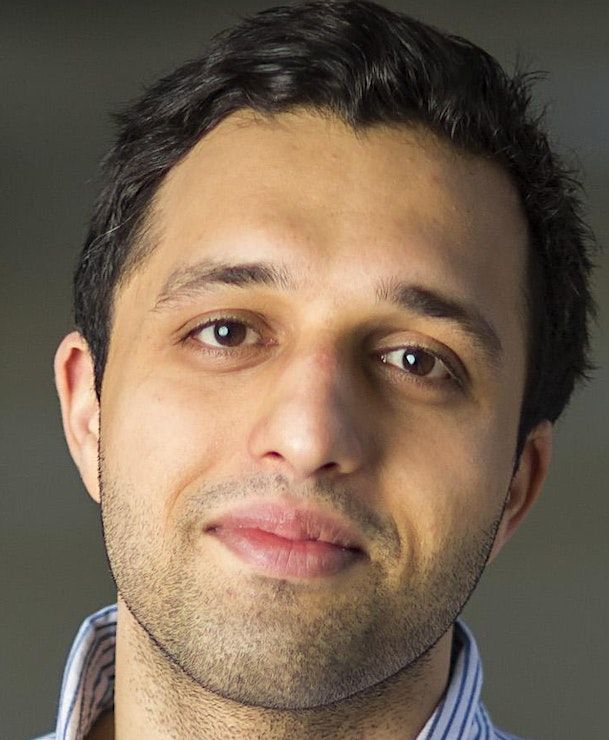
Faisal Mushtaq is a Professor of Cognitive Science and the Director of the Centre for Immersive Technologies at the University of Leeds.
Faisal and his team have received several national and international awards for their impact on neuroscience and virtual reality. Faisal Co-Direct's the #EEGManyLabs programme, one of the largest meta-science efforts in the world, involving >240 scientists from >40 countries. He is the Action Chair for EEG101, the first pan-European neuroscience programme dedicated to improving methods and practices for scalp-recorded electrophysiology. His team have created and maintains the most widely used open-source VR research toolbox- the Unity Experiment Framework.
Faisal is a former Fellow of the Alan Turing Institute, the UK's National Centre for Data Science and AI. He sits on the British Neuroscience Association's Credibility Advisory Board and is a part of the Steering Group for the Global Brain Consortium. As Research Theme Lead at the Centre for Applied Education Research, he launched Code/Place, a community-based initiative working to digitally upskill children and young people through Citizen Science.
Event Venue & Nearby Stays
Worsley Building, Clarendon Way, Woodhouse, United Kingdom
GBP 0.00