About this Event
https://vimeo.com/783733294
SYNOPSIS
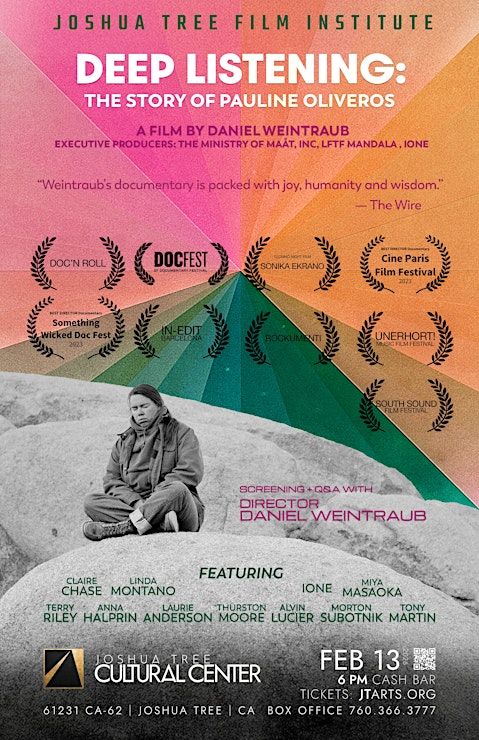
"Deep Listening: The Story of Pauline Oliveros" tells the story of the iconic composer, performer, teacher, philosopher, technological innovator and humanitarian, Pauline Oliveros. She was one of the world's original electronic musicians, one of the only females amongst notable post-war American composers, a master accordion player, a teacher and mentor to musicians, a gateway to music and sound for non-musicians and a technical innovator who helped develop everything from tools that allow musicians to play together while in different countries to software that enables those with severe disabilities to create beautiful music.
On the vanguard of contemporary American music for six decades, her story illuminates the pathway to how we got where we are and where the future will take us in the worlds of music, the philosophy of sound, and the art of listening.
Produced in collaboration with executive producer lone, Oliveros' partner in life and work and the Ministry of Maât, Inc., the film combines rare archival footage, live performances, and unreleased music with appearances by Terry Riley, Anna Halprin, lone, Linda Montano, Laurie Anderson, Thurston Moore, Alvin Lucier, Claire Chase, Miya Masaoka, Morton Subotnick, Tony Martin, Ramon Sender and many more ground-breaking artists.
Following the screening, the film's director Daniel Weintraub will host a Q&A.
ABOUT PAULINE OLIVEROS
Pauline Oliveros (1932-2016) composer, performer, humanitarian, was an important pioneer in American Music. Acclaimed internationally, for six decades she explored sound–forging new ground for herself and others. Through improvisation, electronic music, ritual, teaching and meditation she created a body of work with such a breadth of vision that it profoundly effects those who experience it and eludes many who try to write about it. Oliveros was honored with many awards, including four honorary doctorates, grants and concerts internationally. Whether performing at the John F. Kennedy Centre in Washington DC, in an underground Cistern, or in the studios of a West German radio station, Oliveros' commitment to interaction with the moment was unchanged. She could make the sound of a sweeping siren into another instrument of the ensemble. Through Deep Listening Pieces and earlier Sonic Meditations, Oliveros introduced the concept of incorporating all environmental sounds into musical performance. To make a pleasurable experience of this requires focused concentration, skilled musicianship, and strong improvisational skills, which are hallmarks of Oliveros' form. She built a loyal following through her concerts, recordings, publications, and musical compositions that she wrote for soloists and ensembles in music dance, theater, and inter-arts companies. She also provided leadership within the music community by acting in an advisory capacity for organizations such as The National Endowment for the Arts, New York State Council for the Arts, and many private foundations. She served as Distinguished Research Professor of Music at Rensselaer Polytechnic Institute and Darius Milhaud Composer in Residence at Mills College. Oliveros was vocal about representing the needs of individual artists, about the need for diversity and experimentation in the arts and promoting cooperation and good will among people.
She founded the Deep Listening Institute, formerly Pauline Oliveros Foundation, and now Center for Deep Listening at Rensselaer.
DIRECTOR'S STATEMENT (DANIEL WEINTRAUB)
Pauline and I shared the feeling that her story was made for me to tell. I looked for many years for a subject about which to do my first feature length documentary. When my neighbor in upstate New York introduced me to Pauline, I knew I had meta person who would inspire me throughout the inevitably lengthy process of making a film. I also felt an instant obligation to share the story of this incomparable sonic icon. In the process of making this film, Pauline and I became close friends.
Through Pauline, I found a language to explain and express thoughts I had entertained my whole life around the importance of listening and how that can impact and expand community. I also had the good fortune to follow Pauline for nearly three years, filming rehearsals, workshops, performances, recording sessions, and various community activities. I saw how she inspired an expansive creativity within her community in Kingston, NY and with the world class musicians she regularly created work with. In addition, I filmed over thirty interviews. With Pauline 's guidance and her warm reputation, I was able to record interviews with artists whose cultural impact is comparable to Pauline's.
In Pauline's absence, her creative partner and spouse IONE, trustees and community, all offered their continued support and guidance to tell Pauline's story the best way I could posthumously. Now that Pauline has left this plane, I feel an even greater obligation to tell her story. I can think of few other people of the last century whose message of healing, unity and unbridled creative expression is more deeply needed at this time in history. I am so honored to have been in conversation with her and have the experience and ability to capture some essence of Pauline, that can be shared in the world now through this independent film.
I dedicated my life to music and filmmaking from an early age. In all those years, I never met a subject like Pauline Oliveros, whose compelling story and life's work provided me with such a perfect opportunity to align both my passions. I felt it crucial, when making this film about Pauline, to whom listening is the center of her private and artistic world, that I as the filmmaker contribute my knowledge of music and sound recording, and to be an editor who listens. I believe Pauline chose to work with me on this documentary film because of my experience as a recording engineer, and the way I present sound in my films.
Soon after we met, Pauline invited me to mix a recording of her with friend and collaborator Miya Masaoka, and to record and mix a trio with Nels Cline and Thollem McDonas, which turned out to be Pauline's final recording. As Pauline herself said "I never tried to build a career, I only tried to build a community". As an artist coming of age in the 1950's as a woman who identified as queer, Pauline had to overcome many obstacles placed in front of her by society. She did this largely by always being committed to the idea that, through their art, artists have a responsibility to bring people together. During her life, Pauline built an incredible world-wide community. "Deep Listening: The Story of Pauline Oliveros" is not only a film about a crucial piece of American cultural evolution, but a vehicle through which we can continue to expand Pauline's community and its commitment to listening and understanding.
As part of our immersive film series, this screening is designed to promote a deeper cultural reflection of cinema. We invite filmmakers to participate in our screenings, enabling the audience to better understand their creative perspective. By encouraging thoughtful, collaborative participation crossing both sides of the screen, this series is dedicated to studying and preserving the art of film.
Event Venue & Nearby Stays
Blak Box Theater in Joshua Tree, 61231 Hwy 62, Joshua Tree, United States
USD 12.51 to USD 14.64