About this Event
Quantum computing hardware has improved dramatically in recent years, with significant increases in fidelity across most major qubit modalities.
However, physical qubit operations will likely never reach the 10^-12 error rates required to reliably run large-scale quantum algorithms.
To achieve this, we require quantum error correction, in which lower error rates are achieved by using logical qubits composed of many physical qubits.
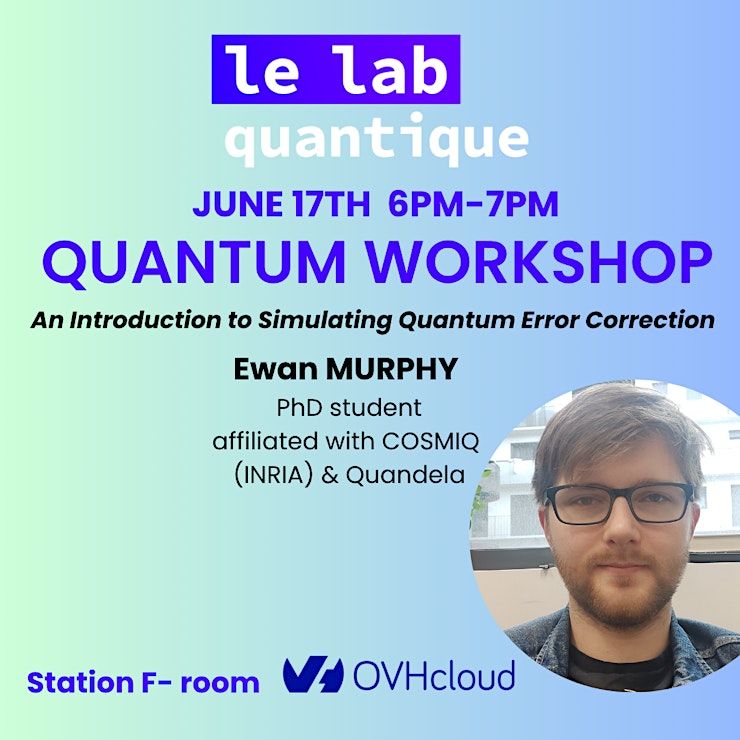
In this talk, I will give an introduction to quantum error correction, highlighting the important terminology and technical tools used in the field.
I will discuss how simulations play an important role in characterizing the performance of a quantum code, before introducing Stim, the main numerical tool used to perform these simulations.
Recommended reading (I will not assume they have read these but if people are completely new to topic, they could be helpful):
+ Quantum Error Correction: An Introductory Guide (http://arxiv.org/abs/1907.11157)
+ Stim getting started notebook (https://github.com/quantumlib/Stim/blob/main/doc/getting_started.ipynb)
Event Venue & Nearby Stays
STATION F, 5 Parvis Alan Turing, Paris, France
USD 0.00